You’ve probably noticed it — that wall of heat when you open the garage door on a July afternoon. Or the layer of moisture that forms on the walls every winter morning. Or the rust starting to creep across your toolbox after two wet seasons.
These aren’t just annoying. They’re expensive. And in most cases, they’re completely preventable with the right insulation.
Insulated metal garages are one of the smartest upgrades a homeowner, contractor, or business owner can make to a steel building. The right insulation controls temperature, stops condensation, protects your equipment, and turns a basic storage structure into a year-round usable workspace. Done right, it pays for itself faster than most people expect.
This guide covers everything — what insulation options are available for steel garages, how each type performs, what it costs, which one is right for your climate, and whether the investment is actually worth it. By the time you finish reading, you’ll have everything you need to make a confident decision.
What Are Insulated Metal Garages?
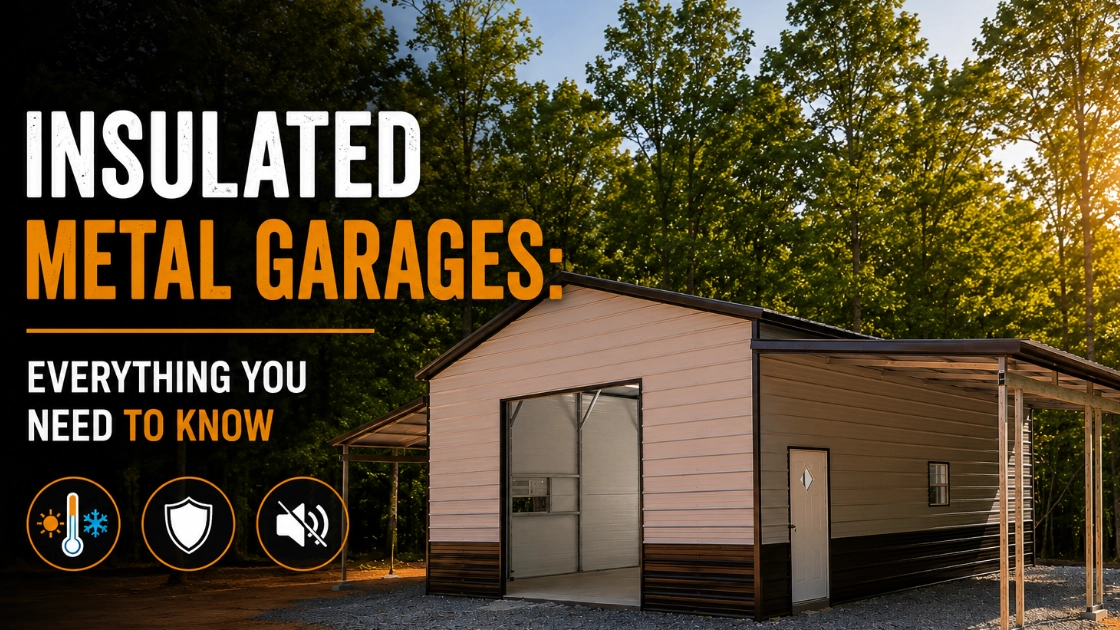
An insulated metal garage is a steel building that has thermal insulation material installed either on the interior walls and ceiling, between the framing panels, or built directly into the wall system. The purpose is to slow the transfer of heat, cold, and moisture between the inside and outside of the building.
Steel is one of the strongest and most durable building materials available — but it has one significant drawback as a building envelope: it conducts heat and cold very efficiently. That means without insulation, a metal garage gets brutally hot in summer, bitterly cold in winter, and is constantly sweating with condensation in humid climates.
Insulation is the fix. It creates a thermal barrier that slows heat transfer, keeps interior temperatures stable, and dramatically reduces the moisture buildup that leads to rust, mold, and equipment damage.
Insulated steel garages are used across the country for:
- Vehicle storage and garages — keeping cars, trucks, and motorcycles protected year-round
- Workshops and fabrication shops — maintaining a comfortable working environment
- Home gyms — temperature control for year-round use
- Home offices and studios — sound dampening and climate comfort
- Agricultural and equipment storage — protecting machinery and supplies
- Retail and commercial use — customer-facing spaces that need climate control
Whether you’re upgrading an existing custom metal garage or planning insulation into a new build from the start, the principles are the same — and the benefits are significant.
Why Insulation Matters in a Steel Garage
Most people think about insulation as a comfort feature. It is — but it’s also a protection feature and a cost-reduction feature. Here’s what’s actually at stake.
Heat Control
Steel panels absorb radiant heat from the sun. On a 95°F summer afternoon, an uninsulated metal garage can reach interior temperatures of 130–140°F or higher. That’s not just uncomfortable — it’s dangerous for anyone working inside and damaging to anything stored there. Tires degrade faster. Finishes crack and peel. Electronics fail.
A properly insulated steel garage can keep interior temperatures 40–60°F cooler than an uninsulated building on the same hot day. That’s the difference between a building you can’t use in summer and one you work in comfortably.
Cold Weather Protection
In the winter, the opposite problem plays out. An uninsulated metal building offers almost no thermal protection — the interior temperature tracks closely with the outside air. For a garage in Minnesota, Michigan, Ohio, or any northern state, that means frozen pipes, vehicles that won’t start, and tools that sit unused for months.
Insulation keeps heat inside the building, making it dramatically more usable in cold climates — especially when combined with a basic heater.
Condensation Prevention
This is the single most underappreciated function of insulation in a metal building — and the most damaging when it’s ignored.
Condensation happens when warm, humid air contacts a cold metal surface. The surface cools the air below its dew point, and moisture drops out of the air and forms on the wall or ceiling. In a steel building with no insulation, this happens constantly in spring, fall, and any humid climate.
The result: rust on tools, corrosion on vehicles, mold on stored items, and deterioration of the steel panels themselves over time. Insulation keeps the surface temperature of the metal above the dew point — which stops condensation from forming in the first place.
Energy Efficiency
If you’re heating or cooling your garage — whether it’s for a workspace, home gym, or hobby room — insulation is what makes that practical and affordable. Without it, any heat or air conditioning you put into the space escapes through the walls and roof almost immediately. With proper insulation, a small space heater or mini-split can maintain comfortable temperatures at a fraction of the cost.
Noise Reduction
Steel panels with no insulation act almost like a drum — they amplify noise from rain, wind, and outside activity. Insulation, especially spray foam and rigid board, significantly dampens both exterior noise coming in and interior noise (power tools, music, engines) from carrying out into the neighborhood.
Benefits of an Insulated Steel Garage at a Glance
| Benefit | What It Means for You |
| Temperature control | 40–60°F cooler in summer; more usable in winter |
| Condensation prevention | Stops rust, mold, and moisture damage |
| Lower energy costs | Heating/cooling costs reduced significantly |
| Noise reduction | Less echo inside; less noise escaping outside |
| Equipment protection | Vehicles, tools, and stored items last longer |
| Year-round usability | Use the space in July and January equally |
| Increased property value | Finished, climate-controlled garage adds resale value |
Types of Insulation for Metal Garages
This is where most guides get vague. Here’s a straight, practical breakdown of every insulation type used in metal garages — what each one does, what it costs, and where each one makes the most sense.
1. Fiberglass Batt Insulation
What it is: The pink or yellow roll insulation you’ve seen in most residential construction. It comes in pre-cut batts or rolls that fit between metal framing members.
How it works: Fiberglass traps air in its fiber matrix, slowing the transfer of heat through the wall assembly.
R-value range: R-11 to R-38 depending on thickness.
Best for: Budget-conscious builds, moderate climates, walls and ceilings in standard garages.
Pros:
- Most affordable insulation option
- Widely available, easy to install
- Works well in walls and ceilings with standard framing
- Effective for thermal control in most U.S. climates
Cons:
- Doesn’t address condensation on metal surfaces (air gap between fiberglass and steel can still allow sweating)
- Requires a vapor barrier facing on the warm side to be effective
- Absorbs moisture if the vapor barrier is compromised — can harbor mold over time
- Doesn’t seal air gaps; wind and moisture can still infiltrate around the batts
Cost estimate: $0.40–$1.20 per square foot for materials; total installed cost varies by thickness and coverage area.
2. Spray Foam Insulation
What it is: A two-component chemical foam that expands when sprayed, filling every gap and adhering directly to the metal surface.
How it works: Closed-cell spray foam creates an air-impermeable, moisture-resistant thermal barrier that bonds to the steel. It doesn’t just slow heat transfer — it seals the building completely.
R-value range: R-6 to R-7 per inch (closed-cell); R-3.5 to R-4 per inch (open-cell).
Best for: Maximizing performance in extreme climates; condensation-prone buildings; workshops and finished spaces; humid coastal regions.
Pros:
- Highest R-value per inch of any insulation type
- Creates a complete air and vapor seal — eliminates condensation when applied directly to metal
- Adheres to steel, filling every seam and penetration
- Structurally stiffens the building slightly
- Long-lasting — closed-cell spray foam retains performance for 20+ years
Cons:
- Most expensive insulation option
- Requires professional installation with specialized equipment
- Cannot be easily removed if access to framing is needed later
- Off-gassing during installation requires ventilation and PPE
Cost estimate: $1.00–$2.50 per square foot for open-cell; $1.50–$3.50 per square foot for closed-cell, professionally installed.
3. Rigid Board Insulation (Foam Board)
What it is: Pre-cut panels of foam insulation (EPS, XPS, or polyisocyanurate) attached to the interior walls and ceiling.
How it works: Rigid boards provide a continuous insulation layer with no gaps at framing members. They’re typically glued or mechanically fastened to the interior metal surface.
R-value range: R-3.8 to R-6.5 per inch depending on foam type (polyiso performs highest).
Best for: Retrofitting existing metal garages; combination with other insulation types; insulating large flat wall sections.
Pros:
- Higher R-value per inch than fiberglass
- Provides continuous insulation without thermal bridging at framing
- Moisture resistant (XPS and polyiso are excellent vapor barriers)
- Easy to cut and install for DIY applications
- Relatively affordable compared to spray foam
Cons:
- Doesn’t seal air gaps as completely as spray foam
- Requires careful edge sealing to prevent air infiltration
- Adds thickness to interior walls, reducing usable space slightly
- Not ideal for curved or irregular surfaces
Cost estimate: $0.25–$0.80 per square foot for materials; $0.75–$2.00 per square foot installed.
4. Double-Bubble / Multi-Layer Reflective Insulation
What it is: A product consisting of two layers of polyethylene bubble material between reflective foil facing layers. Commonly called “double-bubble” or sold under brand names like Reflectix.
How it works: The foil facing reflects radiant heat (especially solar radiation), while the bubble layers trap air. It’s primarily a radiant barrier — it works best at reducing heat gain from radiant sources like the sun.
R-value range: R-2 to R-4 as a standalone product (marketing claims vary — real-world thermal performance is modest).
Best for: Hot, sunny climates (South Texas, Arizona, Florida, Gulf Coast) where radiant heat is the dominant problem; use as an add-on vapor retarder in combination with other insulation.
Pros:
- Lightweight and very easy to install (staple directly to framing)
- Effective radiant barrier in high-sun climates
- Works as a vapor barrier layer
- Very affordable
- Common choice for prefab steel buildings as a standard add-on option
Cons:
- Lowest thermal insulation value of any option — ineffective as standalone insulation in cold climates
- Frequently over-marketed with misleading R-value claims
- Does not stop air infiltration
- Not effective against conductive heat transfer (heat through walls, not just radiant)
Cost estimate: $0.10–$0.30 per square foot for materials; fast and easy to self-install.
Best Insulation by Climate Region
Where your garage sits in the U.S. has a major impact on which insulation type delivers the best return. Here’s the practical breakdown.
Hot, Sunny Climates (Texas, Arizona, Florida, New Mexico, Southern California)
Primary problem: Radiant heat gain through the roof and walls.
Best approach: Closed-cell spray foam on the roof deck + double-bubble reflective as a secondary radiant barrier in the walls. The spray foam handles the real thermal load; the reflective layer addresses direct sun radiation.
Secondary option: Rigid board (polyiso) on walls with a reflective foil facing, combined with good ventilation.
What to avoid: Fiberglass batt alone — it addresses conductive heat transfer but does little against radiant heat through steel panels.
Cold Climates (Minnesota, Wisconsin, Michigan, Colorado, Montana, New York, Pennsylvania)
Primary problem: Heat loss through walls and roof; condensation when warm interior air meets cold metal.
Best approach: Closed-cell spray foam — the only insulation that completely addresses both heat loss and condensation in extreme cold. Applied directly to the interior metal surface, it creates a seamless thermal and vapor barrier.
Secondary option: Rigid board (XPS — blue or pink foam) on walls, with taped seams, combined with fiberglass batt in the ceiling cavity.
What to avoid: Double-bubble reflective as a primary insulation — it simply doesn’t have the thermal performance for cold climates.
Humid Coastal Climates (Gulf Coast, Southeast, Pacific Northwest)
Primary problem: Condensation from high ambient humidity; moisture intrusion.
Best approach: Closed-cell spray foam applied directly to the metal. In a humid climate, vapor drive is the dominant threat — and nothing stops vapor drive better than closed-cell foam.
Secondary option: Rigid board (XPS) with fully taped seams and a dedicated vapor barrier on the warm side.
What to avoid: Open-cell spray foam (which is vapor permeable) or unfaced fiberglass batt without a proper vapor barrier.
Moderate Climates (Pacific Coast, Mid-Atlantic, parts of the Southeast)
Primary problem: Mild seasonal temperature swings; occasional condensation.
Best approach: Fiberglass batt with proper vapor barrier works well here — and is the most budget-friendly option for mild climates where extreme heat or cold isn’t the issue.
Secondary option: Rigid board on the walls for improved R-value and easier installation in retrofit applications.
How Insulation Prevents Condensation in Metal Buildings
Condensation deserves its own explanation because it’s the most misunderstood problem in metal building ownership.
Why metal buildings “sweat”:
When warm, moist air hits a surface that’s cooler than the dew point temperature of that air, moisture condenses out of the air onto the surface. Metal conducts temperature very efficiently, so the metal surface closely tracks the outdoor temperature. In spring and fall — when nights are cold and days are warm — this happens constantly.
In a humid climate, it can happen almost every morning. You walk into your garage and the walls are literally wet. Your tools are spotted with rust. Your stored equipment is damp.
What insulation does about it:
Insulation keeps the surface temperature of the metal above the dew point. When the interior metal surface is warm enough, moisture can’t condense on it. This is why spray foam applied directly to the metal surface is so effective — it eliminates the cold metal surface entirely by covering it with a warm, sealed foam barrier.
Fiberglass batt, by contrast, doesn’t eliminate the cold surface — it just sits in front of it. If humid air can still reach the metal through the fiberglass, condensation still happens. That’s why vapor barriers matter with fiberglass systems, and why spray foam is superior in high-humidity applications.
Signs of a condensation problem:
- Rust spots forming on interior wall panels
- Water droplets on the ceiling after a temperature change
- Damp or musty smell inside a closed building
- Rust on stored tools or equipment that shouldn’t have been exposed to rain
- Deteriorating stored items with no obvious water source
What Does an Insulated Metal Garage Cost?
Insulation cost depends on four main variables: building size, insulation type, labor or DIY, and climate requirements. Here’s a realistic breakdown.
By Insulation Type (for a 24×30 ft garage)
| Insulation Type | DIY Material Cost | Professional Installed |
| Double-Bubble Reflective | $300–$600 | $600–$1,200 |
| Fiberglass Batt (R-13 walls) | $600–$1,200 | $1,500–$2,800 |
| Rigid Board (XPS, 2-inch | $900–$1,800 | $2,200–$3,800 |
| Spray Foam (Closed-Cell, 2-inch) | Not recommended DIY | $3,500–$6,500 |
Other Cost Factors
Building size: Larger buildings cost more to insulate, but the per-square-foot cost typically drops as square footage increases.
Access difficulty: Low ceilings or complex roof geometry can increase labor costs.
Vapor barriers and framing: Adding interior furring strips or a vapor barrier system adds cost but improves overall performance.
New build vs. retrofit: Insulating during new construction is significantly more efficient than retrofitting an existing building — both in labor and material cost. If you’re planning a new steel garage building, specifying insulation upfront is the smart play.
HVAC integration: If you’re conditioning the space (heating or cooling), factor in the HVAC system cost alongside insulation. They work together — insulation without HVAC won’t make the space comfortable in extreme weather, and HVAC without insulation is wasteful.
Is an Insulated Metal Garage Worth It?
For most applications, yes — and often significantly.
If you use the space regularly: Insulation pays back in comfort alone. Working in a 70°F garage instead of a 130°F one in July isn’t a luxury — it’s a safety consideration. If you’re spending real time in the building, insulation is basic quality of life.
If you’re protecting valuable assets: A single vehicle damaged by moisture, rust, or temperature extremes can cost thousands in repairs. A detailing shop’s paint products, a woodworker’s lumber supply, a car collector’s vehicles — all of these have replacement values that dwarf the cost of insulation many times over.
If you’re heating or cooling the space: Without insulation, every dollar you put into heating or cooling the building walks out through the walls. With closed-cell spray foam or rigid board insulation, energy consumption for heating and cooling can drop by 40–60%. In a building you’re actively conditioning, insulation typically pays back in energy savings within 3–5 years.
If you’re protecting the building itself: Condensation is the slow killer of metal buildings. It causes rust, mold, and structural deterioration over time. Preventing it from the start with the right insulation system protects your investment in the building itself — not just what’s stored in it.
If you’re building for the future: A basic garage today might become a finished workshop, gym, or home office in five years. Building with insulation from the start — or at minimum designing for it — costs far less than retrofitting a finished space later.
Best Uses for Insulated Metal Garages
The right insulation opens up what a steel garage can do. Here are the most common applications — and what each one needs from an insulation standpoint.
Automotive Workshop Needs: Temperature comfort for year-round work, condensation control to protect tools and vehicles, noise reduction for grinding and power tools. Best insulation: Closed-cell spray foam on all surfaces, or rigid board walls with spray foam on the roof deck.
Vehicle Collection Storage Needs: Stable temperature and humidity to prevent finish degradation and rust. Best insulation: Closed-cell spray foam — most effective moisture and temperature control. Often paired with a dehumidifier.
Home Gym Needs: Temperature control for comfortable workouts, noise dampening to avoid disturbing the neighborhood. Best insulation: Spray foam or rigid board walls + ceiling; optional rubber floor mat for additional insulation at ground level.
Woodworking or Craft Studio Needs: Temperature and humidity control (wood moves with moisture), dust management, comfortable working temperature. Best insulation: Closed-cell spray foam or rigid board with vapor barrier. Minimize air infiltration.
Home Office or Studio Needs: Year-round temperature comfort, noise isolation, livable interior finish. Best insulation: Full spray foam or rigid board + fiberglass combination with interior wall finish (drywall over rigid board works well). Pair with mini-split HVAC.
Agricultural or Equipment Storage Needs: Basic condensation prevention to protect equipment and stored supplies. Best insulation: Double-bubble as a minimum; rigid board for better protection. Spray foam if valuable equipment or crop storage is involved.
How to Choose the Right Insulation for Your Metal Garage
If you’re not sure where to land after all of this, use this simple decision framework:
Is your climate extreme (very hot, very cold, or very humid)? → Closed-cell spray foam. It’s the highest-performing option for extreme climates and it eliminates condensation completely.
Are you on a budget and in a moderate climate? → Fiberglass batt with a vapor barrier facing. Cost-effective and sufficient for mild temperature swings.
Do you need easy DIY installation? → Rigid board (XPS) is the easiest insulation to cut, handle, and install yourself while still delivering solid R-value and moisture resistance.
Is radiant heat in a hot, sunny climate the main problem? → Double-bubble reflective is worth including as a radiant barrier, but don’t rely on it as your only insulation. Pair it with rigid board or spray foam for real thermal performance.
Are you building new (not retrofitting)? → Specify insulation in your original order. It’s significantly cheaper and cleaner to build with insulation than to add it later. Talk to your Viking representative about including insulation packages in your initial build spec.
Is the building going to be heated or cooled? → Spray foam or rigid board minimum. Anything less and your HVAC system is fighting a losing battle.
Why Viking Metal Garages Is the Right Partner for Your Insulated Garage
Not all steel building companies offer the same level of guidance when it comes to insulation, climate specs, and long-term building performance. Here’s what sets Viking Metal Garages apart.
Engineer-certified structures: Every Viking building comes with access to certified structural drawings that meet local wind and snow load requirements. Your insulated garage is built to perform in your specific climate — not a generic national standard.
Customization from the start: You’re not choosing from a catalog. Width, depth, height, roof style, door placement, insulation spec — all of it is ordered to your requirements. If you want a 40×30 workshop with closed-cell spray foam and a 12-foot eave height, that’s exactly what you can order.
Vertical roof options: For maximum weather performance, Viking’s vertical roof garage style is the right pairing with a serious insulation package. Vertical panels shed water and snow cleanly, reducing moisture infiltration at roof seams — which makes your insulation work more effectively and lasts longer.
Nationwide delivery and installation: Viking installs across all 48 contiguous states. One call handles the full process — design, order, delivery, and professional installation with a crew that knows what they’re doing.
Expert guidance: Not sure which insulation type fits your climate and budget? Our building specialists answer that question every day. Call us before you commit to anything — the right advice at the planning stage saves real money.
Conclusion: Build It Right From the Start
An insulated metal garage isn’t just a more comfortable place to park your car. It’s a building you can actually use — year-round, in any weather, for any purpose you need it to serve.
The right insulation stops condensation before it starts, keeps temperatures workable in July and January, protects everything stored inside, and makes your heating and cooling dollars count. The wrong insulation — or no insulation — costs you in rust damage, energy waste, and a building that sits unused six months a year.
If you’re planning a new build, include insulation in your original spec. It’s always cheaper to do it right during construction than to retrofit it after the fact. If you’re upgrading an existing steel garage, start with condensation control — typically rigid board or spray foam — and build from there.
Viking Metal Garages builds fully custom insulated steel garages across all 48 contiguous states, with engineer-certified drawings included on most orders. Our building specialists can walk you through insulation options for your climate, size, and budget — and get you a custom quote within one business day.
Call us at (704)-741-1587 to talk through your project, or request a free custom quote online. We’ll help you build a garage that works as hard as you do
Frequently Asked Questions
Expand each item below to explore a few helpful answers before moving to the next blog post.
For most applications, yes. Insulation controls temperature, stops condensation, reduces energy costs, and protects stored equipment. In climates with real winters or summers, the payback is typically fast — and the comfort improvement is immediate.
Closed-cell spray foam delivers the highest performance — it provides excellent R-value, seals the building completely against air and moisture, and directly eliminates condensation. It costs more than other options but outperforms them in every metric. For budget-conscious builds in moderate climates, rigid board XPS is an excellent alternative.
The most effective solution is closed-cell spray foam applied directly to the interior metal surfaces. It keeps the metal surface warm enough that moisture cannot condense on it. In existing buildings, a vapor barrier system with rigid board insulation can significantly reduce (though not always eliminate) condensation.
Yes — substantially. In a conditioned space (heated or cooled), proper insulation can reduce energy consumption by 40–60%. Insulation is what makes it practical to heat a large steel building efficiently.
It depends on your climate and how you use the space. A general guide: R-13 to R-15 for walls and R-19 to R-38 for ceilings in moderate to cold climates. For very cold regions (Zone 5 and above per IECC), aim for R-20+ in walls and R-38–49 in the ceiling.
Spray foam insulation is indefinite in performance — it doesn't degrade, sag, or absorb moisture when properly installed. Fiberglass batt retains most of its performance for 20–30 years but can lose effectiveness if it gets wet. Rigid board has a very long service life as well. Double-bubble reflective is durable but its reflective facing can degrade over time with direct UV exposure.
Fiberglass batt and rigid board insulation are DIY-friendly. Spray foam requires professional equipment and training — attempting it without the proper setup is messy, potentially hazardous, and rarely produces good results. If spray foam is your choice, hire a professional installer.
In some jurisdictions, insulation R-values are regulated for conditioned spaces. If you plan to heat or cool the garage, check your local building code for minimum insulation requirements. Viking's engineer-certified drawings can be tailored to meet local energy codes.