
2 car garage
September 25, 2026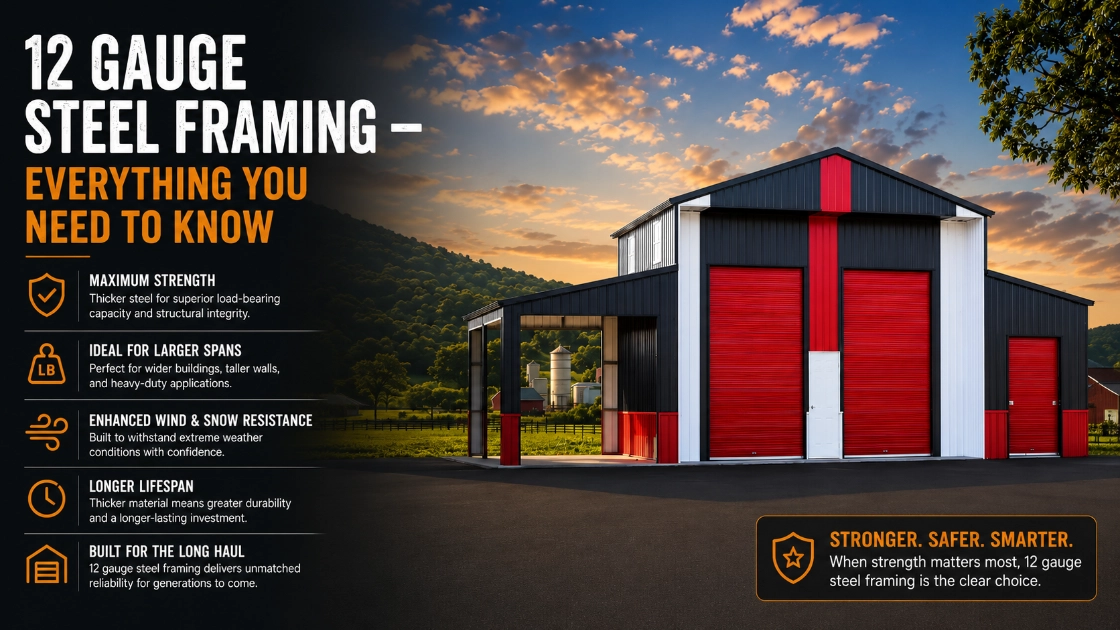
When you start comparing metal buildings, the framing gauge conversation comes up fast. And once it does, one question tends to follow: is 12 gauge steel framing actually worth the extra cost?
That’s a fair thing to ask. The difference in price is real, but so is the difference in performance. And the answer isn’t the same for every buyer. A homeowner in Tennessee building a two-car garage has very different needs than a business owner in Michigan building a 40-foot wide commercial shop.
This guide breaks down 12 gauge steel framing in plain language — what it is, where it makes sense, and how to know if it’s the right choice for your project.
12 gauge steel framing describes the wall thickness of the square steel tubing used to build a metal building’s structural skeleton. This tubing shows up in the vertical legs, roof arches, base rails, and horizontal girts — every major load-bearing part of the structure.
The gauge numbering system works backwards from what most people expect: the lower the number, the thicker the steel. So 12 gauge is thicker and stronger than 14 gauge, and 14 gauge is stronger than 16 gauge. Once that clicks, the rest of the conversation becomes easy.
In the metal building industry, 12 gauge is the step up from the standard 14 gauge
option. It’s the choice for buyers who need more structural muscle — whether that’s because of their local weather, their building’s size, or what they plan to do inside it.
12 gauge galvanized steel has a wall thickness of approximately 0.1094 inches — just over 1/10th of an inch, or about 2.8mm. The tubing used in most 12 gauge metal building frames measures 2¼” × 2¼” in diameter.
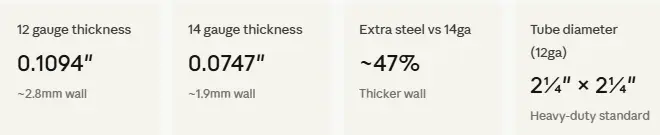
Here’s something that surprises a lot of buyers: even though 12 gauge tubing has a thicker wall, the outer tube diameter is actually slightly smaller than 14 gauge (2¼” vs 2½”). What makes it stronger is what’s inside that wall — significantly more steel per linear foot.
Like 14 gauge, most 12 gauge framing is made from galvanized steel — regular steel with a protective zinc coating that resists rust and corrosion for decades. Because the walls are thicker, there’s more metal for the zinc to coat, which is one reason 12 gauge typically qualifies for longer rust-through warranties.
The extra wall thickness isn’t just a number — it changes real-world performance in measurable ways:
Thicker steel walls mean the tubing can bear more weight before flexing or yielding. This matters most in wide-span buildings, where the roof puts significant downward force on each frame member. A 40-foot wide building puts nearly twice the stress on each leg and rafter compared to a 24-foot wide building. 12 gauge handles those wider spans more comfortably.
Wind doesn’t just push sideways — it also tries to lift the roof. Engineers measure this as “uplift force,” and it’s especially significant in open areas, coastal zones, and tornado-prone regions. Thicker framing resists racking (the tendency of a frame to twist or shift in strong winds) more effectively than thinner steel.
Heavy snow accumulates fast and adds significant weight to a roof. A wet foot of snow can weigh 20–40 pounds per square foot. 12 gauge framing, combined with proper bracing and a vertical roof design, handles these loads better and gives buyers in snowbelt states more peace of mind through the winter months.
Metal buildings aren’t completely rigid — they move a little in wind and thermal cycles. With thinner 14 gauge steel, you may notice subtle movement or a slight “springy” feeling in high gusts. 12 gauge stays stiffer, which also protects connection points (bolts, screws, welds) from fatigue stress over years of repeated movement.
Because 12 gauge adds strength where it counts, it shows up in applications where the stakes are higher or the structural demands are greater:
One frequently overlooked use case: large roll-up door openings. A 12′ or 14′ wide roll-up door creates a significant gap in the wall line, which can cause the frame to go out of square over time. 12 gauge framing holds its shape better around large openings and reduces long-term alignment issues.
Here’s a direct, side-by-side comparison of both options across every factor that matters to buyers:
| Factor | 12 Gauge | 14 Gauge |
| Wall thickness | 0.1094″ (~2.8mm) | 0.0747″ (~1.9mm) |
| Tube diameter | 2¼” × 2¼” | 2½” × 2½” |
| Relative strength | Higher — better for wide spans & tall legs | Standard — good for most residential use |
| Price vs 14 gauge | 10–15% higher cost | Lower — best value |
| Snow load rating | Higher — rated for up to 60 psf | Moderate — good for most regions |
| Wind load rating | Up to 170 mph (engineered) | Up to 130–140 mph (engineered) |
| Typical warranty | 20–25 year structural | 10–12 year structural |
| Recommended width | 30’–40’+ clear span | Up to 30′ wide |
| Recommended height | 10 feet and above | Under 10 feet |
| Best climate | Harsh — snow belts, hurricane, tornado zones | Mild to moderate |
| Commercial use | Recommended — especially with cranes | Light commercial only |
| Certifiable | Yes — required in some states | Yes — most states |
Gauge is one piece of the puzzle. A 12 gauge building still needs the right design and installation to perform at its full potential. Here are the other factors that matter:
The outer diameter of the tubing works alongside wall thickness to determine stiffness. While 12 gauge tubing is slightly narrower (2¼” vs 2½”), its thicker walls give it more cross-sectional steel — which is what engineers use to calculate load resistance.
A 12 gauge frame on a poorly anchored foundation is only as strong as its weakest point. On concrete, wedge anchors lock the building to the slab. On soil, auger-style or helical anchors dig deep enough to resist uplift forces. The anchor system should be matched to both your frame gauge and your local wind zone — not treated as an afterthought.
How often legs and trusses are placed along the length of the building affects load distribution. Tighter frame spacing allows each member to carry less load — and in extreme wind or snow zones, some builders combine 12 gauge tubing with tighter spacing for maximum performance.
A vertical roof — where panels run vertically down the slope — sheds snow and rain efficiently, reducing the live load on the frame. In heavy snow regions, a vertical roof paired with 12 gauge framing is the most performance-oriented combination available in light-gauge steel construction. It’s also what we recommend at Viking Metal Garages for buildings in the Northeast and upper Midwest.
Diagonal bracing at the corners and along the eave struts prevents the frame from racking under sideways wind load. Proper bracing is especially critical in tall buildings with large door openings, since those openings reduce the wall’s ability to resist lateral force.
A building on an open hilltop or a coastal plain experiences significantly more wind pressure than the same building tucked behind trees or in a valley. Engineers call this “exposure category,” and it’s factored into the structural calculations. If your site is exposed, that’s an argument for 12 gauge — regardless of what the regional average wind speed is.
The honest answer: it depends on your situation. Here’s how to think through it.
If you’re building a garage, carport, or workshop in a moderate climate — and your building is under 30 feet wide and under 10 feet tall — 14 gauge is likely sufficient and will save you money. But if your building is taller, wider, or located in a region with significant weather events, 12 gauge is a smart investment. The 10–15% price increase on framing is modest relative to the total project cost, and the longer warranty alone can justify it.
For commercial applications — especially any building with overhead cranes, forklifts, heavy foot traffic, or large roll-up doors — 12 gauge is the standard. The dynamic loads from equipment movement, repeated door cycling, and daily operational stress exceed what 14 gauge is rated for over the long term.
12 gauge buildings typically carry longer structural warranties (up to 20–25 years vs 10–12 for 14 gauge). In areas with volatile weather, that warranty reflects real engineering confidence — and it can matter for insurance and resale value down the road. Fewer structural repairs over a 20-year period can more than offset the initial price difference.
Transparency matters. Here’s when 12 gauge may not be the best fit:
Four factors drive the right answer for almost every buyer:
Your zip code is the single biggest driver of gauge selection. Check your county’s design wind speed and ground snow load requirements under ASCE 7 — or ask your building specialist to pull them for you. If your area has design wind speeds above 115 mph or ground snow loads above 25 psf, 12 gauge is the stronger choice.
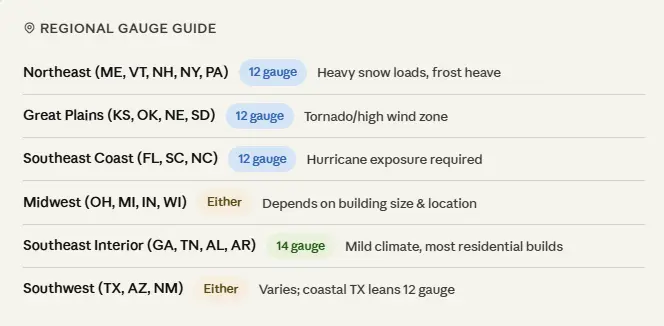
As a general rule: buildings over 30 feet wide or over 10 feet tall benefit significantly from 12 gauge framing. RV garages, multi-bay structures, and buildings with multiple large doors are almost always better served by 12 gauge regardless of climate.
Residential storage and personal garages in mild climates → 14 gauge is usually fine. Anything commercial, any building with overhead cranes or heavy equipment, and any structure where long-term structural confidence matters → start with 12 gauge.
If budget is tight and your application is clearly residential, 14 gauge is a proven, reliable choice. But if you can stretch the budget even slightly, 12 gauge pays back through longer warranties, better weather resistance, and reduced likelihood of structural issues over a 20–30 year building life.
At Viking Metal Garages, we offer both 14 gauge and 12 gauge framing — and we’re upfront about which one we’d recommend for your specific situation, not just the one with a better margin for us.
Whether you’re building a single-car garage or a 60-foot commercial shop, we’ll help you build it right — with the framing strength your project actually needs.
Read More – 14 Gauge Steel Framing – Everything You Need to Know
12 gauge steel framing is the heavy-duty choice in the light-gauge metal building industry — and for buyers who need that extra muscle, it delivers real, measurable advantages: higher load ratings, better wind and snow resistance, longer warranties, and stronger long-term structural confidence.
Here are the key takeaways:
Not sure which gauge is right for your project? The team at Viking Metal Garages will cross-reference your zip code, building size, and intended use — and give you a straight answer based on what your building actually needs.
Expand each item below to explore a few helpful answers before moving to the next blog post.
Yes — 12 gauge has a thicker wall (0.1094" vs 0.0747") and significantly more steel per linear foot. It handles higher wind loads, heavier snow accumulation, and wider building spans more effectively than 14 gauge framing.
12 gauge galvanized steel used in metal building frames is approximately 0.1094 inches thick (about 2.8mm). It's formed into 2¼" × 2¼" square tubing for the structural frame members.
For most commercial applications, large buildings, harsh climates, or structures over 30' wide — yes. The 10–15% price increase on framing is modest, and you gain a longer warranty, better structural performance, and more peace of mind in demanding conditions.
Absolutely — especially for large, tall, or wide garages. For a standard residential two-car garage in a mild climate, 14 gauge is often sufficient. But for RV garages, triple-wide setups, or garages in snow-heavy or hurricane-prone areas, 12 gauge is the stronger choice.
In most cases, yes. Most manufacturers offer 20–25 year structural warranties on 12 gauge buildings, compared to 10–12 years on standard 14 gauge. The thicker galvanized coating wears more slowly, which supports longer rust-through coverage as well.
No single national rule applies — requirements vary by state and county. Many jurisdictions in Florida, Texas, and the Northeast require 12 gauge for certain building sizes or wind zones. Always check local building codes or ask your building specialist to verify requirements in your area.
Yes. 12 gauge buildings can be certified to meet local wind and snow load requirements, and are often required for certified structures in high-load zones. Certifications typically come with stamped engineering drawings for permit applications.
Just as important. Even a 12 gauge frame can fail without proper anchoring. Wedge anchors on concrete and auger-style anchors on soil are matched to your local wind zone. The frame and the anchor system need to work together to achieve the rated performance.
Last Call for Summer Savings! Get Up To 30% Off |View Offer >>
Last Call for Summer Savings! Get Up To 30% Off |View Offer >>
Last Call for Summer Savings! Get Up To 30% Off |View Offer >>
Last Call for Summer Savings! Get Up To 30% Off |View Offer >>
Last Call for Summer Savings! Get Up To 30% Off |View Offer >>
Last Call for Summer Savings! Get Up To 30% Off |View Offer >>
Last Call for Summer Savings! Get Up To 30% Off |View Offer >>
Last Call for Summer Savings! Get Up To 30% Off |View Offer >>
Last Call for Summer Savings! Get Up To 30% Off |View Offer >>
Last Call for Summer Savings! Get Up To 30% Off |View Offer >>
Last Call for Summer Savings! Get Up To 30% Off |View Offer >>
Last Call for Summer Savings! Get Up To 30% Off |View Offer >>
Last Call for Summer Savings! Get Up To 30% Off |View Offer >>
Last Call for Summer Savings! Get Up To 30% Off |View Offer >>