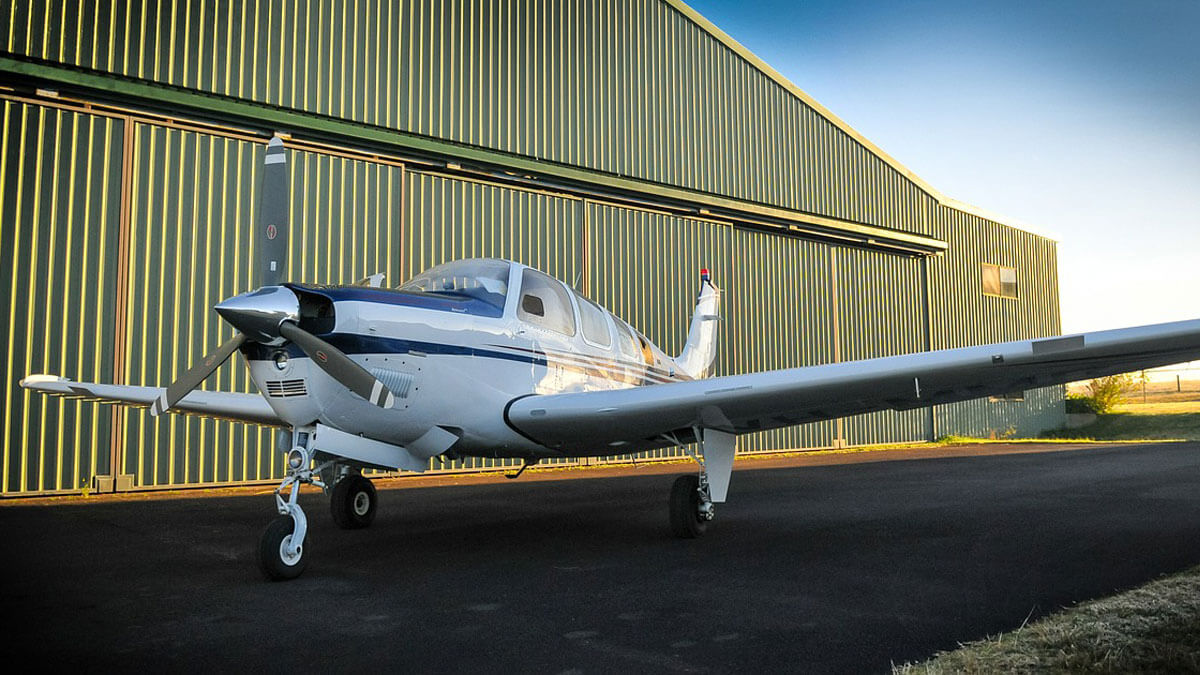
Your aircraft is one of the most significant investments you own. Whether it’s a single-engine Cessna, a turboprop, a helicopter, or a private jet, leaving it exposed to the weather isn’t just an inconvenience — it’s a risk to the airframe, avionics, and engine systems that adds up to real money over time.
UV degradation fades paint and damages seals. Temperature swings stress the airframe and electronics. Moisture causes corrosion in places you can’t see until it becomes expensive. Birds, rodents, and debris do the kind of damage that grounds aircraft.
A steel airplane hangar eliminates all of it.
Today’s prefab aircraft hangars are a completely different product from the corrugated sheds of decades past. Modern steel airplane hangars are pre-engineered to exact specifications, certified for local wind and snow loads, available with commercial-grade door systems and full insulation packages, and can be delivered and installed in a fraction of the time it takes to pour a wood-framed foundation. They’re built to protect your aircraft for 30 to 40 years with minimal maintenance — and they’re fully customizable from the first design call.
This guide covers everything you need to make the right decision: hangar types, sizing recommendations by aircraft class, door system options, insulation, cost factors, permits, and what to look for in a builder. By the end, you’ll have a clear picture of exactly what you need — and why steel is the right material to build it with.
What Are Steel Airplane Hangars?
A steel airplane hangar is a pre-engineered, clear-span metal building specifically designed to house, protect, and provide maintenance space for aircraft. The defining feature is the clear-span interior — no interior columns or load-bearing walls — which means your full aircraft footprint fits inside without obstruction, and you can move freely around every part of it.
Pre-engineered steel hangars are manufactured off-site to your exact specifications, then delivered and assembled at your location. This approach produces consistent quality, faster installation, and significantly lower labor costs compared to site-built construction.
Steel is the material of choice for aircraft hangars for several reasons that matter specifically in aviation applications:
- Clear-span capability up to 300+ feet — wide enough for commercial aircraft
- Galvanized or Galvalume-coated panels that resist corrosion in coastal and humid environments
- Engineer-certifiable for local wind and snow load requirements
- Non-combustible — steel’s fire resistance is critical near fuel and aviation fluids
- Customizable for any door system, insulation package, height requirement, or layout
Private aircraft owners, flight schools, FBOs, maintenance operations, and agricultural aviation operators across the U.S. all use steel hangars as their standard. It’s not a budget compromise — it’s the industry standard for a reason.
Benefits of Metal Airplane Hangars
Clear-Span Interior Space
This is the fundamental structural advantage of steel construction for aviation. Conventional framing requires interior support columns — which immediately create obstacles around wingtips, propellers, and fuselages. Pre-engineered steel frames achieve clear spans of 60 to 300+ feet with no interior posts. You park the aircraft, you work around the aircraft, and nothing is in your way.
All-Weather Aircraft Protection
An aircraft stored outdoors degrades noticeably faster than one hangared properly. UV exposure attacks paint and composite surfaces. Rain infiltrates seals and causes rust in control cables and fasteners. Temperature cycling causes sealants to harden and crack. A properly built metal airplane hangar eliminates all of these exposure mechanisms in one structure.
Durability That Matches the Investment
Commercial-grade steel framing with galvanized panels doesn’t rot, warp, split, or attract pests. A steel hangar installed today will still be structurally sound in 40 years with routine inspection. That’s a longer service life than most aircraft programs.
Low Maintenance Cost
Unlike wood-framed structures that require regular painting, pest treatment, and structural inspection for rot and deterioration, steel hangars need very little ongoing maintenance. Periodic inspection of fasteners, sealants at penetrations, and a basic exterior rinse is typically all that’s required.
Fire Resistance
Aviation fuel, hydraulic fluid, and lubricants make fire resistance a genuine operational priority in any hangar. Steel framing is non-combustible — it will not contribute fuel to a fire. This is not a feature most competitors lead with, but it matters significantly for insurance classification and safety compliance.
Fast Installation
Pre-engineered components arrive manufactured to exact tolerances, ready for assembly. Most single-aircraft hangars can be erected in one to three days. Larger commercial hangars take longer, but the timeline from permit to occupancy is consistently faster than site-built alternatives.
Expansion Flexibility
Steel buildings can be extended in length with minimal structural disruption. If your aircraft situation changes — a larger aircraft, additional aircraft, a maintenance bay — a pre-engineered steel hangar can typically be extended at the end wall without replacing the existing structure.
Types of Prefab Aircraft Hangars
Not every hangar is the same, and the right type depends on your aircraft, your operational needs, and your budget.
|
Hangar Type |
Best For |
Clear Span Width |
Key Benefit |
|
T-Hangar |
Single-engine aircraft, small airports |
40–60 ft per unit |
Efficient use of space; multiple aircraft on shared apron |
|
Box Hangar |
Single aircraft, private owners |
40–80 ft |
Simple layout; easy access; most common for private use |
|
Clear-Span / Executive Hangar |
Multi-aircraft, business jets, helicopters |
80–150 ft |
Full unrestricted interior; premium aircraft access |
|
Commercial Aviation Hangar |
Airlines, MRO, FBO |
150–300+ ft |
Maximum span; full maintenance and fleet capacity |
T-Hangars
T-hangars are designed to house multiple individual aircraft in a shared building footprint. Each “T” unit is its own enclosed bay opening onto a shared taxiway or apron. The T-shaped footprint nests aircraft efficiently, making them common at smaller general aviation airports where space is managed by the airport authority.
T-hangars work well for single-engine and light twin aircraft up to about a 40-foot wingspan. The layout maximizes aircraft per square foot of building, but they offer less flexibility for maintenance work than a dedicated box hangar.
Box Hangars (Single-Unit Private Hangars)
The most common configuration for private aircraft owners. A box hangar is a standalone, enclosed building with a single large door opening and clear-span interior. It’s your aircraft’s dedicated space — you control the temperature, the access, and the layout.
Box hangars range from 40×40 feet for a single light aircraft up to 80×80 feet or larger for business twins and turboprops. They can be fully insulated, climate-controlled, and finished to whatever standard you want.
Clear-Span Executive and Multi-Aircraft Hangars
For operators with multiple aircraft, business jets, or helicopters, a larger clear-span hangar provides the unrestricted interior space that maintenance and operational efficiency require. These structures often include mezzanine offices, pilot lounges, parts storage, and full climate control systems.
Clear spans of 80 to 150 feet accommodate most business and charter aircraft. Viking custom steel building configurations are available in these dimensions with full engineering certification.
Commercial Aviation Hangars
Large commercial MRO facilities, airline maintenance bases, and military aviation operations require spans of 150 feet and beyond. These are purpose-engineered structures with specialized door systems, crane rails, fire suppression systems, and often second-floor office and logistics space integrated into the design.
How to Choose the Right Hangar Size
Aircraft dimensions — not personal preference — determine your minimum hangar size. The table below gives practical starting points by aircraft category:
|
Aircraft Category |
Example Models |
Min. Width Needed |
Min. Depth Needed |
Min. Door Height |
|
Light Single-Engine |
Cessna 172, Piper PA-28 |
40 ft |
40 ft |
10 ft |
|
High-Wing Single-Engine |
Cessna 182, Piper Super Cub |
45 ft |
45 ft |
12 ft |
|
Light Twin-Engine |
Piper Seneca, Beechcraft Baron |
50 ft |
50 ft |
12 ft |
|
Turboprop (single) |
TBM 940, Pilatus PC-12 |
55 ft |
50 ft |
14 ft |
|
Turboprop (twin) |
King Air 350, Cessna Caravan |
65 ft |
55 ft |
14 ft |
|
Light Business Jet |
Citation CJ3, Phenom 300 |
70 ft |
60 ft |
16 ft |
|
Mid-Size Business Jet |
Citation XLS, Learjet 75 |
80 ft |
65 ft |
18 ft |
|
Large Business Jet |
Gulfstream G550, Global 6000 |
100 ft |
80 ft |
22 ft |
|
Helicopter (light) |
Robinson R44, Bell 206 |
40 ft |
40 ft |
12 ft |
Planning rules that prevent expensive mistakes:
- Measure wingspan, not just fuselage. Your hangar width must clear the full wingspan plus a minimum of 5 feet on each side for safe maneuvering.
- Measure tail height, not just the fuselage. Tail height — not cockpit height — is what determines door clearance. A Cessna 172’s tail stands about 8.9 feet; a King Air 350’s stands about 14.3 feet.
- Plan for the push-back angle. When the aircraft is being towed out at an angle, the wingtip sweeps a wider arc than the final parked position. Build in extra width for this.
- Allow for maintenance equipment. Lifts, engine stands, GPU carts, and wing jacks all need floor space beyond the aircraft footprint. Add at least 10 feet on each side and 15 feet at the nose.
- Build for your next aircraft. If there’s a realistic chance your aircraft will be upgraded in the next 10 years, size the hangar for the next one up.
Best Roof Styles for Steel Airplane Hangars
Roof style affects weather performance, long-term maintenance, and — in snow-prone regions — structural load requirements.
|
Roof Style |
Panel Orientation |
Weather Performance |
Best For |
|
Regular (Horizontal) |
Side to side |
Fair — water can pool at seams |
Dry, low-snow climates |
|
A-Frame / Boxed Eave |
Angled, horizontal |
Good — sheds rain with pitch |
Mild climates |
|
Vertical Roof |
Top to bottom |
Excellent — water and snow shed cleanly |
All climates; strongly recommended |
For aircraft hangars, vertical roof is the right choice in virtually all climates. The vertical panel orientation channels rain and snowmelt straight off the sides of the building rather than sitting at horizontal seam lines. This eliminates the most common source of moisture infiltration in steel buildings — and protects your aircraft from the water intrusion that horizontal roof systems allow over time.
In high-snowfall states — Minnesota, Wisconsin, Michigan, Ohio, Colorado, Montana, New York, Pennsylvania — vertical roof combined with the correct certified snow load rating is essential. In coastal and Gulf states, vertical roof with a wind-speed-certified frame protects against hurricane and tropical storm conditions.
Insulation and Climate Considerations for Aircraft Hangars
Aircraft are sensitive to temperature and moisture in ways that passenger vehicles and equipment are not. Avionics are particularly vulnerable — circuit boards, connectors, and display systems degrade faster when subjected to repeated condensation cycles. Engine oil thickens in extreme cold, making winter starts harder on components. Composite airframe sections can absorb moisture and develop delamination over time.
Insulating your metal airplane hangar addresses all of these risks. Here’s how the main options apply to hangar applications:
Double-Bubble Reflective Insulation The standard entry-level option included with many prefab steel buildings. It reduces radiant heat gain from the sun, which helps in hot, sunny climates like Texas, Arizona, and Florida. As a standalone insulation system, it does not provide meaningful thermal resistance or condensation control — but it’s a practical option for hangars in mild climates where temperature control isn’t the priority.
Fiberglass Batt Insulation Provides real R-value (R-13 to R-38) for thermal control. Works well in hangars in moderate climates where you want comfortable working temperatures without full HVAC. Requires a vapor barrier facing to prevent moisture issues with metal contact surfaces. Best for wall and ceiling applications in standard box hangars.
Rigid Board Insulation (XPS) A strong middle option — higher R-value per inch than fiberglass, moisture-resistant, and DIY-friendly for retrofit applications. Good continuous thermal coverage with no gaps at framing members. Works well in combination with fiberglass ceiling batt insulation for a balanced system.
Closed-Cell Spray Foam The premium solution and the best choice for aviation applications in any climate. Applied directly to the interior metal surface, closed-cell foam creates an air-impermeable, vapor-proof thermal barrier. It eliminates condensation completely — which directly protects avionics, airframes, and stored equipment. For heated or cooled hangars, spray foam delivers the highest energy efficiency of any insulation option. It also adds marginal structural rigidity to the building.
Climate-specific recommendations:
- Hot, sunny climates (TX, AZ, FL, NM): Double-bubble reflective + spray foam on roof deck
- Cold northern climates (MN, WI, MI, CO, MT): Closed-cell spray foam throughout — condensation control is non-negotiable
- Humid coastal climates (Gulf Coast, Southeast, Pacific NW): Closed-cell spray foam — vapor drive from high ambient humidity demands a complete vapor barrier
- Moderate climates: Fiberglass batt with vapor barrier; upgrade to rigid board or spray foam if aircraft electronics are a priority
Hangar Door Options: The Most Important Specification
The hangar door is the most operationally critical component of the building — and the one with the most variation between products. The door must clear your aircraft’s full wingspan and tail height, open and close reliably in all weather conditions, and fit within your budget and site constraints.
|
Door Type |
Opening Mechanism |
Best For |
Key Advantage |
Consideration |
|
Bi-Fold / Hydraulic |
Hydraulic cylinders lift the panel up and in |
Executive hangars, business jets |
Full clear opening; no door swing outside the building |
Higher initial cost; requires maintenance of hydraulic system |
|
Sliding (Horizontal) |
Door panels slide on a bottom track |
T-hangars, large commercial hangars |
Very wide openings possible; simple mechanism |
Track requires keeping clear of debris and ice |
|
Schweiss Bi-Fold (Strap-Lift) |
Strap hoist system folds door up |
Single-aircraft private hangars |
Simpler than hydraulic; full clear opening |
Opening height limited by building eave |
|
Vertical Lift |
Motor drives door straight up |
Large commercial and military |
True vertical opening; suits very tall aircraft |
Requires significant eave height above door opening |
|
Swing-Out |
Traditional hinged panels |
Budget builds, non-aviation applications |
Lowest cost |
Door swing requires clear space outside building; not recommended for aircraft |
Key door sizing rules:
- Width: Door opening width must equal or exceed aircraft wingspan plus at least 10 feet (5 feet per side) for safe maneuvering
- Height: Door opening must clear the aircraft’s highest point (typically the tail) by at least 2–3 feet
- For bi-fold doors: The folded panel stores inside the building — your hangar interior depth must account for this. A bi-fold door panel typically requires 15–20 feet of interior space when open
- For sliding doors: The door panels stack to one or both sides — your hangar width must account for the stacked panel width when the door is fully open
For most private aircraft owners, a bi-fold or strap-lift door on a properly sized box hangar provides the best combination of full-opening access, operational simplicity, and value.
What Affects the Cost of a Steel Airplane Hangar?
Hangar cost varies significantly by size, configuration, and specification. Here are the primary factors:
Building size is the largest cost driver. Structural steel requirements, panel square footage, and foundation size all scale with building dimensions. Larger clear-span widths require heavier framing members and more sophisticated engineering.
Steel gauge affects both strength and cost. Heavier gauge (lower gauge number) provides higher structural integrity and is required in high-wind and heavy-snow-load regions. Don’t cut corners here — the structural frame is what the building’s certified performance depends on.
Roof style has a modest impact. Vertical roof systems add a small premium over standard horizontal panel systems but provide significantly better long-term weather performance — the payback in reduced maintenance makes it worth it on any hangar built to last.
Insulation package ranges from minimal (double-bubble reflective) to comprehensive (full closed-cell spray foam throughout). The cost range is significant — a basic insulation package might add $3,000–$8,000 to a mid-size hangar; full spray foam on a large hangar can add $20,000–$40,000+. The value depends on how the space is used and what climate conditions are at play.
Door system is often the largest variable cost beyond the structure itself. A basic sliding door on a small hangar might add $5,000–$10,000. A hydraulic bi-fold door on a large executive hangar can add $30,000–$80,000 or more depending on width and height. This is not a place to cut the budget — operational reliability of the door system is mission-critical.
Foundation requirements vary by county. Most enclosed hangars require a concrete slab. The slab specification (thickness, reinforcement, drainage) depends on aircraft weight and local code. This cost is typically managed separately from the building itself.
Local code certification may require stamped engineering drawings, wind and snow load certification, or specific framing specifications depending on your county and state. Viking provides engineer-certified drawings with most builds — which simplifies the permit application significantly.
Approximate starting price ranges (materials + installation, excluding foundation and door system):
- Small single-aircraft hangar (40×40 ft): Starting around $18,000–$25,000+
- Mid-size box hangar (60×60 ft): Starting around $35,000–$55,000+
- Executive hangar (80×80 ft): Starting around $60,000–$90,000+
- Large clear-span (100+ ft): Custom quote required
Note: These figures are starting estimates. Final pricing depends on location, certification requirements, insulation, door specifications, and site conditions. Contact Viking for a custom quote.
Why Prefab Aircraft Hangars Are a Smart Long-Term Investment
The cost of a steel airplane hangar is easy to quantify. The cost of not having one is more spread out — and more insidious.
Annualized damage from outdoor storage: UV degradation of paint and composites, seal deterioration, corrosion of exposed fasteners and control cables, and avionics damage from condensation and temperature cycling can easily total $2,000–$10,000+ per year in increased maintenance costs and component replacement, depending on aircraft type and climate. A well-built hangar eliminates most of that exposure.
Airport tiedown and T-hangar rent: Renting a T-hangar at a public airport typically runs $250–$800 per month depending on location and aircraft size. At $500/month, you’re spending $6,000/year for a space you don’t control, can’t customize, and may lose to a waiting list. A private hangar on your property pays back that ongoing cost — and builds equity rather than disappearing into a rent check.
Operational availability: An aircraft in a dedicated hangar is ready when you are. No snow removal from the aircraft, no waiting for ice to clear from the control surfaces, no bird droppings on the canopy. For professional operations, that availability has direct dollar value.
Property value: A permitted, engineered aircraft hangar on a private airstrip property adds measurable value to the real estate. Buyers of airpark properties specifically seek out quality hangar infrastructure.
Why Choose Viking Metal Garages for Your Steel Airplane Hangar
Viking Metal Garages has been delivering and installing custom steel buildings across the U.S. for years, with thousands of completed structures in all 48 contiguous states.
Engineer-certified structures: Every Viking hangar is available with certified structural drawings that meet local wind and snow load requirements. Our buildings are engineered for the climate they’ll be built in — not a generic national spec.
Full customization: Width, length, eave height, door system, insulation, roof style, wall color, window placement, walk doors — every dimension and feature is ordered to your specification. You’re not choosing from a limited catalog.
Custom metal building configurations available for any size and use case — from private single-aircraft hangars to large clear-span commercial facilities.
Vertical roof available on all hangars: Viking’s vertical roof option is the right choice for aviation applications in any U.S. climate. It’s available on every hangar configuration we build.
Nationwide delivery and professional installation: Our installation crews operate in all 48 states. One call handles design consultation, order processing, delivery, and professional assembly. You don’t have to manage subcontractors or coordinate multiple vendors.
Financing available: Major investments require flexible payment structures. Viking offers financing options that make it practical to get the right-sized hangar — not just the minimum you can afford upfront. Ask your specialist about current financing programs.
Expert guidance from day one: Our building specialists answer hangar sizing, door system, insulation, and code questions every day. If you’re not sure what you need, that’s what the first call is for.
Ready to Protect Your Aircraft Right?
A steel airplane hangar isn’t just storage — it’s protection for one of the most significant investments you own. The right hangar keeps your aircraft in flight-ready condition year-round, eliminates chronic exposure damage, reduces annual maintenance costs, and gives you a dedicated space to work on and with your aircraft on your own terms.
The key decisions are straightforward: size the hangar to your aircraft’s actual dimensions with room to work, choose a door system that provides full clear access, select an insulation package appropriate for your climate, and work with a builder who engineers to your local code requirements — not a generic national plan.
Viking Metal Garages builds fully custom steel airplane hangars across all 48 contiguous states. Every hangar is delivered and professionally installed, with engineer-certified drawings included on most orders. Our building specialists can help you work through sizing, door selection, insulation, and permit requirements — and get you a custom quote within one business day.
Call us at (704)-741-1587 to talk through your project with a hangar specialist, or request a free quote online. Let’s build something that protects your aircraft for the next four decades.
Frequently Asked Questions
Expand each item below to explore a few helpful answers before moving to the next blog post.
Steel is the industry standard for aircraft hangars — and for good reason. It provides clear-span interiors without interior columns, resists fire, handles high wind and snow loads with proper certification, and lasts 30–40+ years with minimal maintenance. No other building material delivers the same combination of clear-span capability, durability, and cost-effectiveness.
Small single-aircraft hangars (40×40 ft) start around $18,000–$25,000 installed, not including foundation or door system. Larger executive hangars (80×80 ft) start around $60,000–$90,000+. Final pricing depends on size, insulation, door system, certifications, and location. Contact Viking for a custom quote on your specific configuration.
Yes — when properly engineered. Pre-engineered steel hangars are designed to meet local wind and snow load certifications specific to your region. In hurricane zones, high-wind certifications are standard. In heavy-snow states, increased structural ratings handle the load. The key is working with a manufacturer that engineers to your local requirements rather than a generic national spec.
Start with your aircraft's wingspan and add 10 feet minimum (5 feet per side) for safe maneuvering. Door height must clear your aircraft's tail height — typically the highest point — by 2–3 feet. Add maintenance space around the entire aircraft footprint. For specific recommendations by aircraft category, refer to the sizing table in this article.
Yes — and for most aviation applications, insulation is strongly recommended. Closed-cell spray foam is the best option for hangars where avionics protection and condensation control are priorities. Fiberglass batt and rigid board insulation are practical options for moderate climates with lower humidity. Double-bubble reflective insulation is the entry-level option for hot, sunny climates where radiant heat is the primary concern.
For most private aircraft owners with a dedicated box hangar, a bi-fold (hydraulic or strap-lift) door provides the best combination of full clear opening, operational simplicity, and long-term reliability. Sliding doors are better suited to T-hangars and larger commercial facilities. Avoid swing-out doors for aircraft applications — the exterior swing requires clear space that conflicts with aircraft movement on the apron.
In most U.S. counties, yes. An enclosed aircraft hangar requires a building permit, site plan, and engineer-stamped structural drawings. At public-use airports, FAA and airport authority approvals may also be required. Viking provides certified engineer drawings with most hangar orders, which covers the structural portion of most permit applications.
A small to mid-size single-aircraft hangar typically takes one to three days for the structure itself, once site preparation and foundation work is complete. Larger structures take longer. The full timeline from order to occupancy depends on your permit process, foundation contractor, and current manufacturing lead times — Viking can provide an estimated delivery and installation schedule when you place your order.