
Metal Garages
September 18, 2026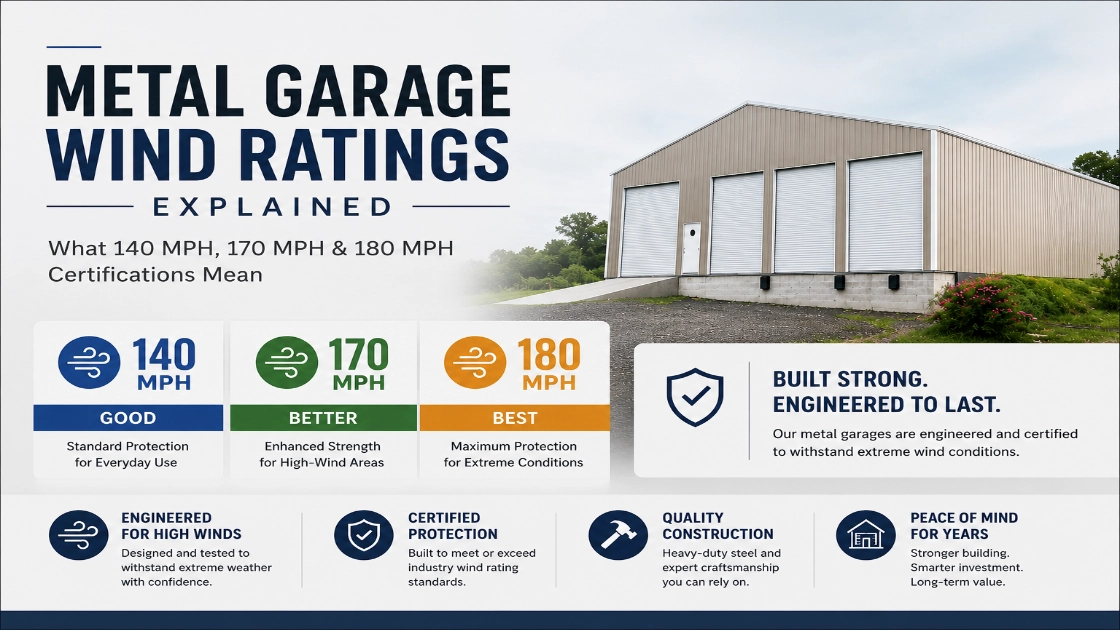
Wind ratings show up in almost every metal garage conversation — but most buyers aren’t sure what they’re actually buying when they see “140 MPH certified” or “engineered to 180 MPH.” Is 140 MPH good enough? Does the number on the spec sheet mean the building survives a direct hurricane hit? And what actually determines whether a metal garage stays standing in high winds?
These are fair questions, and the answers matter more than most people realize — especially in Florida, Texas, the Gulf Coast, the Carolinas, and the Great Plains, where high-wind events are a real annual risk.
This guide explains exactly what metal garage wind ratings mean, how they’re determined, what the 140 MPH, 170 MPH, and 180 MPH certifications represent, which states require which ratings, and what structural factors actually give a building its wind resistance. By the end, you’ll be able to read a wind certification like someone who knows what it covers — and make a confident decision about what your garage needs.
A metal garage wind rating — also called a wind speed rating, wind load rating, or design wind speed — is the maximum wind velocity (measured in miles per hour) that the building has been engineered to withstand without structural failure.
The key word is engineered. A wind rating isn’t a marketing claim. It’s a number derived from structural calculations that account for the building’s size, shape, steel gauge, framing spacing, anchoring method, roof style, and the wind exposure category of the installation site.
When a manufacturer says a garage is “140 MPH certified,” that means a licensed structural engineer has produced stamped drawings verifying that the building, when properly installed per those drawings, can resist wind forces equivalent to a sustained wind speed of 140 MPH. The certification is only as good as the engineering behind it — and only valid when the building is installed exactly as specified.
Quick definition:
A metal garage wind rating is the maximum engineered wind speed (in MPH) that a steel building’s structure can resist without collapse or structural damage, as calculated and certified by a licensed structural engineer.
This is different from a garage door wind rating, which measures the pressure resistance of the door panel itself. A certified garage structure and a wind-rated door are separate specifications — both matter in a high-wind event, and both should be confirmed when you’re in a hurricane zone.
In the United States, wind design for buildings is governed by ASCE 7 — the standard published by the American Society of Civil Engineers titled Minimum Design Loads and Associated Criteria for Buildings and Other Structures. The current version is ASCE 7-22.
ASCE 7 is the engineering reference that determines what wind speed a building in any specific location must be designed for. State and local building codes adopt ASCE 7 as their technical foundation — which is why a building in coastal Florida requires a higher wind rating than the same building in inland Tennessee.
The standard doesn’t just establish a single number for the whole country. It identifies Wind Speed Zones (visualized in wind maps) that specify the “basic wind speed” — the design wind speed a building must be engineered for at a given location, based on historical wind data and risk modeling.
Beyond the basic wind speed zone, ASCE 7 also defines exposure categories that modify the effective wind pressure on a building based on the surrounding terrain:
| Exposure Category | Description | Effect on Wind Pressure |
| Exposure B | Suburban and urban areas; significant ground-level obstructions (trees, buildings) within 1,500 ft | Lower effective wind pressure |
| Exposure C | Open terrain with scattered obstructions; most rural areas, open fields | Moderate wind pressure — most common category |
| Exposure D | Flat, unobstructed areas near water (coastlines, lakeshores, wide rivers) | Highest effective wind pressure |
Two identical buildings with the same wind speed rating installed in different exposure categories will perform differently. A building rated for 140 MPH in Exposure B may not meet code at the same location if the county classifies it as Exposure C or D. This is why location-specific engineering matters — not just the number on the spec sheet.
These three certification levels represent the most common design wind speeds for pre-engineered metal garages in the U.S. market. Here’s what each one covers and where it applies.
What it covers: A 140 MPH wind-certified metal garage is engineered to withstand sustained wind forces equivalent to 140 miles per hour. This covers most of the continental United States and aligns with the ASCE 7 design wind speed requirements for large portions of the South, the Plains states, and the interior Southeast.
Where it’s typically required or appropriate:
What structures it applies to: Standard enclosed metal garages in moderate- to high-wind regions that are not in designated hurricane zones or high-velocity wind areas. For most residential and agricultural applications in these states, 140 MPH certification is the baseline code requirement.
Steel gauge typically used: 14-gauge galvanized steel framing is standard at this certification level for most residential garage sizes.
Important caveat: 140 MPH is often the minimum required certification in these areas — not a conservative choice. If your site is on elevated terrain, an open hilltop, or has minimal surrounding windbreaks, a higher rating may be appropriate even in regions where 140 MPH is the baseline.
What it covers: A 170 MPH certification is for buildings engineered to resist substantially higher wind forces than the 140 MPH standard. This level requires more robust framing, closer column spacing, heavier anchor systems, and certified engineering calculations that reflect the significantly higher lateral and uplift forces at play.
Where it’s typically required or appropriate:
What structures it applies to: Any enclosed metal garage in coastal or near-coastal high-wind zones that fall within ASCE 7 wind zones requiring design wind speeds in the 160–170 MPH range. This certification is also appropriate for larger structures (wider or taller buildings) in high-exposure locations that would otherwise be borderline at 140 MPH.
Steel gauge typically used: 12-gauge steel framing is standard at 170 MPH certification. The heavier gauge provides significantly more resistance to bending and deflection under high-wind lateral forces.
What it covers: The 180 MPH certification represents the highest standard commonly available for pre-engineered residential and light commercial metal garages. Buildings engineered to this level are designed for the highest wind-load requirements in the continental U.S. and are built to survive conditions associated with major hurricanes.
Where it’s typically required or appropriate:
What structures it applies to: Any enclosed garage or metal building in designated high-velocity hurricane zones. In Miami-Dade County specifically, local building codes require the Florida Building Code (FBC) compliance, which mandates 180+ MPH design wind speeds with additional impact resistance and product approval requirements beyond standard structural certification.
Steel gauge typically used: 12-gauge framing is required; additional structural reinforcement, closer frame spacing (often 4-foot rather than standard 5-foot column spacing), heavier base rail anchoring, and enhanced gusset plate systems are typically part of a certified 180 MPH design.
Key distinction: A 180 MPH-certified Viking Metal Garages building is engineered to sustain winds of 180 MPH or greater — which puts it in the structural range of a Category 5 hurricane. This isn’t a marketing number; it’s a load calculation verified by a licensed engineer.
| Certification | Typical Steel Gauge | Where It Applies | Hurricane Category Equivalent |
| 140 MPH | 14-gauge (standard) | Inland South, Plains, mid-Atlantic interior | Cat 1–2 range |
| 170 MPH | 12-gauge (recommended) | Coastal Southeast, Gulf Coast, central FL, Hawaii | Cat 2–3 range |
| 180 MPH | 12-gauge (required) | HVHZ FL, extreme coastal zones, territories | Cat 4–5 range |
Note: Hurricane categories are based on the Saffir-Simpson scale sustained wind speeds. A building rated to 180 MPH does not guarantee survival of a direct hit from a Category 5 storm — factors including debris impact, storm surge, and localized tornado circulation within a hurricane can exceed structural design parameters.
The certification number is the result — not the cause. Wind resistance in a metal garage comes from a combination of structural factors working together. Understanding what those factors are helps you evaluate whether a building is genuinely wind-resistant or just carrying a number.
The thickness of the steel framing members directly determines how much lateral force the structure can handle before bending or failing. Steel gauge is measured inversely — lower gauge numbers mean thicker steel.
| Gauge | Thickness (inches) | Typical Application |
| 14-gauge | 0.075 in | Standard residential garages; 140 MPH certification |
| 12-gauge | 0.105 in | High-wind zones; 170–180 MPH certification |
The difference between 14-gauge and 12-gauge isn’t subtle. 12-gauge steel is approximately 40% thicker than 14-gauge, which translates to substantially higher resistance to both bending and deflection under lateral wind pressure.
Standard column spacing for pre-engineered metal garages is 5 feet on center. In high-wind applications, closer spacing — often 4 feet on center — distributes wind loads across more framing members, reducing the load per connection and improving overall structural performance. Closer frame spacing is a common engineering requirement at 170–180 MPH certifications, particularly for wider or taller buildings.
A wind-certified building that isn’t properly anchored to its foundation will fail in high winds regardless of what the structural frame is rated for. Anchoring method is a critical part of the wind certification — and it’s explicitly specified in engineer-stamped drawings.
Common anchoring methods and their applications:
| Anchoring Method | Application | Wind Performance |
| Mobile home anchors / auger anchors | Soft soil, gravel pads | Baseline for non-permitted structures; limited uplift resistance |
| J-bolt concrete anchors | Concrete slab with embedded anchors | Standard for permitted enclosed garages; solid uplift resistance |
| Through-bolt / anchor bolt to concrete | Concrete slab with drilled or cast-in anchors | Required for most 170–180 MPH certifications |
| Helical pier foundations | Areas with poor soil bearing capacity | Engineered for specific soil conditions; used where concrete slab isn’t viable |
In Miami-Dade and other HVHZ jurisdictions, the anchoring specifications are explicitly defined by code — concrete slab thickness, anchor bolt diameter, embedment depth, and edge distance are all regulated, not left to installer judgment.
The roof panel orientation affects how wind flows over and around the building — and how much uplift force is generated at the roof surface.
| Roof Style | Panel Orientation | Wind Performance |
| Regular (Horizontal) | Panels run side-to-side | Lowest wind resistance; horizontal seams create uplift vulnerability points |
| Boxed Eave (A-Frame) | Panels run side-to-side, pitched | Moderate improvement; better rain shedding but similar wind profile |
| Vertical Roof | Panels run top-to-bottom | Best wind performance; vertical seams reduce uplift; required for high-wind certifications |
For any building in a 140 MPH or higher wind zone, a vertical roof is strongly recommended — and is typically required for certified 170–180 MPH structures. The vertical panel orientation allows wind to flow over the roof more efficiently and reduces the pressure differential that drives roof uplift failures. Viking’s vertical roof metal garages are available with engineer certification at all wind speed levels.
Gusset plates are steel connector plates installed at framing joints — particularly where roof trusses meet wall columns — that reinforce the connection against lateral racking forces. In high-wind designs, heavier gusset plates and additional diagonal bracing in the wall and roof planes are standard components of the engineered system. These are not visible in standard building photos, but they’re a meaningful part of what separates a 140 MPH building from a 180 MPH building structurally.
Building dimensions directly affect wind loads. Taller buildings experience higher wind velocities (wind speed increases with height above grade) and generate more uplift force at the roof. Wider buildings present larger surface areas to lateral wind pressure. Longer buildings require additional lateral bracing to prevent racking.
An engineer designing a 40×80-foot building for 170 MPH winds must account for significantly higher forces than the same certification applied to a 24×30-foot structure. Building-specific calculations — not a generic spec sheet — determine whether the actual building geometry meets the certified wind speed.
Wind rating requirements vary significantly across the U.S. The following is a practical reference for the regions where wind certification most commonly affects buying decisions.
Florida has the most complex wind code requirements in the nation. The Florida Building Code (FBC) divides the state into several wind zones:
Florida requires engineer-stamped drawings for building permits on enclosed structures in virtually every county. Most counties also require wind load documentation at permit application.
Texas wind zone requirements vary by county and proximity to the Gulf:
Most of Hawaii falls within ASCE 7 design wind speed zones requiring 160–180 MPH certification. Consult county building departments for specific requirements, as each county may have additional local amendments.
The Central Plains states (Kansas, Oklahoma, Nebraska, Missouri, Iowa) are subject to tornado risk. It’s important to understand that tornadoes produce wind speeds that can far exceed the structural rating of any pre-engineered building. Wind ratings for metal garages are based on sustained hurricane-style wind events, not the extreme localized wind speeds of a direct tornado strike.
For tornado-prone regions, a certified metal garage provides meaningful protection from non-direct storm events and wind-driven rain. The 140 MPH certification standard is appropriate and typically code-compliant in these states. No pre-engineered residential structure is engineered to withstand a direct tornado hit at EF3 or higher.
In most U.S. counties, a building permit is required for any enclosed metal garage. The permit process almost always includes a structural review — and wind load certification is a core component of that review.
What building departments typically require:
Viking Metal Garages provides engineer-certified structural drawings with most enclosed garage orders. These drawings include the certified wind speed, exposure category assumptions, framing specifications, and anchoring requirements — and are designed to satisfy the structural portion of most U.S. county permit applications.
If a metal garage seller cannot provide stamped engineer drawings for a certified wind speed, treat that certification with appropriate skepticism. A legitimate certification is a documented calculation — not a marketing statement.
Here’s a practical decision framework:
Step 1: Find your county’s required design wind speed. Your county building department can tell you the required design wind speed for enclosed structures in your area. Alternatively, the ASCE 7 wind speed maps (publicly available) show design wind speeds by location. Your Viking building specialist can also look this up for your zip code.
Step 2: Identify your exposure category. Open terrain with minimal surrounding trees or structures = Exposure C or D. Suburban area with buildings and trees within 1,500 feet = Exposure B. Your exposure category affects the effective wind pressure your building must be designed for.
Step 3: Consider your site-specific factors.
Step 4: Choose a certified building at or above the required level. Always meet or exceed the code requirement. For most homeowners, the cost difference between a 140 MPH and 170 MPH certified garage is less significant than the risk of building to a lower standard than what local weather conditions can produce.
| Your Location | Recommended Minimum Certification |
| Inland Southeast, Plains, interior South | 140 MPH |
| Coastal Southeast, Gulf Coast, central Florida | 170 MPH |
| Coastal Florida, HVHZ, extreme coastal zones | 180 MPH |
| Hawaii, U.S. territories | Consult local code; typically 160–180 MPH |
| Great Plains, Midwest (tornado regions) | 140 MPH (code standard); tornado risk is separate |
Yes — but the cost increase is more modest than most buyers expect, and it’s typically justified by insurance, permitting, and long-term protection value.
The primary cost drivers for higher wind certifications:
As a practical benchmark, upgrading from a standard 14-gauge enclosed garage to a 12-gauge engineer-certified 170–180 MPH build typically adds 10–25% to the building cost, depending on size. For most buyers in coastal or high-wind regions, that premium is a straightforward insurance and code compliance decision — not a luxury upgrade.
Insurance consideration: Many homeowners and commercial property insurers provide better coverage terms or lower premiums for buildings with documented engineer-certified wind ratings. In Florida especially, having certified drawings can be the difference between a covered loss and a denied claim.
Wind ratings and snow load ratings are separate structural specifications — and in many parts of the country, both matter.
Wind rating measures resistance to horizontal and uplift forces from wind pressure (expressed in MPH).
Snow load rating measures the vertical load capacity of the roof framing (expressed in pounds per square foot — PSF).
In northern states (Minnesota, Michigan, Colorado, Wisconsin, Montana, New England), snow load requirements are often the dominant structural consideration. In coastal southern states, wind rating is typically the critical specification. In many mid-latitude states — the Carolinas, Virginia, Missouri, Kansas — both specifications need to be evaluated.
A complete structural specification for a metal garage should address both. Viking’s engineer-certified build
The wind speed number in an advertisement is only meaningful if it’s backed by legitimate engineering documentation. Here’s what separates a real certification from a marketing claim:
A legitimate wind certification includes:
Red flags to watch for:
Viking Metal Garages provides engineer-certified drawings for certified builds — documentation that satisfies structural review requirements at most U.S. county building departments. Our building specialists can walk you through exactly what’s included in the certification package for your specific building and location.
A metal garage wind rating isn’t a sticker you put on a building — it’s an engineered performance specification that determines how your structure behaves in the worst weather your area can produce. Getting it right means understanding what your county requires, what your site exposure category is, and what structural elements actually deliver the certified performance.
Viking Metal Garages builds fully custom certified metal garages across all 48 contiguous states, with engineer-certified drawings included on most enclosed garage orders. Our building specialists handle the wind certification and permit documentation questions every day — for buyers in coastal Florida, the Texas Gulf Coast, the Carolinas, Hawaii, and everywhere in between.
If you’re not sure what wind rating your location requires or whether your current plans will pass a county structural review, call us at (704)-741-1587. We’ll confirm your county’s requirement, recommend the right certification level for your site, and get you a custom quote — typically within one business day.
Your garage should stand as long as you need it. Build it to the right standard from the start.
Expand each item below to explore a few helpful answers before moving to the next blog post.
A wind rating is the maximum wind speed (in MPH) that a metal garage is engineered to withstand without structural failure. It's determined by structural calculations accounting for building size, steel gauge, framing spacing, roof style, anchoring, and site exposure category — and certified by a licensed structural engineer.
It depends on your county's required design wind speed, which is based on your location's ASCE 7 wind zone. Most inland southern states require 140 MPH; coastal Southeast and Gulf states typically require 140–170 MPH; Florida's High Velocity Hurricane Zone requires 180+ MPH. Your county building department or a Viking building specialist can confirm the requirement for your zip code.
Not always. 140 MPH may be sufficient for moderate inland hurricane-zone counties, but coastal areas typically require 150–170 MPH, and Florida's HVHZ requires 180+ MPH. Always verify the specific requirement with your county building department rather than assuming 140 MPH covers all hurricane-exposed locations.
The structural differences include: heavier steel gauge (12-gauge vs. 14-gauge), closer frame spacing (4 ft vs. 5 ft on center), enhanced gusset plates and bracing, heavier anchoring system, and a vertical roof requirement. A 180 MPH building is engineered for significantly higher lateral and uplift forces than a 140 MPH structure — and the engineering documentation reflects those specific calculations.
Yes — significantly. 12-gauge steel (approximately 0.105 inches thick) is about 40% thicker than 14-gauge (0.075 inches), providing substantially greater resistance to bending under wind loads. Most 170–180 MPH certifications require 12-gauge framing. Upgrading to 12-gauge is one of the most important structural decisions in a high-wind-zone purchase.
In most U.S. counties, yes. Engineer-stamped structural drawings are required for building permits on enclosed metal garages. These drawings must specify the certified design wind speed, exposure category, and anchoring details. Viking provides engineer-certified drawings with most enclosed certified garage orders.
A wind-certified metal garage provides meaningful protection from non-direct storm events. However, no pre-engineered residential structure is designed to withstand a direct EF3+ tornado — the localized wind speeds in a direct hit far exceed the structural design limits of any standard certified building. Wind ratings are based on sustained hurricane-style winds, not the extreme point-load forces of a direct tornado strike.
Potentially, yes — particularly in Florida and coastal states. Many insurers recognize certified wind ratings in their underwriting, and having documented stamped drawings can support better coverage terms. Contact your insurer before ordering to understand their specific certification requirements.
Last Call for Summer Savings! Get Up To 30% Off |View Offer >>
Last Call for Summer Savings! Get Up To 30% Off |View Offer >>
Last Call for Summer Savings! Get Up To 30% Off |View Offer >>
Last Call for Summer Savings! Get Up To 30% Off |View Offer >>
Last Call for Summer Savings! Get Up To 30% Off |View Offer >>
Last Call for Summer Savings! Get Up To 30% Off |View Offer >>
Last Call for Summer Savings! Get Up To 30% Off |View Offer >>
Last Call for Summer Savings! Get Up To 30% Off |View Offer >>
Last Call for Summer Savings! Get Up To 30% Off |View Offer >>
Last Call for Summer Savings! Get Up To 30% Off |View Offer >>
Last Call for Summer Savings! Get Up To 30% Off |View Offer >>
Last Call for Summer Savings! Get Up To 30% Off |View Offer >>
Last Call for Summer Savings! Get Up To 30% Off |View Offer >>
Last Call for Summer Savings! Get Up To 30% Off |View Offer >>