
2 car garage
September 22, 2026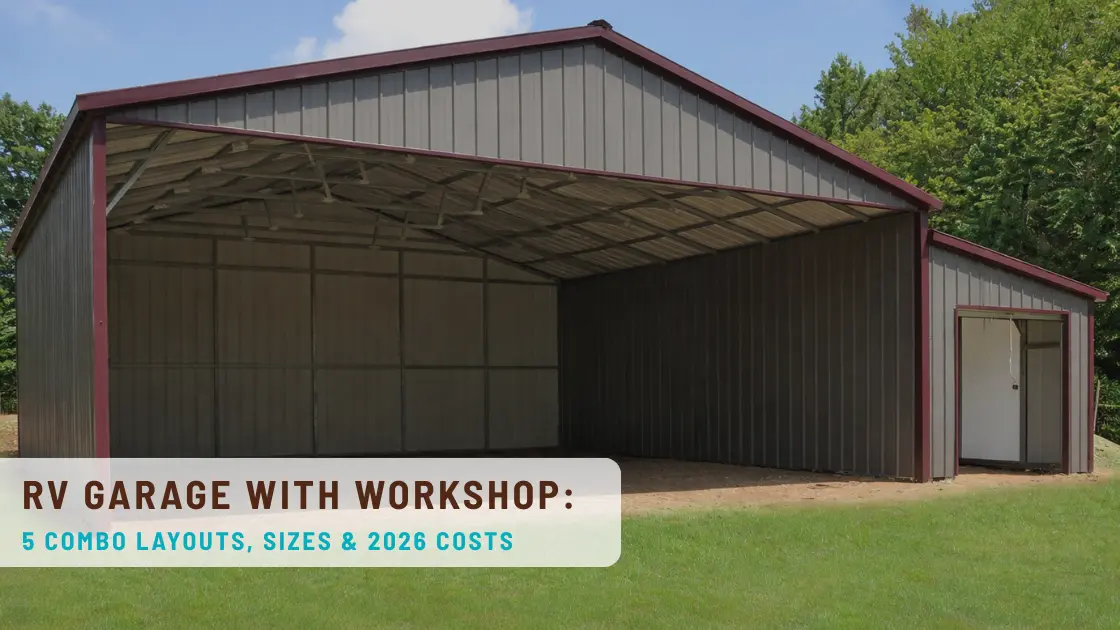
If you’re spending $100,000+ on a motorhome, a bare-bones storage shed isn’t going to cut it. An RV garage with a workshop gives you enclosed protection for your rig plus a real workspace for maintenance, hobbies, or builds—all under one steel roof.
This guide walks you through the five most popular combo layouts, the right building sizes for each RV class, real 2026 cost data, and the add-ons that make a workshop actually functional. Whether you’re parking a Class A motorhome or a fifth wheel, Viking Metal Garages can configure a metal RV garage to include as much — or as little—workshop space as you need.
An RV garage with workshop is a single metal building that combines a tall-door bay for RV storage with a dedicated workspace section — either as a partitioned interior room, a side lean-to addition, or a rear workshop area. Building sizes typically range from 30×40 ft to 40×60 ft, with the workshop occupying 200–600 sq ft of the total footprint. Starting costs run from $17,800 for a basic 24×41 combo to $55,000+ for a fully insulated, climate-controlled 40×60 build.
Storing an RV outdoors costs $100–$500 per month at most storage facilities, $1,200 to $6,000 per year for a vehicle that depreciates the moment it sits in UV exposure and weather. A metal RV garage with a workshop pays for itself over time, and the workshop section multiplies the return.
The case for combining them comes down to three things: you get more building for your money by maxing out your lot’s footprint in one permitted structure, the RV and your tools share one foundation and one roof system, and the workshop keeps you productive year-round without needing a separate outbuilding.
“We went with a 40×60 metal garage so we could have extra space for our fifth wheel plus a small workshop. It ended up around $45k installed, but now I don’t worry about hail or sun damage.”
Not every combo is the same. The right layout depends on your lot width, how you’ll access both sections, and whether you want the workshop visible from the RV bay or completely separated. Here are the five configurations we build most often:
A lean-to addition runs along the full length of one sidewall, creating a covered workshop that’s structurally attached but functionally separate. This is the most popular option because it doesn’t reduce the RV bay’s interior width at all — your 14-ft door and full interior clearance stay intact.
Best size: 30×50 main building + 12×50 lean-to = 42×50 effective footprint
Workshop space: 600 sq ft
Ideal for: Full-time RVers who need a large, permanent workshop
A steel partition wall divides the rear 10–15 ft of the building from the RV bay. The RV pulls in through the front, and the workshop sits at the back — accessible from the RV bay through a man door or from outside through a second entry.
Best size: 30×60 building, rear 15 ft partitioned.
Workshop space: 450 sq ft
Ideal for: Lots with limited side clearance; drive-through setups
The RV section runs at 14–16 ft eave height, and the workshop section steps down to a standard 10–12 ft height. This reduces material cost on the workshop side while giving each area the ceiling clearance it actually needs.
Best size: 20×40 RV bay (16 ft) + 20×30 workshop (10 ft) side by side.
Workshop space: 600 sq ft
Ideal for: Cost-conscious builds; lots with HOA height restrictions
Two equal bays side by side — one with an RV-height door (12×12 ft or 14×14 ft), one with a standard garage door (10×10 ft). Both are open to the same driveway approach. The second bay serves as the workshop with a full concrete floor, outlets, and bench space along the back wall.
Best size: 40×40 or 40×50
Workshop space: 800–1,000 sq ft
Ideal for: Buyers who want a serious shop, not just a bench area
RV doors on both ends of the main bay (front and rear) allow a pull-through approach — no backing required for large Class A rigs or fifth wheels. The workshop occupies a lean-to or step-down addition on one side.
Best size: 24×60 main building + 12×60 lean-to
Workshop space: 720 sq ft
Ideal for: Class A or Super C owners; tight maneuvering lots
For most buyers, the side lean-to layout is the best choice — it preserves the full interior clearance of the RV bay, adds 400–720 sq ft of workshop space, and costs $5,000–$12,000 less than building a fully separate outbuilding. If lot width is restricted, a rear partition in a 30×60 building is the next best option.
Before settling on a layout, you need to know the minimum building size your RV requires. Check your RV garage dimensions first, then add the workshop footprint on top. Here’s the combined guidance:
| RV Type | Min RV Bay Size | Min Door Height | With Workshop (Lean-To) | With Workshop (Partition) |
| Class B / Camper Van | 14×30 ft | 10 ft | 24×30 + 10×30 lean-to | 18×40 (rear 10 ft partitioned) |
| Class C Motorhome | 14×40 ft | 12 ft | 24×40 + 12×40 lean-to | 24×50 (rear 10 ft) |
| Class A Motorhome | 20×45 ft | 14–16 ft | 30×50 + 12×50 lean-to | 30×60 (rear 15 ft) |
| Fifth Wheel | 14×40 ft | 12–14 ft | 24×45 + 12×45 lean-to | 30×55 (rear 15 ft) |
| Travel Trailer | 14×35 ft | 12 ft | 24×40 + 10×40 lean-to | 24×45 (rear 10 ft) |
Rule of thumb: Add at least 3 ft of clearance on each side of the RV and 2 ft of headroom above the rooftop AC unit. For a Class A with a 13.5 ft roofline, that means a 16 ft eave height minimum — which means a 14 ft door, since doors must be installed 2 ft below the eave on certified buildings.
The cost of an RV garage with a workshop starts at $17,800 for a 24×41 ft basic combo and scales significantly with size, insulation, and finish level. Viking’s building prices include delivery and installation — there are no hidden labor charges. For a full breakdown by size, see our steel RV garage prices page.
| Building Configuration | Building Kit (Installed) | + Foundation (Est.) | + Insulation (Est.) | Total Turnkey Est. |
| 24×41 ft — basic lean-to combo | $17,800–$22,000 | $6,000–$9,000 | $2,500–$4,000 | $26,000–$35,000 |
| 30×50 ft — mid-size lean-to | $24,000–$32,000 | $9,000–$14,000 | $4,000–$7,000 | $37,000–$53,000 |
| 30×60 ft — large rear-partition | $28,000–$38,000 | $11,000–$16,000 | $5,000–$8,000 | $44,000–$62,000 |
| 40×60 ft — full dual-bay | $38,000–$52,000 | $14,000–$20,000 | $7,000–$12,000 | $59,000–$84,000 |
An RV garage with a workshop costs between $17,800 and $84,000+ depending on size and finish level. A basic 24×41 ft combo with lean-to workshop runs $26,000–$35,000 installed including foundation. A full 40×60 ft dual-bay build with insulation and climate control typically lands between $59,000 and $84,000. Adding a workshop to an existing RV garage building costs approximately $5,000–$15,000 for the lean-to structure alone, not including the foundation extension.
The most common add-on cost buyers overlook is the concrete slab extension for the workshop. If you’re building on bare land, budget for the workshop section of the slab separately — typically $4–$6 per sq ft for a 4-inch reinforced slab, poured and finished.
A workshop that works is planned before the building ships — not after. These are the features that are cheapest to add during the design phase and most expensive to retrofit:
Plan a 200-amp subpanel for the workshop section. You’ll want at least 4–6 duplex outlets on the bench wall, a 240V circuit for a compressor or welder, and overhead lighting on a separate switch from the RV bay. Rough-in conduit runs through the steel framing before the walls close.
For a heated workshop, spray foam on the interior of the steel panels is the most effective option — typically R-13 to R-21 depending on thickness. Bubble insulation works for condensation control but won’t keep a shop warm enough to work in January in northern climates. If you plan to winterize your RV in a heated workshop, budget for spray foam on the workshop walls and ceiling.
Add a man door directly from the workshop to the RV bay — this lets you access both areas without going outside. Add 2–3 windows on the workshop sidewall for natural light and ventilation. These must be specified on the original order; cutting them in post-installation requires professional framing work and voids the roof warranty on some configurations.
The workshop section benefits from a sealed or epoxy-coated concrete floor — keeps dust down, resists oil, and makes the space feel finished. Standard 4-inch reinforced concrete is adequate for foot traffic and most shop equipment. If you plan to install an auto lift, you need a minimum 6-inch slab with rebar in the lift area; confirm the load spec with the lift manufacturer before pouring.
For any combo building, we recommend the vertical roof style over boxed-eave or regular roof panels. Vertical-rib roofing sheds water and debris efficiently, reduces rust risk at the seams, and is required for certification in most high-wind or snow-load counties. The cost premium over a regular roof is typically $500–$1,200 on a full combo build — worth every dollar.
In most U.S. counties, yes — a combo building of this size will require a building permit. The typical triggers are: structures over 200 sq ft (some counties say 400 sq ft), structures with electrical, and any structure with a concrete foundation. Zoning restrictions may also limit total accessory structure square footage on your lot.
Viking’s certified metal buildings come with engineer-stamped drawings that most counties accept for permit applications. We handle the structural certification side; you’ll need to submit the permit application and pay the fee to your local building department. For a full state-by-state breakdown, see our RV garage permit requirements guide.
Expand each item below to explore a few helpful answers before moving to the next blog post.
Yes. A lean-to workshop can be attached to most existing Viking metal buildings if the sidewall framing accommodates the attachment points. Contact us with your building model number and lot dimensions — we'll confirm whether a lean-to addition is feasible and provide a quote. Note that adding electrical to an existing building may require a permit even if the original structure didn't.
For a functional workshop, plan for at least 200 sq ft (a 10×20 ft section) for basic bench work and tool storage. Serious DIY mechanics typically want 400–600 sq ft to accommodate a workbench, tool chest, compressor, and open floor space for moving around the vehicle. The lean-to configuration typically delivers 400–720 sq ft without affecting the main RV bay at all.
Yes, provided your concrete slab is at least 6 inches thick with proper rebar in the lift footprint area. Most 2-post lifts require 4–5 inches minimum; 4-post lifts typically need 6 inches. The steel building itself doesn't restrict lift installation — the limiting factor is always the slab specification and ceiling height. Plan for a minimum 12 ft eave in the workshop section if you want lift clearance for a standard pickup truck.
A lean-to adds footprint to the outside of the building — the workshop sits under an attached slope roof on the side. An interior partition uses a wall inside the existing building envelope to separate a section. Lean-tos give you more total space and cost more; partitions are lower cost but reduce the usable interior of the main RV bay. For Class A rigs, lean-tos are almost always preferred to keep the interior maneuvering space intact.
Yes. Viking offers Rent-to-Own (RTO) options with no credit check required on most builds, as well as standard financing options. RTO is popular for combo builds in the $25,000–$45,000 range where buyers prefer manageable monthly payments over a lump-sum purchase. Contact our team for current RTO rates and terms in your state.
Last Call for Summer Savings! Get Up To 30% Off |View Offer >>
Last Call for Summer Savings! Get Up To 30% Off |View Offer >>
Last Call for Summer Savings! Get Up To 30% Off |View Offer >>
Last Call for Summer Savings! Get Up To 30% Off |View Offer >>
Last Call for Summer Savings! Get Up To 30% Off |View Offer >>
Last Call for Summer Savings! Get Up To 30% Off |View Offer >>
Last Call for Summer Savings! Get Up To 30% Off |View Offer >>
Last Call for Summer Savings! Get Up To 30% Off |View Offer >>
Last Call for Summer Savings! Get Up To 30% Off |View Offer >>
Last Call for Summer Savings! Get Up To 30% Off |View Offer >>
Last Call for Summer Savings! Get Up To 30% Off |View Offer >>
Last Call for Summer Savings! Get Up To 30% Off |View Offer >>
Last Call for Summer Savings! Get Up To 30% Off |View Offer >>
Last Call for Summer Savings! Get Up To 30% Off |View Offer >>