Metal Garages
September 18, 2026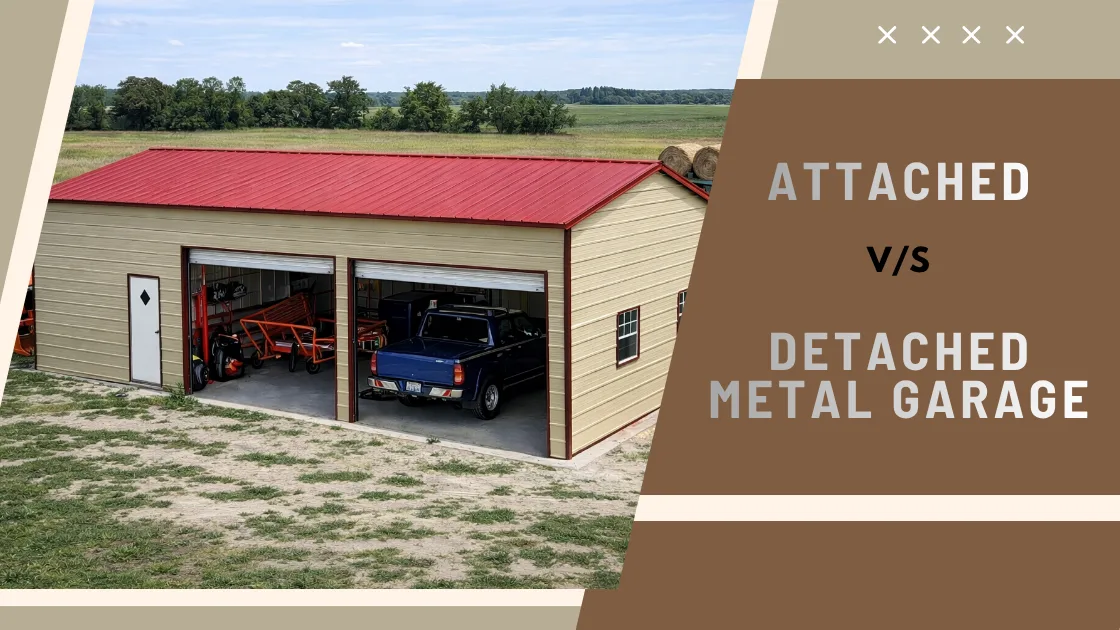
If you’re shopping for a metal garage, you’ve probably already noticed that most online comparisons gloss over the details that actually matter. They tell you “attached garages are more convenient” and “detached garages are more private,” and then call it a day. That’s not good enough when you’re about to invest anywhere from $8,000 to $50,000-plus in a structure that’s going to sit on your property for decades.
At Viking Metal Garages, we’ve helped thousands of American homeowners navigate this exact decision. And the truth is, the right answer isn’t one-size-fits-all. Your lot size, local building codes, climate zone, and how you plan to use the space, and your long-term plans for the property all play a role.
This guide pulls back the curtain on the full picture — including the fire safety requirements most blogs never mention, the real cost difference between attached and detached metal garages in 2025, and a practical decision framework so you can stop second-guessing yourself and start building.
An attached metal garage shares at least one wall — sometimes two or three — with your home. Because it physically connects to the main structure, it generally requires fewer materials to build, integrates more easily with your home’s existing utilities, and lets you walk directly from the house into the metal garage without ever stepping outside.
Attached garages are common in suburban neighborhoods and newer construction homes where lot layouts are tighter and direct home-garage access is a selling feature.
A detached metal garage is a standalone structure. It sits somewhere on your property — could be right behind the house or farther back on a larger lot — but it has zero physical connection to the main building. You need to step outside to get to it.
Detached steel garages offer the most design freedom, the safest separation between vehicles and living space, and the greatest potential for multi-use: workshop, home gym, man cave, she shed, home office, or even a rental unit with the right permits.
Also Read: What Gauge Steel Is Best for Metal Garage Buildings?
| Pros | Cons |
| Direct indoor access — no going outside in bad weather | Fire risk — attached garages must meet stricter code (½” drywall separation, fire-rated doors) |
| Lower upfront cost (20–25% cheaper than detached on average) | Noise and fumes from vehicles, tools, and chemicals can enter the home |
| Easier utility hookup — shares home’s electrical and plumbing | Less design flexibility — must match home’s footprint and architecture |
| Great for families with kids, groceries, or mobility challenges | Expansion is difficult once built — often boxed in on 3 sides |
| Can be included in home mortgage financing | Any garage fire is closer to your living space |
| Typically requires less land area | Privacy is limited — activities visible and audible from the house |
Let’s be real — if you live in Minnesota, Wisconsin, or anywhere else that gets hammered by winter weather, walking through a blizzard in your socks to grab something from the garage gets old fast. The attached garage eliminates that. You step from the kitchen into the garage, load up, and drive off. For families with young kids or anyone with mobility limitations, this convenience is genuinely life-changing on a daily basis.
The same goes for grocery runs, moving heavy items, or simply keeping your vehicles out of the freeze overnight. When the garage door is a direct extension of your home, the garage becomes part of your daily living flow — not a separate destination.
Here’s what most garage comparison blogs skip over: attached garages in the U.S. are legally required to meet fire separation standards under the International Residential Code (IRC). This isn’t optional.
According to the International Code Council (IRC) section 302.6, attached garages must meet fire safety standards. Walls require at least ½-inch drywall, while ceilings below living spaces need 5/8-inch Type X gypsum. Doors must be 1⅜-inch solid wood or steel, or 20-minute fire-rated, and must be self-closing. These requirements ensure proper fire separation and help protect occupants by slowing fire spread between the garage and living areas.
Why does this matter for metal garages? Because metal conducts heat rapidly. In a fire scenario, an attached steel garage can accelerate heat transfer to the shared wall faster than wood framing. This doesn’t make attached metal garages dangerous — it makes the proper fire-separation installation non-negotiable. Make sure your installer is familiar with IRC requirements for your specific state and municipality.
| Pros | Cons |
| Maximum design and placement flexibility — put it anywhere on your lot | 10–20% higher upfront cost than attached due to separate foundation and utilities |
| No fire separation codes between garage and home | You must go outside to access it — inconvenient in bad weather |
| Full privacy for workshops, hobbies, home offices, music practice | Requires running separate electrical (and plumbing if needed) |
| No noise, fume, or carbon monoxide transfer to living space | May reduce yard space and landscaping options |
| Easier to expand or modify later | Needs its own roofing and full four-wall construction |
| Can be converted to living quarters, rental unit, or ADU | Some HOAs or zoning rules restrict detached structures |
This is where detached metal garages really shine. Because you’re not constrained by your home’s existing footprint, you can build virtually any size or configuration — a compact one-car unit, a sprawling four-car workshop complex, a vertical two-story structure with a loft. You choose the placement, the orientation, and the style without worrying about matching siding or rooflines.
Viking Metal Garages customers regularly customize their detached steel buildings with vertical roof panels for superior snow and rain runoff, extra-wide roll-up doors for RVs and commercial vehicles, side walk-in doors for workshop access, and insulation packages that turn the space into a year-round workspace. None of that flexibility is constrained by what your house looks like
A detached metal garage doesn’t have to be just a garage. Homeowners across the country are converting their detached steel structures into home gyms, woodworking shops, photography studios, podcast recording rooms, she sheds, and even legal rental ADUs (accessory dwelling units) in areas that allow it.
Because the space is separate from the home, noise stays contained — your band practice doesn’t wake the kids, your power tools don’t interrupt Netflix night. That separation has real quality-of-life value that’s hard to put a price on until you experience it.
You Might Like: RV Garage With Workshop: 5 Combo Layouts, Sizes & 2026 Costs
Let’s talk numbers. One of the most common questions we get is: “How much more does a detached metal garage cost compared to an attached one?” The answer: typically 10–20% more, depending on size, location, and configuration.
| Factor | Attached Metal Garage | Detached Metal Garage |
| Foundation | Partial (shared wall side) | Full concrete slab required |
| Wall Construction | 3 walls built (1 shared) | 4 full walls required |
| Electrical Run | Short run from home panel | Trenched line from home — higher cost |
| Plumbing | Easy tap into home system | Separate run required if needed |
| 1-Car (12×20) | $6,000 – $10,000 installed | $7,500 – $12,000+ installed |
| 2-Car (24×24) | $10,000 – $20,000 installed | $13,000 – $28,000 installed |
| 3-Car (30×40) | $18,000 – $35,000 installed | $22,000 – $45,000 installed |
| Permit Costs | $800 – $1,500 typical | $1,000 – $2,000 typical |
| ROI at Resale | High in suburban markets | Equal or higher in rural/larger lots |
Note: Prefabricated metal garages offer significant savings over traditional stick-built garages. A standard 24×24 stick-built garage can run $30,000–$45,000, while a metal garage of the same size typically costs $8,000–$15,000 — with delivery and installation included in a final quote when you order from Viking Metal Garages.
Here’s the good news: both attached and detached garages add value to your home. The amount depends on your local market, the size of the structure, and the quality of construction. A well-built garage can increase your home’s value by $5,000 to $33,000, with most homeowners recouping 75–85% of their construction investment at resale.
In suburban markets — think neighborhoods where most homes already have attached garages — an attached garage is often expected. Buyers assume it’s there, and its absence can actually hurt your listing price. In these contexts, a well-built attached metal garage is a strong investment that aligns with buyer preferences.
One important detail: the garage door itself can be a significant value driver. Replacing or upgrading a garage door has been shown to recoup up to 194% of its initial cost in some markets — making the door one of the highest-ROI home improvements available.
In rural areas, larger lot properties, and markets where buyers prioritize functionality over visual cohesion, a detached metal garage often equals or exceeds the value contribution of an attached one. Angela Miller, a certified appraiser in Virginia with 25+ years of experience, notes she gives equivalent value to detached and attached garages, especially in rural and semi-rural markets.
When a detached garage is set up for multi-use — workshop, studio, rental — its value contribution rises substantially. Converted ADUs (accessory dwelling units) can add rental income potential that reflects directly in an appraised value, sometimes adding well over $30,000 in high-demand areas.
Your geographic location should heavily influence this decision. Here’s how different climates tilt the equation:
If you’re in Wisconsin, Minnesota, Michigan, Colorado, or similar climates, the convenience of an attached garage is genuinely compelling. Not having to brave a January morning to get to your car is a daily quality-of-life win. Attached garages also help keep your vehicle from the extreme temperature swings that stress batteries and fluids.
However, a well-insulated detached metal garage with a propane or electric heater is absolutely viable in cold climates. Many homeowners prefer the separation specifically because a heated workshop doesn’t mix fumes with family living space. If going detached in a cold climate, budget for proper insulation and a climate-control system.
In Texas, Florida, Georgia, Arizona, and similar climates, vehicle heat buildup is a real concern. Both attached and detached garages provide shade from the sun’s direct heat. Interestingly, detached garages can actually benefit the home in very hot climates — keeping vehicle heat and exhaust fumes fully separated means your home’s AC system doesn’t have to work as hard.
Ventilation is critical in hot climates for either type. Detached metal garages have more flexibility for natural ventilation (windows on multiple sides, ridge vents) compared to attached structures that may only have one open wall.
For homeowners in hurricane or tornado zones, steel garages are among the most storm-resistant structures you can install. Viking Metal Garages buildings are engineered to meet local wind load and snow load requirements across the U.S. In high-wind areas, a detached steel building can actually serve as a safe storage option for vehicles and equipment that would otherwise be exposed during extreme weather events.
Before you order any garage — attached or detached — you need to understand what your local jurisdiction allows and requires. This is one of the most overlooked steps homeowners skip, and it can cause serious headaches (or fines) down the road.
Most U.S. jurisdictions require a permit for any new garage construction, whether attached or detached. Permit costs typically run $800–$2,000, depending on the state and municipality. Building without a permit can affect your ability to sell the home later, as unpermitted structures often must be disclosed to buyers and may need to be brought up to code before closing. To get exact permit cost information for your location, call our building expert at 704-741-1587 anytime.
Local zoning codes govern how close a structure can be built to your property lines, your house, and the street. Setback requirements for detached garages vary widely — from 3 feet to 20+ feet in some jurisdictions. Always verify setbacks with your local building department before designing your garage placement.
If you live in a neighborhood with a homeowners association, check your CC&Rs (Covenants, Conditions & Restrictions) before purchasing a garage. Some HOAs restrict detached structures entirely, limit height, require matching exterior materials, or mandate approval through an architectural review committee. Attached garages typically face fewer HOA restrictions, though style requirements may still apply.
As covered earlier, the IRC requires fire-rated separation between an attached garage and living space. Key requirements include: ½” Type X gypsum board on the shared wall (garage side), 5/8″ Type X gypsum board if there’s habitable space above, a solid-core fire-rated door with self-closing hardware at the connecting entrance, no HVAC registers (vents) inside the garage that connect to the home’s duct system, and proper sealing of all pipe and wire penetrations through the separation wall. These codes exist for good reason — garage fires are a leading cause of residential structure fires in the U.S.
Still on the fence? Walk through this simple framework:
| Choose ATTACHED if… | Choose DETACHED if… |
| You frequently carry groceries or gear to/from the car | You want a dedicated workshop or hobby space |
| You have mobility challenges or young children | You want to minimize fire risk to your home |
| Your lot space is limited | You have a larger lot with flexibility |
| You live in a harsh winter climate and hate the cold | You want maximum design and size freedom |
| Budget is your primary constraint | You’re planning to use it for more than just a car |
| Your neighborhood expects attached garages | You want to build a rental unit or ADU above the garage |
| You want simpler utility integration | You value noise and odor separation from your home |
At Viking Metal Garages, we’ve been helping homeowners across the United States design and install high-quality steel garages for over 25 years — with more than 10,700 successful installations to our name. Whether you’re leaning toward an attached steel garage that plugs seamlessly into your home’s layout, or a spacious detached metal building that becomes your ultimate multi-purpose space, our team is ready to help you design it right.
We offer a final quote with delivery and installation in most U.S. states, a wide range of sizes and customization options, and pricing that beats traditional wood construction by a significant margin. Our buildings are engineered to meet local wind and snow load requirements, so you know your investment is built to last.
Expand each item below to explore a few helpful answers before moving to the next blog post.
Attached metal garages are generally 10–20% cheaper to build because they share one wall with the home, require a smaller foundation footprint, and have shorter utility runs. However, prefabricated metal garages of either type are significantly cheaper than stick-built wood garages of equivalent size.
In most markets, yes. Both types add comparable value — typically $5,000 to $33,000 depending on size, quality, and location. In rural and semi-rural markets, detached garages often match or exceed the value contribution of attached ones. The key is quality construction, proper permits, and a design that complements the property.
Yes, but it requires careful planning. The connection point must be properly flashed and sealed to prevent water infiltration. The shared wall must meet IRC fire separation requirements. Structural integration with the home's foundation is also a consideration. Viking Metal Garages can build attached metal garages designed to connect to existing residential structures — contact us with your home's details for a custom quote.
In most U.S. jurisdictions, yes. The threshold varies — some areas require permits for any structure over a certain square footage (often 200 sq. ft.), while others require permits regardless of size. Always check with your local building department before ordering. Viking Metal Garages can help guide you through what's typically required in your state.
Detached, hands down. A detached metal garage gives you the noise isolation, ventilation flexibility, and physical separation from your home that makes a real workshop experience possible. You can run loud machinery, run exhaust fans, store chemicals safely, and even add a bathroom without impacting your home's living space. Many of our customers specifically choose detached steel buildings for this reason.
Both types work in cold climates with proper insulation. For attached garages in cold climates, ensure your fire separation wall is also insulated to prevent heat loss through the shared wall. For detached garages, choose a building with proper insulation value (R-13 to R-19 for walls in cold climates), a well-sealed concrete floor, and a dedicated heating source such as an infrared heater or propane unit heater.
Last Call for Summer Savings! Get Up To 30% Off |View Offer >>
Last Call for Summer Savings! Get Up To 30% Off |View Offer >>
Last Call for Summer Savings! Get Up To 30% Off |View Offer >>
Last Call for Summer Savings! Get Up To 30% Off |View Offer >>
Last Call for Summer Savings! Get Up To 30% Off |View Offer >>
Last Call for Summer Savings! Get Up To 30% Off |View Offer >>
Last Call for Summer Savings! Get Up To 30% Off |View Offer >>
Last Call for Summer Savings! Get Up To 30% Off |View Offer >>
Last Call for Summer Savings! Get Up To 30% Off |View Offer >>
Last Call for Summer Savings! Get Up To 30% Off |View Offer >>
Last Call for Summer Savings! Get Up To 30% Off |View Offer >>
Last Call for Summer Savings! Get Up To 30% Off |View Offer >>
Last Call for Summer Savings! Get Up To 30% Off |View Offer >>
Last Call for Summer Savings! Get Up To 30% Off |View Offer >>