
2 car garage
October 12, 2026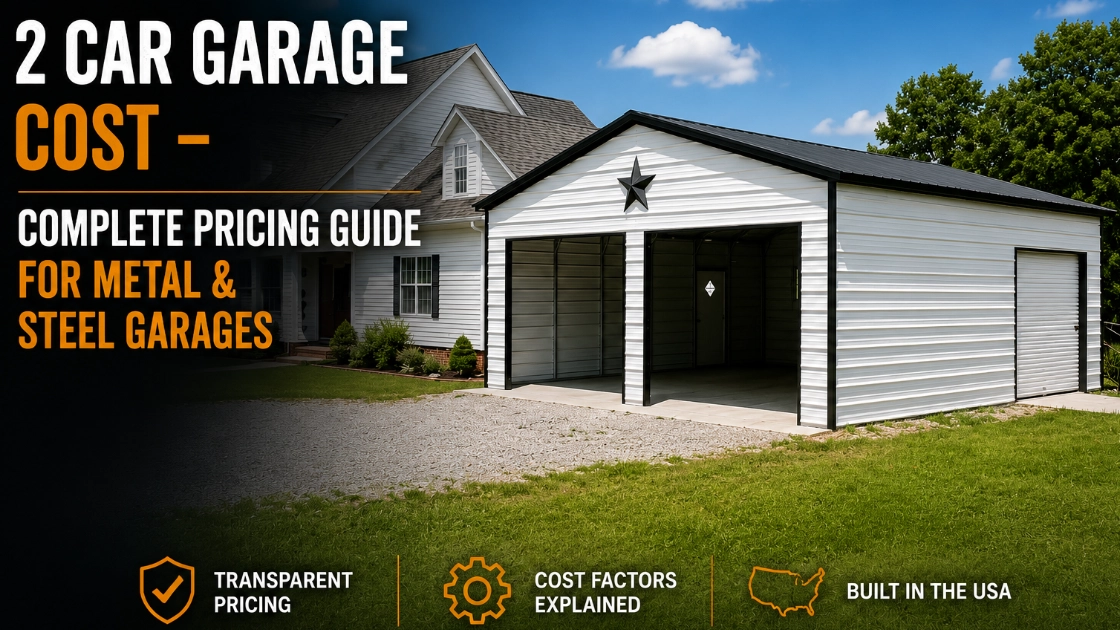
So how much does a 2 car garage actually cost in 2026? The honest answer: it depends on what you build it from, how big it is, and how you customize it. A basic prefab metal 2 car garage can run as low as $7,000–$11,000 delivered and installed. A fully custom metal garage with vertical roof, insulation, and concrete slab can reach $20,000–$35,000 or more. A traditionally built wood-frame garage? Closer to $30,000–$60,000 once labor, materials, and foundation are factored in.
This guide breaks down every cost factor — size, roof style, steel gauge, foundation, add-ons, and more — so you can plan your budget with confidence and avoid the surprises that catch most buyers off guard.
Here’s a realistic pricing snapshot for 2026 based on garage type and configuration. These figures include delivery and installation but exclude concrete foundation unless noted.
| Garage Type | Starting Price | Mid-Range | High-End |
| Prefab Metal (Regular Roof) | $7,000 – $10,000 | $10,000 – $14,000 | $14,000 – $18,000 |
| Prefab Metal (Boxed Eave) | $8,500 – $11,500 | $11,500 – $16,000 | $16,000 – $20,000 |
| Prefab Metal (Vertical Roof) | $10,000 – $14,000 | $14,000 – $20,000 | $20,000 – $28,000 |
| Wood-Frame (Stick-Built) | $28,000 – $38,000 | $38,000 – $52,000 | $52,000 – $70,000+ |
| Attached Garage Addition | $20,000 – $30,000 | $30,000 – $50,000 | $50,000 – $75,000+ |
The term “2 car garage” covers a surprisingly wide range of footprints. The right size depends on your vehicles, how you’ll use the space, and whether you want room to move around comfortably — or just park.
If you drive full-size pickup trucks, SUVs, or plan to use any portion of the garage as a workshop, go at least 24×30. The 20×20 is functional, but drivers of larger vehicles often regret not going bigger. The 24×24 is the sweet spot for most households and the most-ordered size among Viking Metal Garages customers.
No two garages cost the same. Here are the seven factors that most significantly move the final price up or down.
The single biggest cost driver. More square footage = more steel, more panels, more labor. Going from a 20×20 to a 24×30 adds roughly 320 sq ft — which typically adds $3,000–$6,000 to the total depending on roof style and gauge.
Regular roof is cheapest. Boxed eave adds a small premium. Vertical roof costs the most upfront but offers the best long-term value. Expect vertical to add $1,000–$3,000 over a regular roof on a typical 2-car garage.
Standard 14-gauge steel framing is included in base pricing. Upgrading to 12-gauge adds cost but significantly increases wind and snow load capacity — an important consideration in northern states and coastal areas. The upgrade typically runs $500–$1,500 depending on building size.
Many states require certified buildings that meet local wind speed and snow load ratings. Certified buildings cost more to engineer and build, but they’re required by code in many jurisdictions — and they last longer. Certification adds $800–$2,500 depending on your state’s requirements.
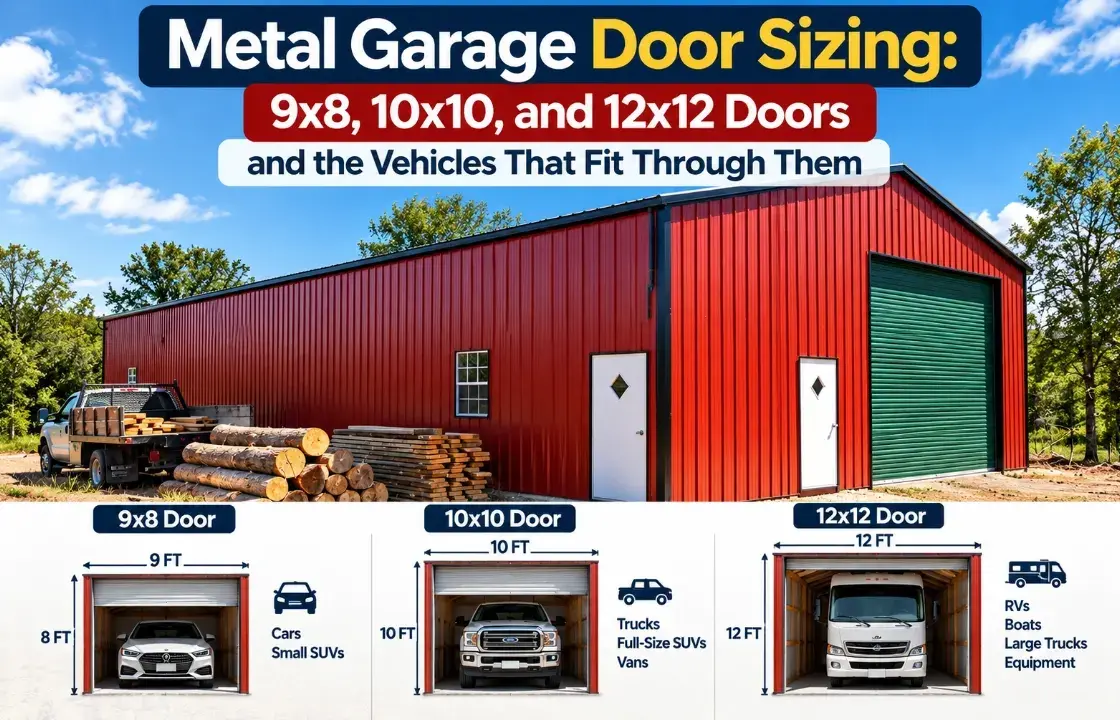
Most base-priced garages include one or two garage doors and a walk-in door. Additional doors, wider openings, insulated doors, and windows all add to the total. A standard 9×8 garage door runs $400–$800; insulated models cost more.
The garage structure price rarely includes the concrete slab. A 24×24 concrete slab runs $3,000–$6,500 depending on your region, slab thickness, and site prep needed. This is often the biggest “surprise” cost for first-time buyers — budget for it upfront.
Permit fees vary widely — from under $100 in some rural counties to $500–$1,500+ in regulated municipalities. Your builder can advise on local requirements, but always check with your county before ordering. Non-permitted structures can create issues if you sell your property.
This is one of the most common questions buyers ask. The table below compares metal and wood-frame garages across every factor that matters to your budget and long-term satisfaction.
| Factor | Metal (Prefab Steel) | Wood (Stick-Built) |
| Starting Cost (24×24) | $10,000 – $16,000 | $28,000 – $45,000 |
| Installation Time | 1–2 days (prefab) | 2–6 weeks |
| Maintenance Cost | Very low (occasional inspection) | Moderate (painting, rot, pest control) |
| Lifespan | 30–50+ years | 20–40 years (with upkeep) |
| Fire Resistance | High (non-combustible steel) | Low (combustible wood) |
| Pest Resistance | Excellent (termite-proof) | Vulnerable without treatment |
| Customization | High (size, color, roof, doors) | Very High (any design possible) |
| Weather Resistance | Excellent (certified options) | Good |
| Resale Value Add | $15,000 – $25,000 typical | $20,000 – $35,000 typical |
| Permitting Complexity | Lower (prefab = pre-engineered) | Higher (site-built = more inspections) |
Metal garages win on cost, speed, durability, and maintenance. Wood-frame garages may hold a slight edge in raw design flexibility and peak resale value — but for the majority of U.S. buyers focused on practical value, prefab steel is the smarter investment.
Roof style is one of the most misunderstood pricing factors. Here’s exactly what each style costs and what you get for the money.
Vertical roof panels run top-to-bottom rather than side-to-side, allowing snow and rain to shed quickly off the building. In states like Minnesota, Michigan, Colorado, and New York, a vertical roof isn’t optional — it’s essential. Even in milder regions, the extra investment in vertical pays back in reduced maintenance and longer panel life.
For a deeper breakdown, see our complete garage roof styles guide — including exactly how each roof type handles snow load and rain drainage.
This is where a lot of buyers get surprised. The price you see quoted for a metal garage almost always refers to the building structure — it doesn’t include what goes under it.
A concrete slab is the recommended foundation for any metal garage. For a 24×24 footprint, expect to pay $3,000–$6,500 depending on your region, slab thickness (typically 4–6 inches), and ground conditions. If the site has poor drainage or slopes, site grading adds cost.
Clearing, leveling, and grading your site before pour and installation can run $500–$3,000 depending on how much work is needed. Flat, clear lots cost the least; wooded or sloped sites cost more.
Metal garages must be properly anchored to their foundation. Most prefab installers include anchoring hardware in the building price. In high-wind states, additional anchoring systems may be required by code.
One of the biggest advantages of prefab metal garages is that delivery and installation is typically included in the purchase price — a significant savings compared to hiring a general contractor to frame a wood building. Installation of a 2-car metal garage usually takes 1–2 days with a professional crew.
Short answer: yes — and significantly more so than most alternatives.
When you calculate total cost of ownership — purchase, foundation, maintenance, and longevity — a quality prefab metal garage typically outperforms wood-frame construction in pure financial terms over a 20–30 year horizon.
There are dozens of prefab metal garage dealers in the U.S. Here’s what sets Viking Metal Garages apart:
🏗️ Certified Buildings – Our buildings meet state and local wind and snow load requirements. Certified engineering means your structure is built to code and built to last.
⚡ Fast Installation – Professional installation crews complete most 2-car garages in 1–2 days. No waiting months for a contractor — we deliver and build on schedule.
🇺🇸 Nationwide Service – We serve customers across the U.S. — from the snow-heavy northern states to the rain-prone Gulf Coast. Our team understands regional weather requirements.
💳 Flexible Financing – Rent-to-own options available with no credit check required. Traditional financing also available. Get the garage you need today without waiting to save up the full amount.
🔧 Full Customization – Choose your size, roof style, steel gauge, color, doors, windows, and add-ons. Use our 3D builder to design your garage and see pricing in real time.
🛡️ Strong Warranties – Our buildings come backed by a 20-year rust-through warranty, 10-year panel warranty, and 1-year workmanship warranty — because we stand behind what we build.
The 2 car garage cost question has a real answer — it just depends on what you build. For most U.S. buyers, a prefab metal garage delivers the best combination of upfront affordability, long-term durability, and lowest total cost of ownership.
Here’s the quick summary:
Viking Metal Garages makes this process straightforward. Our team handles the details — engineering, delivery, installation — so you can focus on what matters: getting a quality structure built right, on time, and within budget.
Expand each item below to explore a few helpful answers before moving to the next blog post.
A prefab metal 2 car garage typically costs $7,000–$20,000 for the structure, depending on size and roof style. Add $3,000–$6,500 for a concrete slab and $100–$800 for permits. Total realistic budget: $12,000–$28,000 for most configurations. Wood-frame garages run significantly more — often $30,000–$60,000 fully built.
A prefab metal garage with a regular roof in a standard size (20×20 or 24×24) is the most affordable option, typically starting around $7,000–$9,000 delivered and installed. Rent-to-own programs let you get started with little or no money down.
Yes — significantly. A comparable 24×24 metal garage runs $10,000–$16,000. A stick-built wood garage of the same size typically costs $28,000–$45,000 once labor, materials, and contractor fees are included. Metal is also faster to build and cheaper to maintain long-term.
A 24×24 is the most popular and practical size for two vehicles — it fits two cars comfortably with room to open doors. If you drive full-size trucks or SUVs, a 24×30 gives you extra depth without a major price jump. Avoid the 20×20 if you value any workspace at all.
A quality prefab steel garage with proper foundation and anchoring can last 30–50 years or more. Steel is resistant to rot, termites, and fire — the main culprits that shorten wood-frame garage lifespans. Periodic recoating or touch-up of scratches extends panel life further.
Yes. A detached 2-car garage typically adds $15,000–$30,000 in property value depending on your market, region, and garage quality. Even on the conservative end, most buyers recoup 60–80% of the cost at sale — and benefit from the use of the structure in the meantime.
In most U.S. counties, yes — a permit is required for any permanent structure. Requirements vary widely by location. Your metal garage dealer should be able to provide stamped engineering drawings to support your permit application. Always check with your local building department before installation.
For most U.S. buyers — especially in snow-prone or rain-heavy states — yes. The vertical roof's superior drainage and structural reinforcement reduce long-term maintenance costs and extend building lifespan. The additional $1,000–$3,000 upfront typically pays for itself within the first 5–10 years in avoided repairs.
Fall Into Savings! Up To 30% Off |View Offer >>
Fall Into Savings! Up To 30% Off |View Offer >>
Fall Into Savings! Up To 30% Off |View Offer >>
Fall Into Savings! Up To 30% Off |View Offer >>
Fall Into Savings! Up To 30% Off |View Offer >>
Fall Into Savings! Up To 30% Off |View Offer >>
Fall Into Savings! Up To 30% Off |View Offer >>
Fall Into Savings! Up To 30% Off |View Offer >>
Fall Into Savings! Up To 30% Off |View Offer >>
Fall Into Savings! Up To 30% Off |View Offer >>
Fall Into Savings! Up To 30% Off |View Offer >>
Fall Into Savings! Up To 30% Off |View Offer >>
Fall Into Savings! Up To 30% Off |View Offer >>
Fall Into Savings! Up To 30% Off |View Offer >>