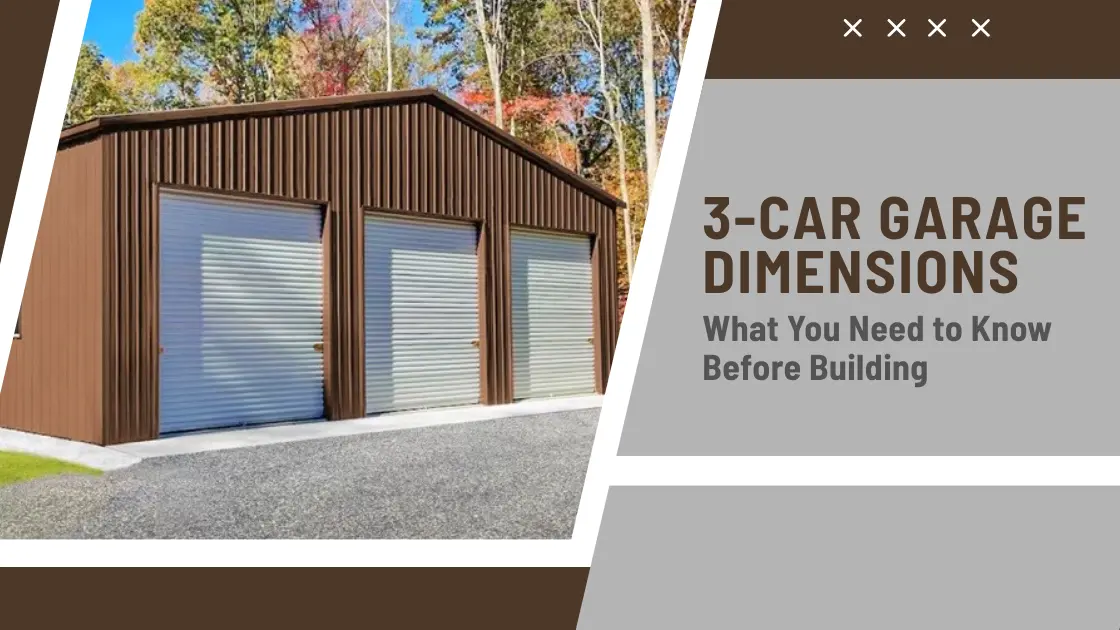
If you have three vehicles — or two vehicles and a serious lack of storage space — you’ve probably started wondering whether a 3-car garage is the right move. It almost always is. But the question most people get wrong isn’t whether to build one. It’s what size to build.
Pick too small and you’re squeezing doors open, parking sideways, and wishing you’d gone bigger from day one. Pick smart, and you’ve got a garage that handles your vehicles, your tools, your lawn equipment, and still has room to breathe.
Many U.S. homeowners are now choosing 3-car steel garages because steel buildings offer the best balance of strength, customization, and long-term value. But before you commit to a plan, let’s cover everything — from standard 3 car garage dimensions and stall widths to door heights, roof styles, layout options, and what the permit process actually looks like.
What Is a 3-Car Metal Garage?
A 3-car garage is a structure designed to comfortably park three vehicles — side by side, in a tandem layout, or in some combination of parking and dedicated storage space.
American homeowners build them for a lot of different reasons. Some need covered parking for three daily drivers. Others want two parking bays and one dedicated workshop. Contractors and collectors often need serious square footage for work trucks, equipment, or seasonal storage. A steel 3-car garage handles all of it — and unlike wood-framed structures, it won’t rot, warp, or need re-roofing in ten years.
Whether you’re a growing family, a car enthusiast, or someone who just needs their garage to do more, the right 3-car layout will serve you for decades.
Standard 3-Car Garage Dimensions
So how big is a 3-car garage, really?
The short answer: standard 3 car garage dimensions run from 30 feet wide by 24 feet deep at the low end, up to 40 feet wide by 30 feet deep for a comfortable, functional layout. The most popular choice among U.S. homeowners sits right at 36 feet wide by 24–28 feet deep.
Here’s what the full range looks like:
- Width: 24 to 40+ ft
- Length (Depth): 20 to 50 ft
- Eave Height: 9 to 14 ft
These aren’t arbitrary numbers. Width is determined by how many vehicles you’re parking and how wide each stall needs to be. Depth is determined by the length of your vehicles plus walking and storage space. Height is determined by what you’re parking and what you plan to do inside.
Quick-Reference: 3-Car Garage Size by Use Case
|
Garage Size |
Sq. Footage |
Best For |
|
24 x 30 ft |
720 sq ft |
Minimum fit — three compact cars, very tight clearance |
|
30 x 24 ft |
720 sq ft |
Basic 3-car layout, limited walkway space |
|
30 x 30 ft |
900 sq ft |
Comfortable for sedans, small storage area |
|
36 x 24 ft |
864 sq ft |
Recommended minimum for SUVs and crossovers |
|
36 x 28 ft |
1,008 sq ft |
Comfortable for larger vehicles + small workshop |
|
40 x 30 ft |
1,200 sq ft |
Full-size trucks, workbench, and storage |
|
40 x 40 ft |
1,600 sq ft |
Oversized — trucks, boats, full workshop |
3-Stall Garage Dimensions: What Each Bay Actually Needs
When planning a three-car layout, think in stalls — one parking bay per vehicle.
A stall is the individual space allocated to each vehicle. The total width of your garage is essentially three stalls side by side, plus any shared wall framing. Getting stall width right is the difference between a garage you use comfortably every day and one where everyone dreads opening their doors.
Here are standard 3 stall garage dimensions broken down by vehicle type:
|
Vehicle Type |
Min. Stall Width |
Recommended Width |
Stall Depth |
|
Compact Cars (Civic, Corolla) |
9 ft |
10 ft |
20 ft |
|
Mid-Size Sedans (Camry, Accord) |
10 ft |
11 ft |
21 ft |
|
SUVs (Explorer, Highlander, Pilot) |
11 ft |
12 ft |
22 ft |
|
Full-Size Trucks (F-150, Silverado 1500) |
12 ft |
13 ft |
24 ft |
|
HD Trucks (F-250/350, Ram 2500/3500) |
13 ft |
14 ft |
26 ft |
|
Lifted/Oversized Trucks |
14 ft |
16 ft |
28 ft |
To get your total garage width: multiply your stall width by 3. If you’re finishing the interior with insulation or wall panels, add 2–3 feet for framing.
Minimum total width for 3 stalls:
- 3 compact cars → 30 ft minimum (10 ft per stall)
- 3 mid-size vehicles → 36 ft recommended (12 ft per stall)
- 3 trucks or SUVs → 40–42 ft recommended (13–14 ft per stall)
Unlike wood-framed construction, steel garages can be ordered in any width increment — so you’re not limited to standard lumber spans. If 38 feet is the right number for your layout, that’s exactly what you can order.
What’s the Best 3-Car Garage Size for Your Vehicles?
The “best” size depends entirely on what you’re parking. Here’s how to think about it by vehicle class:
Three Sedans or Compact Cars
A 30×24 layout works, but it’s tight. You’ll have roughly 10 feet per stall — enough to squeeze in and out, but not enough to open a door wide without worrying. For daily use, go 36 feet wide. You’ll thank yourself within the first week.
Mix of Sedans and One SUV
Move to 36×26 minimum. SUVs like a Honda Pilot or Ford Explorer run 79–80 inches wide. At 12-foot stalls, you have comfortable door clearance on both sides without the constant anxiety of door dings.
Two SUVs and a Full-Size Truck
This is where most buyers underestimate. An F-150 SuperCrew is over 79 inches wide and nearly 20 feet long. For three large vehicles parked comfortably, 40×30 is the sweet spot. You’ll have room to walk around all three vehicles and still fit a workbench along one wall.
Long-Bed or Crew-Cab Trucks
A standard 20–24 foot garage depth barely clears a long-bed F-250. Go 26–30 feet deep so the rear bumper clears the closed door — and leaves you space to actually work behind the truck.
Other Common Three-Car Garage Sizes
Here are the most popular three car garage dimensions homeowners across the U.S. choose. These give you a practical reference for different lifestyle needs:
- 30 x 24 ft — A balanced layout for three everyday vehicles with minimal storage.
- 36 x 26 ft — A bit of extra space for wall shelves or a small workspace.
- 38 x 26 ft — Great for SUVs and family vehicles, solid walking room.
- 40 x 30 ft — Spacious for large vehicles, a full workbench, and storage.
- 30 x 70 ft — Ideal for combining parking, workshop, and seasonal storage under one roof.
A family with three daily drivers might be fine with 30×24. A contractor parking a work truck, a personal truck, and an SUV needs 40×30 at minimum. There’s no one-size answer — which is exactly why steel buildings are custom-ordered rather than mass-produced.
Some homeowners extend their layout by adding a lean-to garage addition to one side. It’s an affordable way to gain covered storage for lawn equipment, bikes, or firewood without increasing the main footprint. For properties with narrow frontage, a side entry garage is worth considering — the doors open from the side rather than the front, giving you more flexibility on tight lots.
How to Choose the Right 3-Car Garage Size
Getting the dimensions right starts with a few honest planning questions. Work through these before you finalize anything:
Measure Your Vehicles Measure every vehicle going in — length, width, and height. If you’re planning to add a vehicle in the next few years, account for it now. Trucks and SUVs need wider stalls and taller doors. Build for what you’re driving, not just what fits on paper.
Allow for Comfort Margins Even if three vehicles technically fit in a tighter layout, add clearance for real life. You need room to open all four doors, carry grocery bags, and not clip your mirror on the way in. Add at least 2 feet per side beyond the width of your widest vehicle.
Plan Your Storage Needs Think about what else is going in: bikes, lawn mowers, tool chests, seasonal bins, sports equipment. Every item that goes in the garage needs a home. Add 5–10 feet of extra depth or an entire storage bay if you’re serious about keeping things organized.
Check Local Building Codes Most counties require a permit for an enclosed garage. Setback requirements (how close you can build to a property line) typically run 5–10 feet, sometimes more in HOA communities. Confirm before ordering anything. At Viking, we provide engineer-certified structural drawings with most builds, which simplifies permit applications in almost every state.
Set a Realistic Budget Larger garages cost more, but the price-per-square-foot drops as you go up in size. Spending a little more to go from 36 to 40 feet wide is almost always worth it — because the alternative is wishing you had for the next 20 years.
Pick the Right Layout Front entry, side entry, and tandem parking all have their place depending on your lot, your neighborhood, and how you use the space. Side entry looks cleaner from the street and works well on wider lots. Tandem suits narrower properties where frontage is limited.
Think Long-Term If you ever plan to install a lift, run a compressor, or use the space as a workshop, build for that now. Taller walls cost incrementally more but completely change what’s possible inside.
Standard 3-Car Garage Door Sizes
The right door setup depends on your vehicles and how you park:
- Three individual doors (9 or 10 ft wide each): Most flexible, best for mixed vehicle types
- One double door (18 ft) + one single (9–10 ft): Good middle ground on narrower layouts
- One large single door spanning all three bays (24–28 ft): Clean look, works well for custom builds
Door heights:
- 7 ft: Standard clearance for most cars and crossovers
- 8 ft: Recommended for trucks, vans, or any vehicle over 7 ft tall
- 10 ft: Required for oversized trucks, lifted vehicles, or those with roof racks
For trucks and vans, always go 10-foot-wide doors. It feels excessive until the first time you pull in and realize you don’t have to fold your mirrors.
Attached vs. Detached 3-Car Garage
Both options work well — the right choice depends on your property and how you’ll use the space.
Attached garages share a wall with the house. They’re convenient for moving between vehicles and living space without going outside, and they’re typically faster to permit because they’re part of the main structure. The trade-off: you’re limited by where your house sits and how the existing structure handles the addition.
Detached garages give you full flexibility on placement, size, and use. You’re not constrained by the home’s footprint, and you can size a detached steel building exactly as needed without compromise. They’re also better for workshop use — noise, fumes, and chemicals stay separated from the living space. If you’re building a steel 3-car garage from scratch, detached is usually the more practical route and gives you the most customization latitude.
Garage Dimensions for Trucks and SUVs: What You Actually Need
Trucks and SUVs are now the most common vehicles on American driveways. Standard garage dimensions were designed for 1990s sedans — and they show. Here’s what the real numbers look like:
|
Vehicle |
Width |
Length |
Min. Stall Needed |
|
Honda CR-V |
73.3 in (6.1 ft) |
182.1 in (15.2 ft) |
10 ft wide x 20 ft deep |
|
Ford Explorer |
78.9 in (6.6 ft) |
198.8 in (16.6 ft) |
11 ft wide x 22 ft deep |
|
Chevy Tahoe |
81.0 in (6.75 ft) |
210.0 in (17.5 ft) |
12 ft wide x 22 ft deep |
|
Ford F-150 SuperCrew |
79.9 in (6.7 ft) |
231.9 in (19.3 ft) |
13 ft wide x 24 ft deep |
|
Ram 2500 Crew Cab LB |
82.4 in (6.9 ft) |
267.0 in (22.3 ft) |
14 ft wide x 26 ft deep |
Bottom line for truck owners: If you’re parking one or more full-size trucks, plan for at least 40 feet of total width and 26 feet of depth. Go 28–30 feet deep if the truck has an extended cab and a long bed — you’ll need it.
Extra Storage and Workshop Planning
Most homeowners underestimate how much non-vehicle space they’ll want. Here’s what to build in from the start:
Storage Wall A 4-foot deep storage zone along the back wall (or one side wall) gives you room for cabinets, shelving, and floor bins without eating into parking space. Add this to your depth calculation upfront.
Workbench Area A dedicated workbench runs best against a wall with good lighting overhead. You need at least 8–10 feet of wall length and 4 feet of depth to work comfortably. If you’re serious about automotive work, plan for 12 feet minimum.
Lawn Equipment Bay Mowers, trimmers, blowers, and wheelbarrows take up more room than people expect. One dedicated corner or bay — roughly 10×10 ft — keeps everything accessible without it sprawling into parking space.
Overhead Storage Ceiling height matters here too. At 12+ foot eave height, you can install overhead loft storage or ceiling-mounted racks that completely clear the floor. This is one of the best arguments for building taller than the minimum.
Roof Style and Height: Two Decisions That Matter More Than Most Buyers Realize
These are the two most commonly underestimated choices in any garage build.
Height
- 9–10 ft eave height: Fine for standard cars and most crossovers, with 7–8 ft door clearance
- 12 ft eave height: Recommended for full-size trucks, vans, or anyone planning overhead storage
- 14 ft eave height: Required for lifted trucks, taller cargo vans, or vehicle lifts
- 16 ft eave height: Best for two-post or four-post vehicle lifts — gives full clearance with a vehicle elevated
Pick your height based on the tallest thing that’s going inside — not the average. If one vehicle in the mix is 10 feet tall, every bay needs to accommodate it.
Roof Style
Three options are available for steel 3-car garages:
|
Roof Style |
How Panels Run |
Weather Performance |
Cost |
|
Regular (Horizontal) |
Side to side |
Fair — water can pool at seams |
Lowest |
|
A-Frame/Boxed Eave |
Angled, side to side |
Good — pitched angle sheds rain |
Mild |
|
Vertical Roof |
Top to bottom |
Best — water and snow shed off the sides |
Slightly higher |
For a 3-car garage, vertical roof is the right call. The panels run vertically, which means water and snow run straight off rather than sitting at horizontal seam lines. In high-snowfall states like Minnesota, Michigan, Ohio, and Pennsylvania, vertical roof isn’t optional — it’s the only responsible choice. In high-wind coastal zones like the Gulf Coast, Florida, and the Carolinas, make sure your building is certified to the local wind speed requirements. Viking structures are engineered to meet those load ratings by default in affected states.
Customization Options for Your 3-Car Steel Garage
One of the biggest advantages of a metal 3-car garage is how completely customizable it is. These aren’t cookie-cutter structures — every dimension, option, and feature is ordered to your spec.
Doors Choose from roll-up doors, walk-in doors, sliding doors, or any combination. Place them on any wall face. Mix widths per bay based on your vehicles.
Windows Add windows anywhere — walls, end panels, doors. Natural light makes the space more usable and reduces the need for overhead lighting during daytime work.
Insulation If you’re working in the garage in summer or winter, insulation is worth every dollar. Options range from basic single-layer to double-bubble reflective to full batt insulation with vapor barrier. It also reduces condensation on metal walls — which extends the life of everything stored inside.
Lean-Tos Add a lean-to on either side for covered outdoor storage. Great for firewood, garden equipment, or a covered work area that doesn’t need to be fully enclosed.
Color Options Steel panels come in a wide range of colors for both walls and trim. Matching your home’s exterior color scheme is straightforward, and most Viking buildings are available in 15+ standard colors with no upcharge.
Electrical Rough-In Have your electrician rough in before the concrete cures. Plan for outlets, lighting circuits, and a subpanel if you’re running power tools or a compressor. Doing it now versus adding it later saves significant cost.
Why a Metal 3-Car Garage Is a Smart Long-Term Investment
Steel buildings have a significant structural and financial edge over wood-framed garages — especially over a 20–30 year horizon.
Durability that outlasts wood Steel doesn’t rot, warp, crack, or attract termites. A properly installed metal garage maintains its structural integrity for decades with minimal maintenance. The panels resist impact, and the galvanized coating prevents rust under normal conditions.
Lower lifetime maintenance costs Wood garages need re-painting, re-staining, roofing repairs, and periodic structural inspections. Steel needs essentially none of that. A light rinse with a garden hose once a year keeps it looking sharp.
Faster build time Pre-engineered steel buildings are manufactured offsite to exact dimensions and assembled on your property in a fraction of the time of a wood build. Most 3-car steel garages are delivered and installed in one to two days.
Property value A permanent, permitted 3-car garage adds measurable resale value. Buyers treat it as usable square footage — and in most markets, a quality detached garage returns a solid percentage of its cost at resale.
Custom from the start Unlike a pre-built wood structure, a steel garage is designed around your vehicles and your needs. If the lot is narrow, you go taller. If you need tandem parking, it’s engineered that way. There’s no compromising to fit a standard plan.
What Is the Cost of a 3-Car Steel Garage?
The cost of a three-car steel garage depends on size, roof style, and customization. A basic 3-car steel garage with a vertical roof starts at $6,495 — that includes delivery and professional installation.
Larger builds and custom options will push that number higher. Factors that affect your final price:
- Dimensions: Larger structures use more material
- Steel gauge: Thicker gauge costs more but holds up better
- Roof type: Vertical roof adds a small premium over boxed eave
- Foundation: Concrete slab costs more than a gravel pad but is required in most counties for a permitted enclosed garage
- Doors and windows: More openings, larger openings, and automatic openers add cost
- Customization: Insulation, color upgrades, lean-tos, and interior partitions
- Location and site prep: Installation costs vary by state, terrain, and access
Prefab steel buildings help control costs because every component is pre-measured and pre-cut. There’s no waste, no on-site framing errors, and no change orders from the framing crew. For a side-by-side price breakdown by garage size, see our 3-car steel garage pricing page.
Permits and Building Codes: Know This Before You Order
This section gets skipped in almost every garage planning guide. Don’t skip it.
Setback requirements Most U.S. counties require an enclosed garage to sit at least 5–10 feet from property lines. Some HOA neighborhoods push that to 20+ feet. Check before you commit to a placement.
HOA restrictions Height limits, door style, roof color, and number of visible garage doors can all be restricted by HOA bylaws. Get written approval before ordering — not after.
Foundation requirements Most counties require a concrete slab for a permitted enclosed garage. Some jurisdictions allow gravel for non-enclosed structures. Your Viking representative can confirm what your specific county requires.
Engineer-certified drawings Most building permits require stamped structural drawings. Viking provides engineer-certified drawings with most orders — at no additional charge. This simplifies the permit application process significantly.
Snow and wind load certifications If your county falls in a high-snow or high-wind zone, your permit may require certified load ratings. Viking structures are engineered to meet local wind and snow load requirements by default in affected states. Just tell us your zip code and we’ll spec it correctly.
Ready to Build? Here’s Where to Start
Getting your 3 car garage dimensions right comes down to three things: your vehicles determine stall width, your usage determines depth, and your climate and local codes determine roof style and height. Get those three decisions right and everything else falls into place.
Three car garage dimensions aren’t one-size-fits-all. A household with an F-250, a Suburban, and a Ram 1500 needs something fundamentally different than a family with three compact sedans. That’s why steel is the right material — it’s custom-built to your exact numbers, not squeezed into a standard plan.
Viking Metal Garages builds fully custom three-car steel garages across all 48 contiguous states — delivered and professionally installed, with engineer-certified drawings included on most orders. From the first phone call to installation day, we handle the complexity so you don’t have to.
Call us at (704)-741-1587 to talk dimensions with a specialist, or request a free quote online and we’ll get you a custom price within one business day.
Frequently Asked Questions
Expand each item below to explore a few helpful answers before moving to the next blog post.
The standard 3-car garage size is 36 feet wide by 24 feet deep (864 sq ft). This comfortably fits three mid-size vehicles with room to move around. For trucks or SUVs, 36x28 or 40x30 is more practical.
At minimum, 30 feet total (10 feet per stall). For comfortable daily use without door ding anxiety, 36 feet (12 feet per stall) is the practical standard. Truck owners should go 40 feet or wider.
Yes — but standard 9-foot stalls are too narrow. An F-150 SuperCrew is about 6.7 feet wide and nearly 20 feet long. Plan for 12–13 foot wide stalls and 24–26 feet of depth. Long-bed heavy-duty trucks need 14-foot stalls and 26–28 feet of depth.
For most vehicles, 24 feet is the functional minimum — long enough to close the door behind most cars and SUVs. For trucks, go 26–30 feet. If you want a storage zone at the back wall, add 4–6 more feet of depth.
Three 9-foot wide doors work for sedans and crossovers. For trucks and SUVs, 10-foot wide doors give much easier entry. Door height should be 7 feet for standard vehicles, 8 feet for trucks and vans, and 10 feet for lifted trucks or vehicles with rooftop equipment.
The true minimum is around 24x30 feet (720 sq ft) — technically fits three compact cars but leaves almost no working space. The practical minimum for real-world use is 30x24 or 36x24, and most people want more once they see it on the ground.
For standard cars and crossovers: 9-foot eave height with 7-foot door clearance. For trucks and vans: 12-foot eave with 8-foot door. For vehicle lifts: 14–16 foot eave height minimum.
In most U.S. counties, yes — an enclosed garage requires a building permit, site plan, and structural drawings. Viking provides engineer-certified drawings with most orders, which covers the structural portion of most permit applications.