

2 car garage
November 26, 2026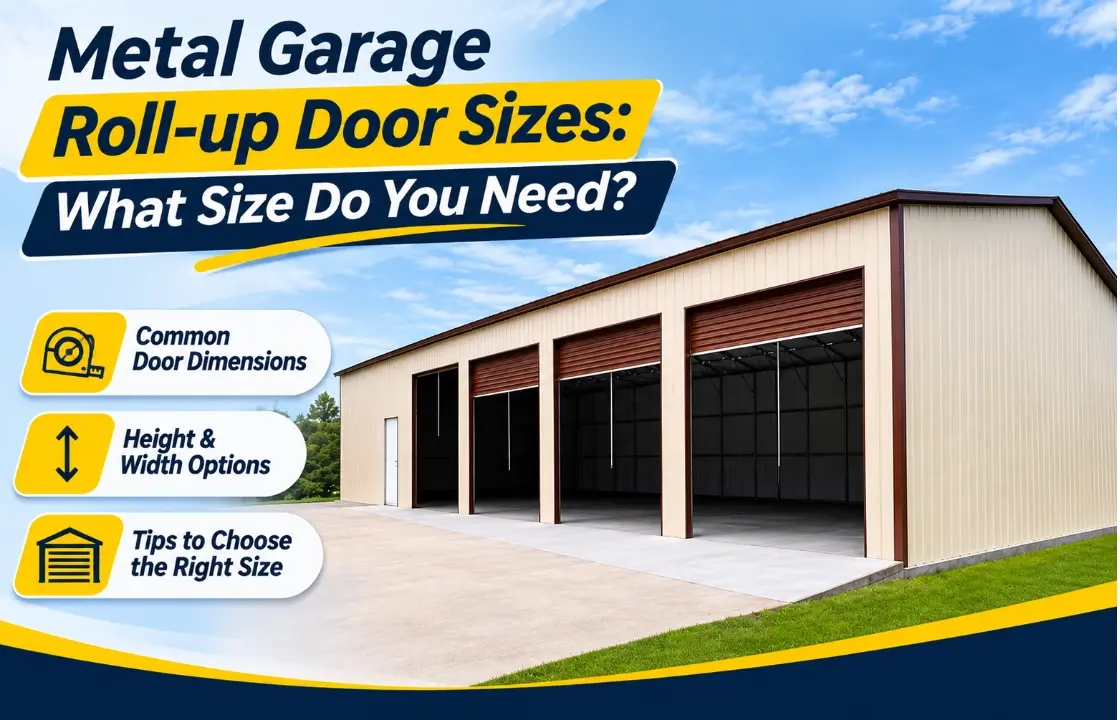
Choosing the right metal garage roll-up door size depends on your vehicle and garage layout. Common options include 8×7 and 9×7 for single-car garages, 9×8 for taller vehicles, 10×10 for larger vehicles and equipment, and 12×12 for commercial or agricultural use. You also need enough headroom and side clearance for the door mechanism.
Explore these five sizes, compare their uses, and learn how to measure your opening to make the right decision today.
The following sizes can help you understand which opening may suit your garage. Actual availability depends on the selected manufacturer’s product range and the building’s structural design.
An 8×7 roll-up door is a compact option for a single-car garage, small workshop, or storage building. It provides an opening that is 8 feet wide and 7 feet high. This size may work for compact cars and some smaller sedans. However, the available width can feel restrictive when entering at an angle or parking a vehicle with wider mirrors.
Consider this size when:
Measure your vehicle’s width, including mirrors, before selecting this opening. For example, the 18×21×10 vertical roof garage features two 8×8 roll-up doors, offering separate access points for parking vehicles or storing equipment. It is a useful example of how two roll-up doors can be incorporated into a compact metal garage.
A 9×7 door provides an additional foot of width compared with an 8×7 opening. That extra space can make entering and exiting more comfortable for many passenger vehicles. It is a common option to consider for a single-car metal garage. It may also suit a workshop where you regularly move smaller equipment in and out.
If you plan to park a larger SUV or pickup truck, check the vehicle’s height and width carefully. A wider opening does not automatically provide enough vertical clearance.
A 9×8 roll-up door offers the same width as a 9×7 door but provides an additional foot of height. This can be useful when a vehicle needs more vertical clearance. It may suit some larger SUVs, pickup trucks, and garages used for general equipment storage. The extra height can also provide more flexibility if you change vehicles in the future.
Before choosing this size, check the vehicle’s highest point, including roof accessories, racks, or other attachments. You should also confirm that the building’s eave height and overhead clearance can accommodate the door assembly.
A 10×10 roll-up door offers a wider and taller opening than the previous options. It can be suitable for larger pickup trucks, taller vehicles, equipment storage, and certain commercial applications.
This size is worth considering if your garage will serve more than one purpose. For example, you may use it to store a vehicle and move lawn equipment, workshop tools, or machinery through the same opening.
Keep in mind that a 10×10 opening requires enough structural space around the door. The building frame, header, and roof height must support the selected door system.
A 12×12 roll-up door provides a larger opening for commercial garages, workshops, agricultural buildings, and equipment storage facilities. It may be useful when you need to move wider or taller equipment through the garage entrance. However, not every roll-up door model supports this dimension. You may need a heavier-duty door system designed for larger openings.
Also consider how frequently the door will operate. A large door used throughout the day may require a different operating system and hardware from a smaller door used occasionally.
Use this quick door sizes chart to compare the five options and their typical applications.
| Door size (W × H) | Potential application |
| 8×7 ft. | Compact cars and small storage buildings |
| 9×7 ft. | Single-car garages and workshops |
| 9×8 ft. | Taller vehicles and general garage use |
| 10×10 ft. | Larger vehicles and equipment access |
| 12×12 ft. | Commercial and agricultural applications |
These are reference dimensions, not a guarantee that every door model is available in each size. Check the manufacturer’s specifications before ordering.
Knowing how to measure for a roll-up garage door is just as important as selecting the door size. An incorrect measurement can affect installation and operation.
Follow these steps before finalizing your order.
Measure the horizontal distance between the two sides of the rough opening. Take measurements at the top, middle, and bottom. Record the smallest measurement if the opening is not perfectly square. Also check whether the side jambs are straight and suitable for mounting the door guides.
Measure vertically from the finished floor to the underside of the header. Take measurements on both sides and near the center. Check whether the floor is level. An uneven floor can leave gaps beneath the door or affect its fit.
Inspect the header and side framing to confirm they can support the selected door system. Roll-up doors are often mounted behind the opening, so the complete door assembly may be wider than the rough opening.
Ideal Door’s installation guide explains that the rough opening dimensions are used to determine the door size, while additional space is needed for brackets and installation clearances.
Write down the opening width and height, along with the available space above, beside, and behind the opening. Share these measurements with the door supplier or installer to confirm the correct model.
Door clearance is an important part of metal garage roll-up door sizes. Even if the opening is correct, the door may not operate properly if the surrounding space is too limited.
Here are the main clearance areas to check:
Clearance requirements vary by door model. For example, Ideal Door’s 200M model requires approximately 15½–18 inches of headroom, depending on door height, while its 400M model requires approximately 20–22 inches. The listed side room is 4 inches for the 200M and 7 inches for the 400M.
Do not use these figures as universal measurements. Check the technical drawings for your exact door, including any additional space needed for insulation, a hood, or an operator.
The best size depends on more than the vehicle you currently own. Consider how you plan to use the garage over the next several years.
Measure the widest and tallest points of your vehicle. Include side mirrors, roof racks, antennas, and other attachments. If you store a trailer, mower, tractor, or workshop equipment, measure those items too.
Your door opening must work with the garage’s width, eave height, roof structure, and framing. A taller door may require a taller building wall and a different header arrangement. Also explore the metal garage sizes guide, so you have a complete idea about the overall sizes of your garage.
Consider whether the door will face the driveway, side yard, or an internal work area. Make sure there is enough approach space for vehicles to enter without sharp turns.
If you may add a larger vehicle, equipment, or workshop space later, consider whether a wider or taller opening would be useful. Analyze your current and future needs before customizing door placement and opening dimensions. Check some design tips for a two-car metal garage for better decisions.
Choosing the right metal garage roll-up door sizes starts with accurate opening measurements and a clear understanding of your daily requirements. An 8×7 or 9×7 door may suit a compact single-car garage, while 9×8, 10×10, and 12×12 options can support taller vehicles and larger applications.
Remember to check headroom, side room, backroom, and structural support before selecting a door. Most importantly, confirm the final dimensions and clearance requirements with the manufacturer or a qualified installer. A properly planned opening helps your roll-up door operate smoothly and makes your metal garage more practical for everyday use.
Expand each item below to explore a few helpful answers before moving to the next blog post.
Yes. Some roll-up door models are available with insulated curtains or insulation options. The exact construction varies by manufacturer. Check the product specifications if temperature control or noise reduction is important for your garage.
In many cases, yes, but the existing frame must be suitable for the door's weight, mounting hardware, and operating requirements. A professional should inspect the opening and supporting structure before installation.
Yes, a metal garage can be designed with multiple door openings. Their placement depends on the building's width, framing, intended use, and the space needed between openings.
Yes. Inspect the guides, brackets, fasteners, curtain, and operating components periodically. Follow the manufacturer's maintenance instructions and arrange professional service if the door becomes difficult to operate.
The choice depends on door size, frequency of use, and convenience. Manual operation may suit smaller doors with occasional use, while motorized systems can be useful for larger doors or frequent access. Confirm that the selected door model supports the operator you want.
BLACK FRIDAY & CYBER MONDAY SALE! UP TO 30% OFF |View Offer >>
BLACK FRIDAY & CYBER MONDAY SALE! UP TO 30% OFF |View Offer >>
BLACK FRIDAY & CYBER MONDAY SALE! UP TO 30% OFF |View Offer >>
BLACK FRIDAY & CYBER MONDAY SALE! UP TO 30% OFF |View Offer >>
BLACK FRIDAY & CYBER MONDAY SALE! UP TO 30% OFF |View Offer >>
BLACK FRIDAY & CYBER MONDAY SALE! UP TO 30% OFF |View Offer >>
BLACK FRIDAY & CYBER MONDAY SALE! UP TO 30% OFF |View Offer >>
BLACK FRIDAY & CYBER MONDAY SALE! UP TO 30% OFF |View Offer >>
BLACK FRIDAY & CYBER MONDAY SALE! UP TO 30% OFF |View Offer >>
BLACK FRIDAY & CYBER MONDAY SALE! UP TO 30% OFF |View Offer >>
BLACK FRIDAY & CYBER MONDAY SALE! UP TO 30% OFF |View Offer >>
BLACK FRIDAY & CYBER MONDAY SALE! UP TO 30% OFF |View Offer >>
BLACK FRIDAY & CYBER MONDAY SALE! UP TO 30% OFF |View Offer >>
BLACK FRIDAY & CYBER MONDAY SALE! UP TO 30% OFF |View Offer >>