Metal Building
August 18, 2026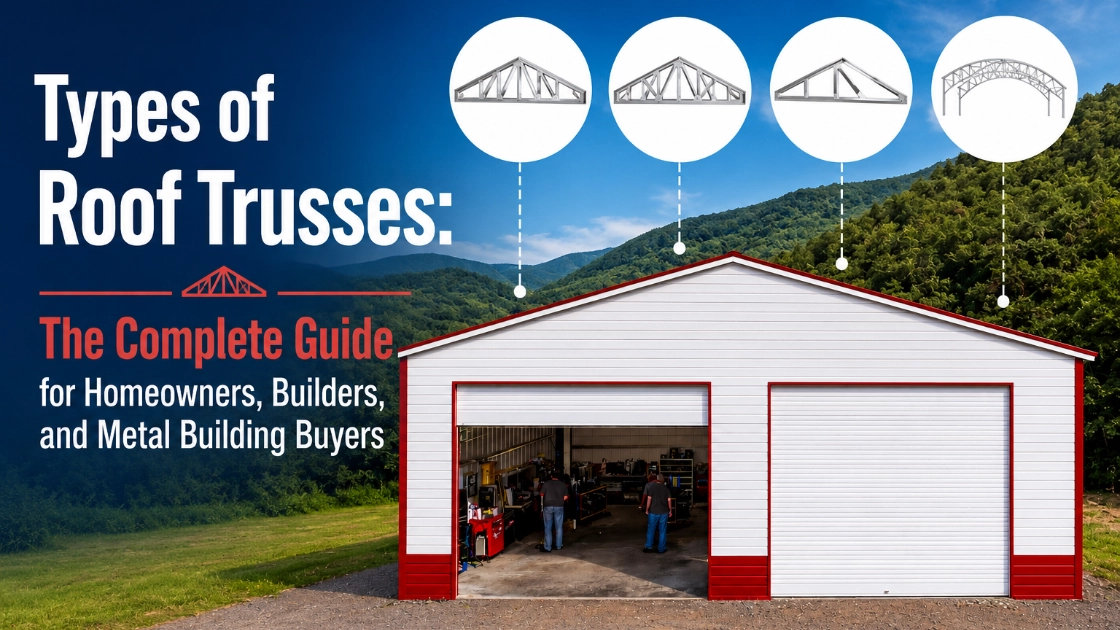
If you’ve ever stood inside a large barn, an airplane hangar, or even a big-box retail store and looked up, you’ve seen roof trusses at work. Those triangulated frames overhead aren’t just functional — they’re doing serious structural heavy lifting, transferring the full weight of the roof down to the walls and foundation without the need for interior columns or load-bearing walls below.
Understanding the different types of roof trusses isn’t just knowledge for engineers. It’s practical information for anyone planning a new garage, metal barn, commercial building, or home addition. The truss you choose affects your building’s span capability, interior usability, cost, and long-term weather performance — every one of those factors matters when you’re putting real money into a steel structure.
This guide covers the most common roof truss designs in plain English, explains exactly when each one makes sense (and when it doesn’t), and helps you figure out which type fits your project — whether you’re building a weekend workshop or a large agricultural storage building.
A roof truss is a pre-engineered structural framework made up of interconnected members that work together to support a roof. Almost every truss design is built around triangles, and there’s a good engineering reason for that: a triangle is the only geometric shape that is inherently rigid. You can’t deform it without changing the length of one of its sides.
Every truss has the same three basic components regardless of how it looks:
Top Chords — The sloped outer members that form the roofline. They carry compressive loads from the roof covering, snow, and wind pressing down.
Bottom Chord — The horizontal (or sometimes slightly angled) member running across the base of the truss. It resists the outward thrust that the top chords generate, keeping the walls from spreading apart.
Web Members — The interior vertical and diagonal pieces that connect the top and bottom chords. They transfer loads between chords and determine how efficiently the truss distributes weight across its span.
The combination of these members — and how they’re configured — is what makes each truss type distinct and suited to specific applications.
This is one of the most common questions people ask when planning a new building, and the answer matters more than most realize.
Rafters are individual sloped boards cut and assembled on-site, one at a time. They’re a traditional framing method that’s been used for centuries. Rafters work well for smaller spans, but they require skilled carpentry labor, take longer to install, and don’t perform as efficiently over long distances.
Trusses are engineered and fabricated in a controlled shop environment, then delivered to the job site ready to install. Because the load path through a truss is precisely calculated, they can span much longer distances using less material than rafters. They’re also faster to install — a crew can set a full set of trusses in a fraction of the time required to cut and install rafters.
For most metal building applications — garages, barns, commercial structures — trusses are the standard. The efficiency, consistency, and span capability of a truss-framed roof is simply better suited to pre-engineered steel construction.
There’s no single “best” truss. Each design was developed to solve a specific structural problem — a longer span, a need for usable attic space, a sloped ceiling effect, high wind resistance. Here’s a detailed breakdown of the most widely used types.
The simplest truss design that actually works.
A king post truss uses just five members: two top chords that slope up from the ends to a central peak, one horizontal bottom chord, and two diagonal web members that connect the top chords to a single central vertical post — the “king post.” That central post sits in tension, pulling down on the peak and preventing the top chords from sagging.
Best for: Short spans up to 16–26 feet. Small garages, shed roofs, covered porches, and simple barn additions.
Advantages: Very low material cost. Easy to fabricate. Clean, open appearance when exposed.
Disadvantages: Not suited for longer spans without additional members. Limited load capacity compared to more complex designs.
Metal building relevance: Smaller lean-to additions and carport extensions sometimes use king post geometry. For a full enclosed metal garage or barn, you’ll typically need something with more web members.
The king post’s longer-reaching cousin.
A queen post truss replaces the single central vertical post with two vertical posts set apart from one another, connected at the top by a horizontal compression member called the straining beam. This configuration distributes the load more evenly and allows the truss to span considerably farther than a king post.
Best for: Spans of 20–30 feet. Residential garages, workshop buildings, smaller agricultural structures.
Advantages: More span capability than a king post. Still relatively simple to fabricate. Works well for exposed-truss aesthetic applications.
Disadvantages: The horizontal straining beam at mid-height can limit interior headroom if the truss is low-pitched. Not the most material-efficient option for very long spans.
Metal building relevance: Queen post geometry shows up in smaller steel-framed structures where a clean, traditional truss profile is desired alongside functional clear-span space.
The workhorse of residential roof framing.
If you’ve ever seen trusses being delivered on a flatbed truck to a home construction site, they were almost certainly Fink trusses. The Fink — also called the W-truss because of the internal W-shaped web pattern — is by far the most commonly used roof truss in U.S. residential construction.
The W-shaped web efficiently distributes load from the top chords to the bottom chord using a minimal number of members. This makes the Fink truss an excellent balance of structural efficiency and material economy.
Best for: Spans of 20–40 feet. Residential homes, garages, light commercial buildings, storage buildings.
Advantages: Highly material-efficient. Well-tested and trusted. Easy for fabricators to produce at volume, which keeps costs competitive. Works with a wide range of roof pitches.
Disadvantages: The internal web members create a cluttered attic space — not ideal if you want to use the attic for storage or living space.
Metal building relevance: Many prefabricated steel buildings use truss configurations based on Fink geometry for their primary roof structure. The efficiency of the W-web pattern translates well to steel tubing and welded steel construction.
Vertical webs in compression, diagonals in tension.
The Howe truss reverses the web geometry of a Pratt truss — its internal configuration uses vertical members to carry compression and diagonal members to handle tension. Originally designed for bridge construction in the 1840s, the Howe truss saw widespread use in timber construction before modern engineering analysis showed the Pratt pattern to be more efficient for roof applications.
Best for: Spans of 20–30 feet. Heavier roof loads where vertical members are preferable.
Advantages: Works well with timber construction where members are stronger in compression.
Disadvantages: Not as material-efficient as the Pratt or Fink for steel or modern engineered lumber. Less common in new construction today.
Metal building relevance: Less common in modern steel-framed buildings, but still appears in some specialty applications and timber-frame hybrid structures.
Engineered for efficiency under gravity loads.
The Pratt truss is one of the most structurally efficient designs ever developed for gravity-loaded spans. Its internal web members are arranged so that the diagonals are always in tension — and steel is strongest in tension. The vertical members carry compression. This arrangement minimizes the amount of material needed to carry the load, which is why the Pratt configuration became the dominant design in bridge and industrial roof construction.
Best for: Spans of 30–60+ feet. Industrial buildings, warehouses, commercial structures, aircraft hangars.
Advantages: Extremely efficient use of material for longer spans. Very strong under gravity and roof loading. Well-suited to steel construction where tension members can be made slender.
Disadvantages: More web members than simpler designs, which adds fabrication complexity for shorter spans where the efficiency advantage isn’t as significant.
Metal building relevance: This is the truss geometry that underpins many large-span commercial and industrial steel buildings. If you’re looking at a wide-clear-span commercial steel building or large metal barn, Pratt-based framing is likely part of the structural engineering solution.
The classic barn profile — built for maximum storage overhead.
The gambrel truss creates the instantly recognizable silhouette of a traditional American barn — two different roof pitches on each side, with a steep lower slope and a shallower upper slope. This double-pitch geometry dramatically increases the usable volume in the upper portion of the building compared to a standard gable truss.
Best for: Agricultural buildings, barns, large storage structures where loft space is valuable. Spans of 24–50 feet.
Advantages: Maximizes usable loft space. Classic barn aesthetic. Efficient use of roof volume for storage.
Disadvantages: More complex to fabricate than single-pitch trusses. The knuckle joint where the two pitch angles meet requires careful engineering. Can be more expensive than a standard Fink or Pratt truss.
Metal building relevance: Steel gambrel barns are a popular choice for horse properties and farm storage precisely because of the overhead loft space they create. Viking Metal Garages offers metal horse barns and agricultural steel buildings that take advantage of this profile.
The vault-ceiling solution.
A scissor truss flips the conventional bottom chord upside down. Instead of a flat horizontal bottom chord, the bottom chord members angle upward from each end toward the center, crossing each other in a scissors shape. The result is a building interior with a sloped ceiling that follows the pitch of the roof — creating that vaulted, cathedral feel.
Best for: Residential great rooms, churches, showrooms, and any application where interior ceiling height and visual drama matter. Spans of 20–36 feet.
Advantages: Creates impressive vaulted ceiling without added structural complexity. The slope of the bottom chord can be adjusted to control the ceiling pitch.
Disadvantages: Generates significantly higher horizontal thrust on the walls than a flat-chord truss — walls and foundation must be designed to handle the outward push. Not as efficient in material use as a Fink or Pratt for the same span.
Metal building relevance: Steel-framed buildings can incorporate scissor geometry for showrooms, auto dealerships, or specialty workshop spaces where the interior aesthetic matters as much as function.
One slope, all business.
A mono truss is exactly what it sounds like — a single-sloped triangular truss with the high end on one side and the low end on the other. It’s the structural element behind any lean-to roof, shed dormer, or sloped canopy addition.
Best for: Lean-to additions, covered breezeways, shed dormers, carport extensions, single-slope machine shed roofs. Spans of 12–40 feet.
Advantages: Simple geometry. Easy to integrate with existing structures. Allows water and snow to drain efficiently off one side.
Disadvantages: Span-to-depth ratio limitations mean very long single slopes may require deeper truss profiles or additional support points.
Metal building relevance: Mono trusses are the structural workhorse behind lean-to garage additions — one of the most popular ways to expand a steel building’s covered footprint without full structural reconstruction.
Live up there if you want to.
An attic truss is designed specifically to create habitable or storable space within the truss zone itself. Instead of a web filled with diagonal and vertical members that cross every few feet, an attic truss clears out a rectangular space in the center of the truss — creating an attic room framed directly into the truss structure.
Best for: Residential applications where additional living or storage space is desired above the main level without adding a full second floor. Spans of 24–44 feet.
Advantages: Creates usable attic space without adding a separate floor structure. More efficient than building a traditional room above — the truss does double duty as both roof support and floor framing for the attic level.
Disadvantages: More material than a standard Fink truss. Requires larger lumber or steel sections to handle the additional loading. More expensive to fabricate.
Metal building relevance: Attic trusses appear in residential-style steel garages and workshop buildings where the owner wants a loft for storage or an overhead workspace.
When flat is the right answer.
Unlike pitched trusses that come to a point at the top, a parallel chord truss has top and bottom chords that run perfectly parallel — essentially a flat roof structure. The web members between the parallel chords handle the transfer of loads to the support points at each end.
Best for: Flat roof applications, floor framing systems, commercial rooftops that need to support HVAC equipment, low-slope commercial and industrial buildings. Spans of 20–60+ feet.
Advantages: Creates a flat or very low-slope roof plane. Can be used for both roof and floor framing. Allows rooftop equipment to be installed without sloped surface complications.
Disadvantages: Flat roofs require carefully designed drainage systems to prevent ponding water. Not appropriate for high-snow-load climates without specific engineering. Lower visual interest than pitched alternatives.
Metal building relevance: Commercial steel buildings and industrial facilities often use parallel chord roof systems when a flat roofline is required for operational, aesthetic, or equipment reasons.
Slopes on all four sides.
A hip roof has four sloping sides — unlike a gable roof that has two slopes and two vertical end walls. Creating a hip roof with trusses requires a coordinated system of standard trusses, hip trusses at the corners, and jack trusses that fill in between. The result is a roof that’s aerodynamically superior to a standard gable — there are no flat end walls for wind to push against.
Best for: High-wind zones, hurricane-prone coastal areas, buildings where wind resistance is a design priority. Also popular for aesthetic reasons in residential construction.
Advantages: Superior wind resistance — all four sloped sides deflect wind upward rather than allowing full pressure against a vertical wall. Lower profile in high-wind areas reduces uplift risk.
Disadvantages: More complex framing than a simple gable. More individual truss components to fabricate and install. Higher cost.
Metal building relevance: In hurricane zones and high-wind regions, hip-profile roofs offer meaningful structural advantages. Many certified metal garage buildings in coastal states are designed with wind resistance as a primary engineering consideration — your roof geometry is part of that equation.
| Truss Type | Typical Span | Best Application | Relative Cost | Interior Space |
| King Post | Up to 26 ft | Small outbuildings, lean-tos | $ | Open |
| Queen Post | 20–30 ft | Garages, small workshops | $$ | Moderate |
| Fink (W-Truss) | 20–40 ft | Homes, garages, light commercial | $$ | Cluttered webs |
| Howe | 20–30 ft | Timber structures, specialty | $$ | Moderate |
| Pratt | 30–60+ ft | Industrial, commercial, wide-span | $$$ | Efficient |
| Gambrel | 24–50 ft | Barns, agricultural, storage lofts | $$$ | Large overhead volume |
| Scissor | 20–36 ft | Vaulted ceilings, showrooms | $$$ | Vaulted |
| Mono (Lean-To) | 12–40 ft | Additions, sheds, carports | $ | Open |
| Attic | 24–44 ft | Loft space, residential | $$$$ | Habitable loft |
| Parallel Chord | 20–60+ ft | Flat roofs, commercial | $$$ | Flat ceiling |
| Hip System | Varies | High-wind zones, coastal | $$$$ | Standard |
Material choice matters as much as truss geometry. Both wood and steel trusses can be engineered to handle the loads you’re designing for — but they perform very differently over the life of a building.
Wood is the dominant material in residential truss construction. It’s easier to work with, widely available, and lower in upfront cost. Most single-family homes and smaller garages built in the U.S. use wood trusses manufactured from dimensional lumber and connected with steel nail plates.
Advantages:
Disadvantages:
Steel trusses are standard in commercial construction, agricultural buildings, and pre-engineered metal building systems. They’re also the structural backbone of steel garages and barns.
Advantages:
Disadvantages:
For most metal building applications — garages, barns, agricultural storage, and commercial structures — steel framing is the practical and engineering-sound choice. The upfront cost premium is real, but steel’s longevity, dimensional stability, and resistance to the failure modes that degrade wood structures (rot, pests, moisture) make it the better long-term investment for most U.S. climates.
Truss selection doesn’t happen in a vacuum. Every truss design must be engineered to handle the actual loads it will experience in your specific location. Here’s what engineers and manufacturers consider:
Dead load is the constant, unchanging weight that the truss carries every day — the roof covering, any insulation, the weight of the truss itself, and any permanently attached equipment like HVAC units. Dead loads are predictable and consistent.
Live load is temporary weight that comes and goes — workers walking on the roof, equipment being serviced, and most importantly, snow. Snow is the dominant live load concern in most northern states, and it’s what drives the design of truss depth and member sizing in those regions. A heavy wet snowpack can add 20–50+ pounds per square foot of roof area, which adds up fast over a 30×40 foot building.
Wind creates both downward pressure on the windward slope and — critically — uplift force on the leeward slope. In hurricane zones and high-wind regions of the Great Plains, uplift can be the governing design load. Properly engineered trusses in these areas include specific connection details to resist uplift, and vertical roof metal buildings with their slope-following panel orientation handle wind-driven rain and snow shed far better than horizontal panel configurations.
A clear span structure has no interior columns — the roof structure spans from wall to wall with nothing in between. This is highly desirable for garages, agricultural buildings, and commercial spaces because you can use every square foot of the floor without working around posts.
Clear span capability is one of the most important advantages of proper truss engineering. A well-designed Pratt or Fink truss can span 40, 60, or even 80+ feet with no interior support — something that would be far more costly and complex with rafter framing.
Viking Metal Garages offers clear span metal buildings designed specifically for applications where unobstructed interior space is a priority.
Here’s a practical decision framework based on common scenarios:
Building a standard home garage (single or double car, up to 24 feet wide)? A Fink or queen post truss will handle the span efficiently and cost-effectively. Prioritize getting a vertical roof configuration on your steel building for better weather performance.
Building a large agricultural barn or equipment storage building (30–60 feet wide)? Look at Pratt or gambrel trusses. If you want overhead loft storage, gambrel geometry gives you dramatically more usable space in the upper roof volume. For pure functional clear span, a Pratt-based system is highly efficient.
Building an RV garage or airplane hangar (tall walls, long span, large doors)? Clear-span engineering with Pratt or parallel chord geometry gives you the open floor plan and ceiling height you need. RV garage metal buildings specifically are designed with these clearance requirements in mind.
Building in a high-wind or hurricane zone? Hip roof geometry provides the best aerodynamic profile, and your truss connections need to be specifically engineered for uplift resistance. An engineer-certified building with documentation of wind load compliance is essential — not optional.
Need a lean-to addition on an existing building? Mono trusses are purpose-built for this. They integrate cleanly with existing structures and can extend covered square footage without a full new building.
Want vaulted ceilings in a workshop or showroom? Scissor trusses create the effect, but make sure your walls are designed to handle the increased horizontal thrust that scissor geometry generates.
If you’re shopping for a pre-engineered metal building — whether it’s a metal garage, a steel barn, or a commercial structure — the truss system is already engineered into the building’s design. You don’t have to specify trusses the way a general contractor might on a stick-built project.
What you do need to specify — and what directly affects truss engineering — is:
Roof style. Viking Metal Garages offers three roof panel orientations: regular (horizontal panels with rounded corners), boxed-eave (horizontal panels with an A-frame profile), and vertical (panels running perpendicular to the ridge). Vertical roof is the strongest configuration and the right choice for most climates because it sheds precipitation efficiently and supports higher wind and snow load certifications.
Building width. The wider the building, the longer the truss span required — and the more substantial the truss members need to be. This is the most significant cost driver in truss engineering.
Wall height. Taller walls change the geometry of the entire roof system, including truss heel height (the vertical dimension at the eave) and how the truss connects to the wall.
Wind and snow certifications. If your jurisdiction requires an engineer-certified building — and many do — the certification is tied to specific truss engineering calculations for your region’s wind speed and ground snow load requirements.
The types of roof trusses available today cover nearly every building scenario imaginable — from the simple king post spanning a small outbuilding to the precision-engineered Pratt systems holding up clear-span commercial warehouses 80 feet wide and beyond.
For most people shopping for a metal garage, steel barn, or commercial building, the truss engineering is handled by the manufacturer’s design team as part of the building system. Your job is to understand what you need from the building — how wide, how tall, how much load, what climate — and communicate those requirements clearly.
If you’re in a region with significant wind or snow loads, certifications matter. If you need unobstructed interior space, clear-span design matters. If you want overhead loft storage, gambrel geometry might be the conversation to have.
Viking Metal Garages builds pre-engineered steel structures designed to handle U.S. climate conditions from the Gulf Coast to the Great Lakes, with certified engineering available for jurisdictions that require it. Whether you need a compact garage, a wide-clear-span commercial steel building, or a metal horse barn with serious overhead storage — the structural system starts with the right roof framing design.
Get a free quote from Viking Metal Garages →
Tell us your dimensions, your location, and what you’re building for — and we’ll put together a building designed to handle it.
Expand each item below to explore a few helpful answers before moving to the next blog post.
The Fink (W-truss) is the most widely used in residential construction. For metal and commercial buildings, Pratt and parallel chord designs are common. King post and queen post trusses appear in smaller outbuildings and agricultural structures.
For a standard single or double-car garage (up to 24 feet wide), a Fink truss handles the span efficiently. For larger garages — 30 feet wide and beyond — Pratt-based framing or a clear-span engineered steel system provides the structural efficiency you need.
For most metal building applications — garages, barns, commercial structures — yes. Steel offers higher tensile strength, dimensional stability, pest resistance, and fire resistance. Wood trusses are more cost-effective for smaller residential projects and offer greater design flexibility for complex roof shapes.
"Strongest" depends on how you measure it. For pure long-span efficiency, the Pratt truss is one of the most structurally efficient designs ever developed. For overall load capacity across many applications, steel Pratt trusses in engineered clear-span buildings handle the largest loads. For a given span, though, any properly engineered truss of sufficient depth can be designed to the required strength.
A Fink truss — also called a W-truss — uses a W-shaped internal web pattern to distribute roof loads from the top chords to the bottom chord. It's the most common roof truss in U.S. residential construction because it efficiently covers spans of 20–40 feet with minimal material.
A gambrel truss creates the classic double-slope barn profile — a steep lower pitch transitioning to a shallower upper pitch on each side. The geometry dramatically increases usable overhead volume, making it ideal for barns and agricultural buildings where loft space matters.
King post and Fink trusses are generally the most cost-effective for their respective span ranges. For metal building applications, the most cost-effective approach is usually a standard clear-span engineered steel building where the structural system is already optimized by the manufacturer.
Yes — but this requires specific engineering. Solar panels add dead load (typically 3–5 pounds per square foot) that must be accounted for in the original truss design or verified by a structural engineer before installation. If you're planning solar, tell your building manufacturer before ordering so the truss system can be appropriately sized.
Hip roof trusses provide the best aerodynamic profile in high-wind regions — all four sloping sides deflect wind rather than presenting a flat surface. For metal buildings in hurricane zones, look for an engineer-certified building with documented wind load ratings that match your local code requirements.
Properly engineered and installed steel trusses in a metal building can last the lifetime of the structure — 40–60+ years — with minimal maintenance. Wood trusses in a well-maintained, properly ventilated building can last 40–80 years, though they're more vulnerable to moisture, pest damage, and cumulative weathering than steel.
Rafters are individual sloped boards cut and assembled on-site using traditional carpentry. Trusses are pre-engineered structural frameworks fabricated in a shop and delivered ready to install. Trusses span longer distances more efficiently, install faster, and are the standard for most modern metal building systems.
In most U.S. jurisdictions, yes — especially for enclosed structures above a certain square footage. Permit requirements vary significantly by state, county, and municipality. Many jurisdictions require engineer-certified drawings for the truss system. Always check with your local building department before ordering any structure.
Summer Sale 2026 is LIVE! 30% OFF Ends Soon |Check Offer >>
Summer Sale 2026 is LIVE! 30% OFF Ends Soon |Check Offer >>
Summer Sale 2026 is LIVE! 30% OFF Ends Soon |Check Offer >>
Summer Sale 2026 is LIVE! 30% OFF Ends Soon |Check Offer >>
Summer Sale 2026 is LIVE! 30% OFF Ends Soon |Check Offer >>
Summer Sale 2026 is LIVE! 30% OFF Ends Soon |Check Offer >>
Summer Sale 2026 is LIVE! 30% OFF Ends Soon |Check Offer >>
Summer Sale 2026 is LIVE! 30% OFF Ends Soon |Check Offer >>
Summer Sale 2026 is LIVE! 30% OFF Ends Soon |Check Offer >>
Summer Sale 2026 is LIVE! 30% OFF Ends Soon |Check Offer >>
Summer Sale 2026 is LIVE! 30% OFF Ends Soon |Check Offer >>
Summer Sale 2026 is LIVE! 30% OFF Ends Soon |Check Offer >>
Summer Sale 2026 is LIVE! 30% OFF Ends Soon |Check Offer >>
Summer Sale 2026 is LIVE! 30% OFF Ends Soon |Check Offer >>