


2 car garage
September 25, 2026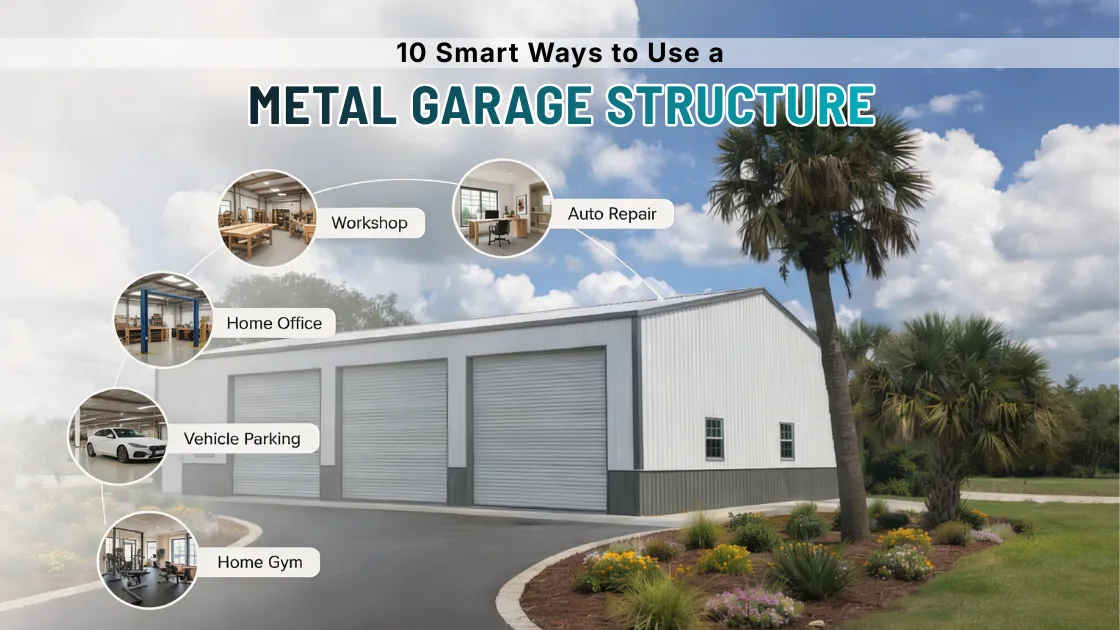
Most people buy a metal garage for parking and quickly discover that parking is the least interesting thing it does. Across the country, the most popular uses of metal garage space on residential properties have almost nothing to do with vehicles. Homeowners are converting their prefab steel structures into fitness studios, private offices, family activity centers, and even professional-quality recording rooms — and the steel construction handles every single one of those uses better than most traditional alternatives.
The metal garage ideas in this article are all scoped specifically to residential and personal use — the conversions that work for homeowners, families, and individuals on their own property. These are not commercial applications. For business-specific uses like retail stores, event venues, breweries, and commercial workshops, see: Creative Uses for Commercial Garages →
Every one of these ten residential metal garage uses succeeds because you are starting with an asset you already own: a large, weatherproof, structurally sound building with a concrete floor and customizable access. Knowing exactly what to do with a metal garage at home comes down to matching the structure’s strengths — open span interior, durability, and size flexibility — to the way you actually live.
Knowing how to use a metal garage at home starts here — but doing vehicle storage properly means going far beyond pulling in and closing the door. A well-configured steel garage is a climate-managed, organized facility that actively protects the vehicles inside it. Sun, moisture, temperature extremes, and road salt exposure all cause progressive damage to paint, interiors, and mechanical components. A properly insulated steel garage eliminates most of that damage for a one-time cost.
The practical upgrades that convert a basic garage into a proper vehicle facility are straightforward: 14-foot roll-up doors for trucks, lifted vehicles, or RVs; wall-mounted storage to keep the floor completely clear; LED overhead lighting positioned to eliminate shadows during maintenance; and electrical outlets for trickle chargers, air compressors, and diagnostic equipment. For multi-vehicle households, a 30-foot or 40-foot-wide building brings in 3 or 4 vehicles with room to work around each one.
One of the most popular metal garage ideas for homeowners right now is the home gym conversion. A metal garage home gym eliminates membership fees, removes commute friction, and creates a private environment where the equipment is always set up and ready. The structural advantages over an interior room are significant: the concrete slab handles the point-load weight of a power rack, deadlift platform, or commercial-grade cardio equipment that wood-frame floors are not rated for.
A standard 20×20 garage comfortably fits a full multi-station metal garage home gym with a power rack, cable machine, cardio equipment, and a stretching zone. A 24×30 opens up dedicated areas for cardio, weights, and functional training simultaneously. The 12-foot standard ceiling height accommodates overhead pressing movements and ceiling-mounted pull-up rigs without compromise — a 9-foot interior ceiling does not.
Design priorities: 3/4-inch rubber flooring over the slab, LED lighting positioned to eliminate shadows under the rack, insulation for year-round temperature comfort, and a mini-split for climate control. One unexpected advantage: the steel panel construction does not transmit bass frequencies the way wood framing does, which makes a garage gym substantially quieter to the rest of the property than an interior room would be.
A metal garage workshop for DIY is about the home woodworker, restorer, crafter, and tinkerer who needs a dedicated space where a project in progress does not have to be cleaned up at the end of every day. That is a fundamentally different use from a professional repair operation, and it is one of the highest-satisfaction metal garage conversion ideas among homeowners who build, make, and create as a hobby.
The practical advantages are hard to replicate inside the house: sawdust, paint fumes, and tool noise stay in a separate structure; large work pieces can be left mid-project without displacing family life; tools mount directly to the steel walls without any additional framing. A 20×30 metal garage workshop for DIY handles a table saw, bandsaw, workbench, drill press, and lumber storage with room to walk around long stock in every direction.
Electrical planning is the most important design decision for this use. Run your sub-panel conduit and wire positions before the slab is poured if possible — retrofitting conduit through a concrete floor is expensive and disruptive. Plan for 60-amp minimum if you run a table saw, dust collector, and air compressor simultaneously.
→ Also see: Metal Garage Buildings for Auto Shops and Repair Centers
One of the most financially productive metal garage conversion ideas for entrepreneurial homeowners is the inventory and storage hub. E-commerce businesses, contractors, landscapers, and service providers all hit the same wall at a certain point: the spare room is full, the rented storage unit is expensive, and a commercial warehouse is more than the operation needs. A steel garage on your own property solves all three problems simultaneously.
Metal garage storage for small business operations works because the structure is secure, insurable, weather-resistant, and — critically — expandable. When the business outgrows the original footprint, extending the rear wall adds square footage at a fraction of what additional warehouse rental costs. Galvanized steel construction resists the pests and moisture that routinely destroy stored inventory in wooden structures.
Design this space for workflow from day one: wide roll-up door for van, truck, or pallet access; industrial shelving on all walls; clear floor lanes for movement; and electrical for security cameras, barcode scanners, and a label printer station. If you store temperature-sensitive products—electronics, paint, adhesives—add insulation and a mini-split. Design your storage hub free with the VMG 3D Estimator →
Remote work has permanently shifted how homeowners think about workspace, and converting a steel garage into a private office is one of the highest-ROI uses of metal garage property on a residential lot. A metal garage home office accomplishes what no interior renovation achieves: genuine physical and psychological separation between work and home life, with its own entrance, its own path to the door, and its own environment.
The conversion is practical and straightforward. Insulate walls and ceiling first — a well-insulated steel garage maintains temperature efficiently with a single small mini-split system. A dedicated internet connection is the most important technical decision: run ethernet through conduit between the house and garage before the slab cures. Do not rely on WiFi through steel panels — the signal attenuation is severe and inconsistent. A metal garage home office needs wired connectivity to be professionally reliable.
Interior finishing to whatever standard your work requires: drywall over the steel framing for a clean professional appearance, or exposed panels with industrial aesthetics for creative work. A 12×20 structure handles a single-person office comfortably. A 20×20 allows for a desk zone, a dedicated video call background with proper lighting, and a small storage area.
Metal garage man cave builds are one of the most searched residential steel structure categories — and the reason is obvious once you think about it. The detached garage gives you a space that is entirely yours, with no design compromises required, no noise spillover to the rest of the house, and enough square footage to build the entertainment setup that interior rooms can never accommodate.
A 20×30 metal garage man cave comfortably holds a full sports bar setup: a 75-inch or larger screen, mini-fridge and bar counter, pool table, dartboard wall, and seating for 8 to 10 people with clear sightlines to the screen. A 24×30 adds a dedicated gaming station in one corner and still has room for a ping-pong table. The concrete floor handles anything — epoxy coating, large-format tile, or interlocking rubber mats depending on the aesthetic you want.
Sound management is the main technical consideration. Steel panels block exterior noise effectively but reflect interior sound, which creates echo. Two solutions, both inexpensive: acoustic foam panels on the wall behind the speakers and screen and a heavy area rug over the floor. Those two additions produce a dramatically better audio experience with minimal cost.
A dedicated metal garage home theater is the conversion that surprises people most—until they experience one. The steel garage’s high ceiling clearance (12 feet standard, 14+ feet available), fully open interior without load-bearing columns, and concrete foundation create an ideal shell for a purpose-built cinema that an interior room almost never provides.
A 20×24 garage is sufficient for a proper metal garage home theater experience: 6 to 8 recliner-style seats in two rows, a 120-inch fixed-frame projection screen on the front wall, a 7.1 surround system with in-ceiling speakers at the correct angle positions, and a projector mounted from the rear ceiling. The extra ceiling height versus a standard 9-foot interior room is what makes proper surround speaker placement possible — in a low ceiling, the elevation channels either do not fit or perform poorly.
The acoustic treatment approach is straightforward: seal any windows with blackout roller shades rather than removing them (preserves ventilation) and add acoustic panels to the side walls and rear wall to control reflections, and run all cables through wall conduit before any interior finishing. An untreated steel interior rings — a treated one is excellent.
A steel garage configured as a dedicated family activity space is one of the most adaptable residential uses because it adjusts to what the family needs right now and can be reconfigured as those needs evolve. A 24×30 stel garage structure handles table tennis, air hockey, a craft corner, and a gaming console zone simultaneously, with wall-mounted storage for seasonal equipment and sports gear. It is the kind of space that gets used every single day.
The practical family benefit of the detached building is the noise separation. Activity levels that would disrupt the house happen out here without any friction — which means parents are more comfortable letting kids use the space freely, and the space actually gets used rather than avoided. For families with older teenagers, a dedicated activity space connected to but separate from the main house is genuinely valuable.
Metal garage recording studio builds have grown substantially in the creator economy era. Podcasters, musicians, voice-over artists, and YouTube content creators all need the same thing: a quiet, acoustically consistent space separated from household noise. The detached steel garage delivers that better than any interior room in the house — for reasons most people do not initially recognize.
The physical separation from the main structure eliminates the recording environment’s biggest enemies: HVAC noise, footsteps, appliance cycles, and ambient family sound. A metal garage recording studio starts with a structural advantage — steel panels are significantly denser than drywall over 2×4 framing, which means better sound isolation from the outside before any acoustic treatment is applied.
The technical challenge is internal reverberation: an untreated steel interior rings. The solution is systematic: mass-loaded vinyl on two opposing walls (adds isolation as well as damping), acoustic foam panels on the remaining surfaces, a heavy area rug over the slab, and a drop ceiling of acoustic tile. A 12×16 room treated this way produces results that satisfy professional recording standards.
Metal garage kids playroom conversions address one of the most persistent problems in family homes: active children generate noise and mess that does not coexist well with the adult living environment, and there is rarely enough space inside the house to dedicate a room to play permanently. A dedicated outdoor playroom in a steel structure solves both problems simultaneously — with a weather-independent, year-round space that gives children freedom and gives parents peace.
For younger children, a 20×20 configured as a metal garage kids playroom accommodates an indoor climbing frame, a reading corner, soft play mat zones, and storage for toys and craft supplies without feeling crowded. For older kids and teenagers, the same footprint becomes a gaming room, study hall, or hangout space — with the personal territory that teenagers need but the main house rarely provides.
Safety and comfort are the design priorities here. Install impact-absorbing flooring — foam tile or rubber mats over the slab rather than bare concrete. Add insulation for year-round usability. Position the walk-in door so it has line-of-sight from the main house. Windows with safety glass placed high on the walls maintain light while preventing ball-impact damage.
→ Also see: Browse all metal garage types and sizes
→ Also see: Metal Garage Workshop type — full product page
→ Also see: Why galvanized steel is best for modern steel garages
Understanding what to do with a metal garage at home ultimately comes down to understanding the structure’s strengths. Every use above succeeds because of the same underlying properties:
Clear-span interior. No interior load-bearing posts means the layout is entirely your decision. Gym equipment, cinema seats, a recording booth, and a climbing frame — none of them are working around structural columns.
Concrete slab foundation. The standard concrete floor handles weight loads that wood-frame structures are not rated for — relevant for gym equipment, workshop machinery, and vehicle weight equally.
Durability without maintenance. Galvanized steel does not rot, warp, attract termites, or deteriorate with humidity. Every use above involves daily interaction with the structure across years. The material performs indefinitely without upkeep cycles.
Cost-per-square-foot. A prefab metal garage delivers more usable square footage per dollar than any conventional construction alternative. That is why the uses above — home gym, private office, home theater, and recording studio — are accessible to a typical homeowner rather than being a luxury category.
Speed. Most residential Viking Metal Garages structures are delivered and installed within weeks of ordering, not months. The timeline from deciding to use it to actually using it is short.
Expand each item below to explore a few helpful answers before moving to the next blog post.
The most popular uses of metal garage space on a residential property extend well beyond vehicle storage. Homeowners regularly configure their steel garages as home gyms, DIY and hobby workshops, private backyard offices, man caves and entertainment rooms, home theaters, family activity spaces, small business inventory hubs, home recording studios, and kids’ playrooms. The most versatile residential size is a 24×30, which handles any of these uses with room to spare. Every configuration can be designed using the free VMG 3D Estimator — real dimensions, real price, no phone call required.
Yes — and a steel garage is arguably better suited for a metal garage home gym than a converted interior room. The concrete slab foundation handles the point-load weight of power racks, heavy plates, and commercial cardio machines that wood-frame floors are not rated for. The standard 12-foot ceiling height accommodates overhead pressing and ceiling-mounted pull-up structures without restriction. Add 3/4-inch rubber flooring over the slab, insulation for year-round comfort, LED lighting, and a mini-split for climate control. A 20×20 metal garage gym is sufficient for most households; a 24×30 creates separate dedicated zones for cardio, weights, and functional training simultaneously.
Converting a metal garage into a metal garage home office requires four things done well: insulation (spray foam or batt between panels and drywall); climate control (a mini-split is the most efficient option for a detached structure), a wired internet connection (run ethernet through conduit before the slab cures — do not rely on WiFi through steel walls); and interior finishing to whatever standard your work requires. The principal advantage over an interior room is genuine physical separation from household distractions. A 12×20 handles a single-person office; a 20×20 allows for a desk zone, a video call corner with a clean backdrop, and storage.
A metal garage recording studio is a highly viable setup with proper acoustic treatment. The steel panel construction provides a head start on sound isolation, and the detached structure eliminates the most common recording problems — HVAC noise transmission, footstep impact, and appliance ambient sound. The acoustic challenge is internal reverberation in an untreated space. Treat it with mass-loaded vinyl on two walls, acoustic foam panels, a heavy area rug, and a drop acoustic tile ceiling. A whisper-quiet mini-split (rated below 40 dB) replaces the standard window unit. A 12×16 room treated this way produces professional-quality results for podcast, voice, and instrument recordings.
A steel garage is one of the best metal garage man cave structures available for a residential property. The clear-span interior with no posts gives complete layout freedom. The detached structure means entertainment levels and noise do not affect the main house. Galvanized steel construction handles years of heavy use without maintenance. A 20×30 is the minimum for a multi-activity man cave; a 24×40 creates a full entertainment complex. For audio quality, add acoustic foam panels to the wall behind the screen and a heavy area rug — both are inexpensive retrofits that produce a significant improvement in the listening environment.


Last Call for Summer Savings! Get Up To 30% Off |View Offer >>
Last Call for Summer Savings! Get Up To 30% Off |View Offer >>
Last Call for Summer Savings! Get Up To 30% Off |View Offer >>
Last Call for Summer Savings! Get Up To 30% Off |View Offer >>
Last Call for Summer Savings! Get Up To 30% Off |View Offer >>
Last Call for Summer Savings! Get Up To 30% Off |View Offer >>
Last Call for Summer Savings! Get Up To 30% Off |View Offer >>
Last Call for Summer Savings! Get Up To 30% Off |View Offer >>
Last Call for Summer Savings! Get Up To 30% Off |View Offer >>
Last Call for Summer Savings! Get Up To 30% Off |View Offer >>
Last Call for Summer Savings! Get Up To 30% Off |View Offer >>
Last Call for Summer Savings! Get Up To 30% Off |View Offer >>
Last Call for Summer Savings! Get Up To 30% Off |View Offer >>
Last Call for Summer Savings! Get Up To 30% Off |View Offer >>