
2 car garage
October 6, 2026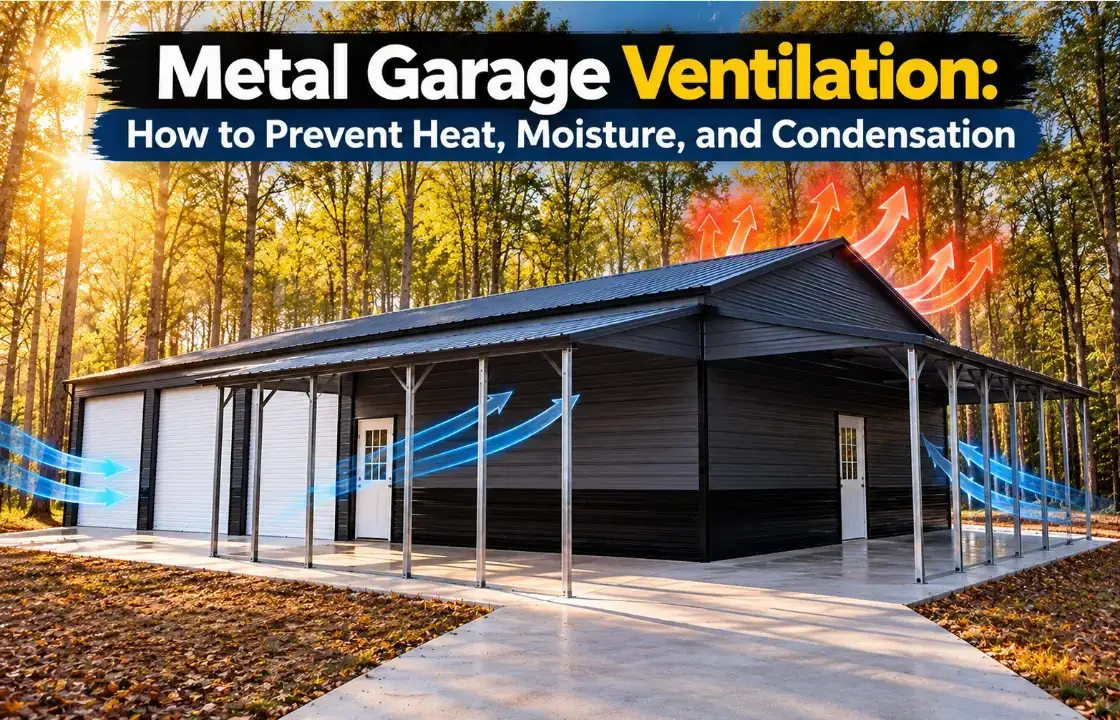
A metal garage can protect your vehicles, tools, and equipment from the weather, but a closed building can also trap heat and moisture. Proper metal garage ventilation helps by creating a path for fresh air to enter while warm, humid air escapes. The right combination of intake and exhaust ventilation, insulation, and moisture control can make the garage more comfortable and help reduce condensation.
Several factors can cause uncomfortable temperatures and excess moisture inside a garage. Understanding the source helps you choose the right solution instead of simply adding more vents.
Metal panels can absorb substantial heat from direct sunlight, particularly during summer. Without enough airflow, that heat can remain trapped inside the building and make the garage much warmer than the surrounding outdoor air.
The roof is especially important because warm air naturally rises. If there is no effective way for that air to escape, heat can accumulate near the ceiling.
A vehicle coming inside after rain or snow can introduce moisture into the building. Wet tools, lawn equipment, outdoor gear, and damp storage materials can have the same effect.
Humidity can also enter through doors, windows, and other openings. In a closed garage with limited air exchange, that moisture can remain inside for long periods.
Condensation forms when warm, moisture-filled air comes into contact with a surface that is cold enough for the moisture to turn into water droplets.
Metal surfaces can make this especially noticeable because they respond quickly to changes in temperature. If you regularly see droplets on walls, ceilings, or stored equipment, the problem may involve humidity, airflow, insulation, or a combination of these factors. In this case, insulated metal garages become an effective choice as they help prevent condensation from happening.
Ventilation is essentially controlled air movement. Fresh outdoor air enters the building, moves through the interior, and allows warmer or more humid air to escape.
Fresh air enters → air circulates → warm and humid air rises → stale air exits.
This is why simply installing one vent does not always solve the problem. Effective ventilation requires a reasonable airflow path between intake and exhaust points.
Intake openings allow fresh air to enter the garage. Depending on the building design, these can include windows, wall vents, or other lower-level openings.
Exhaust openings give warm or humid air a way out. Ridge vents, gable vents, roof vents, and powered exhaust fans can serve this purpose.
For natural ventilation to work well, air needs somewhere to enter and somewhere else to leave. Positioning both openings strategically can encourage air to move through more of the building instead of remaining concentrated in one area.
Different ventilation methods suit different building designs and uses.
| Ventilation option | Best suited for | Main role |
| Ridge vents | General garage ventilation | Releases rising warm air |
| Gable vents | Buildings with suitable end walls | Supports natural airflow |
| Windows | Garages needing fresh-air circulation | Provides intake and cross-flow |
| Exhaust fans | Workshops and high-use spaces | Mechanically removes air |
| Roof vents | Buildings needing high-level exhaust | Helps release trapped heat |
The right combination depends on the building’s dimensions, roof design, climate, and how the space will be used.
Vent placement can be just as important as the number of vents.
If fresh air enters and exits through openings positioned too close together, much of the airflow may bypass the rest of the building. Separating intake and exhaust points can encourage air to travel across the interior.
Warm air rises, so high-level exhaust points can take advantage of this natural movement. Ridge and gable ventilation can be particularly useful when incorporated into the building design.
Shelving, boxes, equipment, and stored materials can restrict circulation if they are placed directly in front of vents. Keep ventilation openings clear so air can move as intended.
Ventilation is important, but condensation control involves more than moving air. Start by identifying where moisture comes from. Wet vehicles, leaks, ground moisture, poor drainage, and high indoor humidity can all contribute to the problem.
You can also:
Proper site preparation also matters. Understanding metal building foundation requirements can help when planning drainage and managing moisture around the structure.
Ventilation and insulation solve different problems, so one should not automatically be treated as a replacement for the other.
| Main concern | What helps address it |
| Trapped hot air | Ventilation |
| Heat transfer through walls and roof | Insulation |
| Water entering around the building | Drainage and moisture control |
| Condensation on cold metal surfaces | Airflow, humidity control, and insulation |
| Workshop fumes or excess heat | Mechanical exhaust |
Insulation can reduce heat transfer and help keep interior surfaces at more stable temperatures. Ventilation, meanwhile, moves air and helps remove accumulated heat and moisture. A recent guide to insulated metal garages explains how insulation can contribute to temperature and condensation control.
A garage used primarily for vehicle storage may have different ventilation needs from one used for regular mechanical or fabrication work.
Workshops can produce additional heat, fumes, dust, and airborne particles depending on the activities taking place inside. Frequent door opening may provide some natural air exchange, but it should not automatically be considered a complete ventilation strategy.
For spaces intended for workshop activities, consider the location of doors, windows, intake openings, and mechanical exhaust during the planning stage. Explore metal workshop garages to see how different building configurations can accommodate workspace and storage requirements.
Imagine a 30×40-foot garage used for vehicle storage, equipment storage, and occasional workshop activities. Instead of relying on the main garage doors for airflow, the building could be planned with high-level exhaust ventilation and strategically positioned intake openings. This creates a more consistent airflow path even when the main doors remain closed.
If workshop activities generate additional heat or fumes, mechanical exhaust may provide another layer of ventilation. Insulation can also be considered when temperature control and condensation are concerns.
The exact arrangement should be based on the building design, local climate, intended use, and applicable building requirements.
Your garage may need better airflow or moisture management if you notice recurring signs such as:
These signs can help you determine whether the issue is primarily airflow, moisture, temperature control, or a combination of several factors.
Ventilation is easier to plan when it is considered alongside the rest of the building rather than added as an afterthought.
Consider the:
For larger structures, the overall building dimensions can significantly influence airflow planning. Reviewing available metal garage sizes can help you think about ventilation alongside usable interior space. It is also useful to review educational resources and infographics about garage design before finalizing the layout.
Poor ventilation planning can create new problems or fail to solve existing ones.
A well-designed garage should do more than keep rain and sunlight outside. It should also give heat and moisture a way to move out before they become persistent problems. The right ventilation strategy creates that movement by bringing in fresh air, releasing trapped warm air, and reducing the conditions that lead to condensation.
The important thing is to look at the garage as a complete system. Ventilation, insulation, drainage, building orientation, and the way you use the space all influence its indoor environment. When these elements are planned together, your garage can stay more comfortable, protect stored items, and handle changing weather with fewer moisture-related concerns.
Expand each item below to explore a few helpful answers before moving to the next blog post.
Use a combination of intake and exhaust openings to create a continuous airflow path. Depending on the building, this may include windows, gable vents, ridge vents, roof vents, or mechanical exhaust fans.
Roof-level ventilation can help release warm air that naturally rises toward the ceiling. Whether it is necessary depends on the building design, climate, and other ventilation features.
Start by identifying moisture sources and improving airflow. Insulation may also help stabilize interior surface temperatures and reduce condensation when temperature differences are contributing to the problem.
It can. Insulation reduces heat transfer and can help keep interior surfaces from becoming cold enough for moisture to condense. However, moisture sources and ventilation should also be considered.
A planned combination of intake and exhaust points generally creates a more effective airflow path than relying on one type of opening alone.
Not every workshop requires a powered exhaust fan, but mechanical ventilation can be useful where activities create additional heat, fumes, or airborne contaminants. Requirements vary by use and local regulations.