Metal Garages
September 18, 2026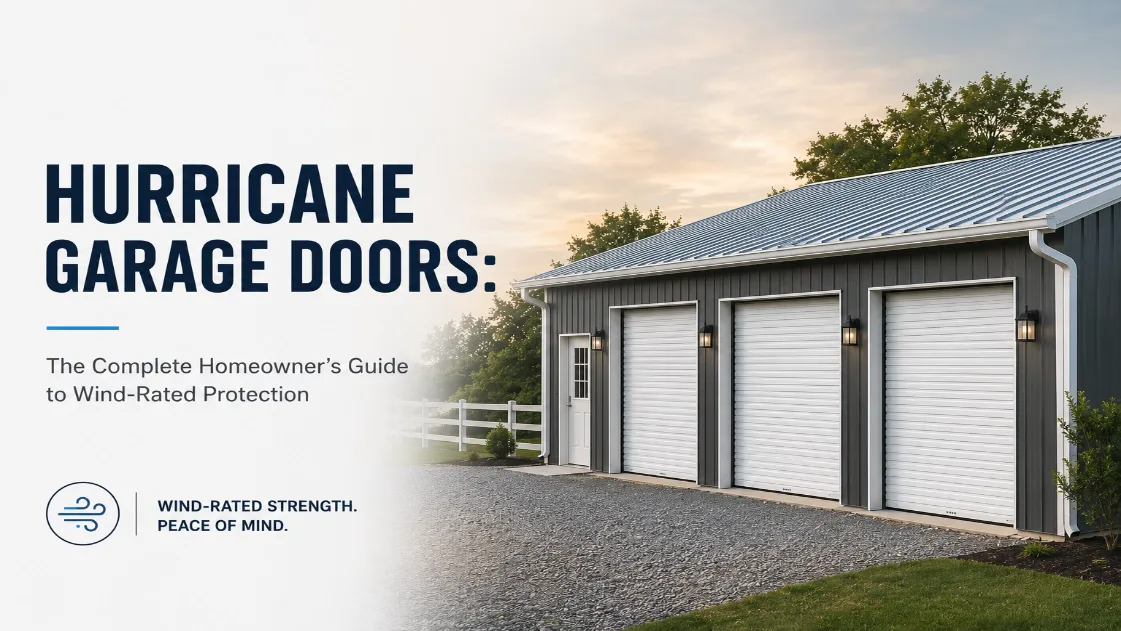
Your garage door is the largest opening on your home — and in a hurricane, it’s the most vulnerable one.
FEMA research identifies garage door failure as the starting point for approximately 90% of residential wind damage during hurricanes. When a standard garage door gives way under high winds, it doesn’t just leave your vehicles and belongings exposed. The sudden pressure change — called internal pressurization — pushes upward on your roof and outward on your walls from the inside. What begins as a failed garage door can escalate to roof loss, wall collapse, and total structural failure within seconds.
For homeowners in Florida, Texas, the Gulf Coast, the Carolinas, and anywhere hurricane-force winds are a seasonal reality, a hurricane-rated garage door isn’t a luxury upgrade. It’s the most critical piece of storm protection on the building.
This guide covers everything you need to know — what hurricane garage doors are, how wind ratings and pressure ratings work, which materials perform best, what state codes require, how much they cost, and whether reinforcing an existing door is a viable alternative. By the end, you’ll have a clear, practical picture of exactly what your home needs.
A hurricane garage door — also called a wind-rated garage door, impact-rated garage door, or storm-resistant garage door — is a reinforced overhead door engineered and tested to withstand extreme wind pressures and flying debris without failing.
Standard garage doors are designed for basic weather resistance and daily operation. They’re not tested for high-wind performance and will typically buckle, deform, or blow out of their tracks in sustained winds above 75–90 MPH — well within the range of a Category 1 hurricane.
Hurricane garage doors are fundamentally different in four ways:
The result is a door that, when properly installed, can withstand Category 3, 4, or even Category 5 wind speeds while keeping the building envelope sealed — which is what prevents the internal pressurization cascade that destroys roofs and walls.
Understanding why garage door failure is so catastrophic helps clarify why investing in a hurricane-rated door matters so much more than it might initially seem.
When wind hits your home, it creates positive pressure on the windward walls — pushing inward. It simultaneously creates negative pressure (suction) on the leeward side and the roof — pulling outward and upward. Your home’s structure is engineered to resist these forces when the building envelope is intact.
When a garage door fails, that’s no longer the case. Wind rushes into the garage, and the interior space suddenly experiences the same positive pressure that was previously acting only on the exterior. Now wind pressure is pushing up on the roof deck from below and pushing outward on the walls from inside — while simultaneously, the negative pressure continues pulling the roof up from outside.
The structural members weren’t designed to resist both simultaneously. The result can be rapid, progressive structural failure — starting with the roof and propagating to the walls.
This is why FEMA consistently identifies garage door failure as the leading trigger of severe residential wind damage. The door isn’t just a door. It’s a critical load-bearing component of your building envelope during a high-wind event.
This is where most homeowner guides get vague, and where most buyers make uninformed decisions. There are two different rating systems for hurricane garage doors, and they measure different things.
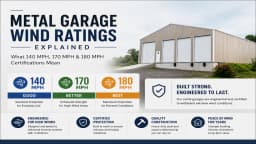
Wind speed ratings — the number in miles per hour you see in most product listings — describe the approximate wind velocity a door is designed to withstand. Common wind speed ratings:
The more technically precise measurement is pounds per square foot (PSF) — the actual pressure the door panel and hardware must resist. PSF is what engineers and code officials use, and it’s what the door’s physical testing is based on.
Wind pressure increases with the square of wind speed — which means doubling wind speed quadruples wind pressure. The actual PSF requirement for a specific door depends on:
PSF ratings are expressed as two values — positive pressure (PSF+) and negative pressure (PSF-) — representing the pressure pushing against the door and the suction pulling it outward, respectively.
Example: A door rated for +40 PSF / -50 PSF can resist 40 pounds per square foot pushing inward and 50 pounds per square foot pulling outward. For a 16×7 foot garage door (112 square feet), that’s 4,480 pounds of inward force and 5,600 pounds of outward force at the rated maximum.
When comparing hurricane garage doors, PSF ratings are more meaningful than MPH ratings — because a door’s actual wind performance depends on its size and the specific wind exposure at your location, not just a generalized MPH number.
When a hurricane garage door is certified, that certification is based on physical testing to specific ASTM (American Society for Testing and Materials) and DASMA (Door and Access Systems Manufacturers Association) standards. Understanding the key tests clarifies what the certification covers:
This test applies uniform air pressure to the door (simulating wind load) to verify the door meets its rated PSF values without permanent deformation or failure. Both positive and negative pressures are tested. This is the foundational structural certification for wind-rated doors.
The industry standard protocol for testing garage doors under cyclical wind pressure loads — simulating the fluctuating pressure pattern of a real storm rather than a single sustained load. Doors must pass both the design pressure and 1.5× the design pressure without failure.
These tests determine whether a door is impact-resistant — meaning it can withstand flying debris, not just wind pressure alone. The E1996 standard defines the debris impact requirement (a 9-pound 2×4 projectile launched at specific velocities); E1886 defines the test method.
Impact-resistant vs. wind-rated: These are not the same certification. A door can be wind-rated (certified for pressure resistance) without being impact-rated (certified for debris impact). In most wind-borne debris regions, both certifications are required. Miami-Dade County requires full impact resistance approval in addition to structural certification.
Florida’s Miami-Dade County has the strictest garage door requirements in the nation. Doors installed in the High Velocity Hurricane Zone (HVHZ) must hold a Miami-Dade Notice of Acceptance (NOA) — a product-specific approval based on testing to Florida Building Code standards, which exceed the national baseline. When shopping for HVHZ-compliant doors, the NOA number is non-negotiable documentation.
Hurricane garage doors are available in several materials, each with different performance characteristics, weight, and cost profiles.
| Material | Wind Performance | Impact Resistance | Weight | Corrosion Resistance | Cost Range |
| Steel (24-gauge) | Excellent | Good | Heavy | Moderate (needs galvanizing/coating) | –$ |
| Steel (26-gauge) | Good | Moderate | Moderate | Moderate | –$ |
| Aluminum | Good | Moderate | Light | Excellent (naturally rust-resistant) | –$ |
| Fiberglass / Composite | Moderate | Good (impact-rated models) | Light | Excellent | $–$$ |
| Wood | Poor for high-wind applications | Poor | Heavy | Poor | –$$ |
Steel is the most common material for wind-rated garage doors and the most practical choice for most homeowners. 24-gauge steel provides the structural rigidity required for high PSF ratings and handles debris impact well. The primary maintenance consideration is corrosion — in coastal salt-air environments, galvanized steel or steel with a factory applied baked-on finish is important for long-term performance.
Heavy-duty steel hurricane doors feature additional horizontal stiffeners — internal reinforcing bars that run across each door section — that increase resistance to bending under wind pressure. The number and gauge of stiffeners determines how high a PSF rating the door achieves.
Aluminum’s natural corrosion resistance makes it particularly well-suited for coastal Florida, the Gulf Coast, and other salt-air environments where steel requires more maintenance. Aluminum hurricane doors are lighter than steel equivalents, which reduces strain on the opening mechanism and makes manual operation easier if power is out during a storm.
The trade-off is that aluminum has lower inherent rigidity than steel at equivalent thickness — which means aluminum hurricane doors often require more reinforcement (thicker extrusions, additional stiffeners) to achieve the same PSF rating. Well-engineered aluminum hurricane doors are fully capable of meeting high wind ratings, but compare PSF specs rather than just material type when evaluating options.
Hurricane garage door requirements vary significantly by state and county. Here’s a practical breakdown for the regions where code compliance most commonly affects buying decisions.
Florida has the most comprehensive garage door wind requirements in the U.S., codified in the Florida Building Code (FBC):
Florida rule of thumb: If you’re pulling a permit in Florida — which is required for garage door replacement in almost every county — you need a door with the appropriate FBC product approval for your wind zone. Your building department can confirm the specific requirement for your address.
Texas garage door requirements are administered at the county level, with additional oversight from the Texas Department of Insurance (TDI) in designated windstorm areas:
Louisiana’s coastal parishes have increasingly adopted stricter wind requirements following significant hurricane damage. Jefferson, Orleans, St. Bernard, Plaquemines, and surrounding parishes typically require 140–170 MPH rated doors in coastal construction.
Gulf Coast counties in both states require wind-rated doors consistent with their coastal design wind speeds. Mobile County (AL) and Harrison and Hancock counties (MS) are the primary coastal enforcement areas.
A fully rated hurricane garage door is the best protection — but it’s also a significant investment. For homeowners in wind-zone counties who need to improve protection before hurricane season without replacing the door, reinforcement options exist. They don’t provide equivalent protection, but they meaningfully improve performance over an unreinforced standard door.
Add-on horizontal stiffener kits can be installed on existing sectional garage doors to increase resistance to wind bowing. These kits consist of metal bracing bars that attach across each door section and connect to the door’s existing frame and track system.
What they do: Reduce door deflection (bowing) under wind pressure, which can prevent the door from jumping out of its tracks in moderate high-wind events.
What they don’t do: Provide certified wind resistance. Retrofit stiffeners are not a substitute for a tested and certified hurricane door and will not satisfy code requirements in hurricane zones.
Best application: As an interim measure for homeowners in lower-wind-speed areas or as a supplement to an existing lightly reinforced door.
Vertical bracing poles clip between the door header (top of the opening) and the floor, creating a physical barrier that resists the door blowing inward. These systems are installed before a storm and removed afterward.
What they do: Provide temporary reinforcement against inward wind pressure.
What they don’t do: Provide code-compliant hurricane protection, resist outward pressure (negative load), or substitute for a rated door in code-regulated areas.
If your existing door has a standard-weight track, upgrading to a heavy-duty commercial-grade track (2-inch or heavier) improves the door’s resistance to jumping off-track under wind loads. Per Artisan Door Works, the track should be at least 14-gauge steel for any wind-reinforcement effort to be meaningful. Track upgrades work best in combination with stiffener kits.
| Situation | Reinforcement Appropriate? |
| Low-wind inland area, non-code-regulated | Yes — provides meaningful improvement |
| Hurricane zone, no current permit pending | Interim improvement; upgrade door when feasible |
| Hurricane zone, pulling a permit | No — code requires certified door; reinforcement kits don’t satisfy this |
| HVHZ (Miami-Dade/Broward) | No — only NOA-approved doors acceptable |
| Seeking windstorm insurance coverage (TX TWIA) | No — only NOA-approved doors acceptable |
These are the mistakes that show up most often — and that cost homeowners the most.
Buying a “wind-rated” door without verifying PSF specs for your door size. Wind speed ratings are sometimes listed for specific door sizes. A door rated for 130 MPH at 9×7 feet may only be rated for 110 MPH at 16×8 feet because larger doors experience greater total force. Always verify the PSF rating applies to your actual door dimensions.
Installing a certified door on a non-certified opener system. The door is only as strong as its installation. If the mounting hardware, brackets, and track system don’t match the door’s rated design, the certification doesn’t apply. Use the hardware specified in the door manufacturer’s installation documentation.
Assuming “hurricane garage door” means impact-resistant. Wind-rated and impact-rated are separate certifications. In wind-borne debris regions (which include all of coastal Florida and most Gulf Coast counties), both are typically required. Confirm both certifications before purchasing.
Skipping the permit. In most hurricane-zone counties, replacing a garage door requires a permit. Skipping the permit may mean the door isn’t inspected for correct installation — which is a separate source of failure — and may create issues with insurance claims after a storm.
Not checking the door after installation. Balance, alignment, and seal quality should all be verified at installation and rechecked annually. A well-built hurricane door that’s poorly balanced or has a compromised bottom seal is not performing to its rated specification.
Not maintaining the door. Hurricane garage doors include moving parts — springs, cables, rollers, hinges, tracks — that require periodic lubrication and inspection. A door that binds, sags, or travels unevenly is stressed during operation and may not perform correctly under wind loading. Annual professional inspection is worth the cost in high-wind areas.
A hurricane-rated garage door is one critical component — but the door is only as effective as the structure it’s installed in. A certified hurricane door mounted in a non-certified metal garage provides limited overall storm protection, because if the building’s frame, wall panels, or roof system fail, the door’s rating becomes irrelevant.
For homeowners in hurricane zones planning a new metal garage, the complete storm protection system includes:
Viking Metal Garages builds engineer-certified custom metal garages with wind ratings up to 180+ MPH across all 48 contiguous states. Our vertical roof metal garages are the recommended structure for any hurricane-zone application — vertical roof panels provide superior wind and water performance compared to standard horizontal panel systems.
When you’re building in a hurricane zone, the garage door and the building structure should both be certified to the same wind speed. Getting one right without the other leaves the weak point that storms will find.
A hurricane-rated garage door that hasn’t been maintained may not perform to its rated specification when a storm arrives. Annual inspection and basic maintenance are essential — especially in coastal environments where salt air, humidity, and UV exposure accelerate wear.
Annual inspection checklist:
Before a storm:
In a hurricane, a garage door is either a catastrophic failure point or a critical line of protection. There’s very little middle ground.
The decision to install a hurricane-rated garage door — and to pair it with a structurally certified metal garage — is one of the highest-return storm protection investments a coastal homeowner can make. The door cost is real. The insurance premium savings, the avoided repair costs, the claim protection, and the structural safety are also real — and they tend to outweigh the upfront investment within a few storm seasons.
If you’re in a hurricane zone and your current garage door isn’t certified to the local design wind speed, that’s the most important item on your storm preparation list.
If you’re planning a new metal garage in a hurricane zone, pair it right from the start — a certified steel garage structure engineered to your local wind speed, with a hurricane-rated door matched to that same wind certification level.
Viking Metal Garages builds engineer-certified metal garages with wind ratings up to 180+ MPH across all 48 contiguous states, with professional installation and certified drawings included on most enclosed garage orders.
Call us at (704)-741-1587 to discuss your hurricane-zone project, or request a free custom quote online. Our building specialists confirm your county’s wind rating requirement, recommend the right building and door specifications, and walk you through every step — so your garage is ready for whatever the season brings.
Expand each item below to explore a few helpful answers before moving to the next blog post.
Hurricane garage doors are reinforced overhead doors engineered and tested to withstand extreme wind pressures and flying debris without failing. Unlike standard doors, they're built with heavier gauge panels, internal stiffeners, and heavy-duty hardware — and certified to specific wind pressure (PSF) ratings through ASTM and DASMA testing standards.
It depends on the specific door's PSF rating and dimensions. Most residential hurricane garage doors are rated for sustained wind speeds from 120–180+ MPH, with the specific rating determined by the door's tested PSF values and the door size. Some specialized impact-rated doors are certified to resist winds exceeding 200 MPH equivalent pressure. Always verify the PSF rating applies to your actual door dimensions, not just a generic wind speed number.
In most coastal hurricane-zone counties, yes — building codes require wind-rated garage doors that meet the local design wind speed. Florida, coastal Texas, coastal Carolinas, Louisiana, and Gulf Coast counties all have wind rating requirements that trigger a permit. Even where not strictly required, wind-rated doors are often required by windstorm insurance policies (particularly in Texas) for covered claims.
Wind-rated doors are tested for pressure resistance — how much wind force the door can withstand before deforming or failing. Impact-rated doors add debris-resistance testing — the door must also resist penetration from wind-driven projectiles (per ASTM E1886/E1996, a 9-pound 2×4 lumber projectile). Most hurricane-zone building codes require both certifications. In Miami-Dade's HVHZ, full impact resistance with a Miami-Dade NOA is mandatory.
Yes — retrofit horizontal stiffener kits, vertical bracing poles, and track upgrades can improve a standard door's wind performance. However, reinforcement kits are not equivalent to a tested and certified hurricane door, and they do not satisfy code requirements in wind-zone areas. They're best used as interim measures or in non-code-regulated lower-wind areas.
Often, yes. In Florida, a certified hurricane door qualifies for windstorm mitigation credits that can reduce windstorm insurance premiums meaningfully — often 10–30% depending on the home's overall mitigation level. In Texas TWIA coverage areas, a compliant wind-rated door is required for windstorm claims to be covered. Check with your insurer before purchasing to understand the specific credit or requirement that applies to your policy.
With proper maintenance, a quality hurricane garage door can last 20–30 years or more. Coastal salt-air environments accelerate corrosion on steel doors — galvanized or high-quality coated steel and aluminum doors perform better in these conditions. Springs, cables, and opener systems are the components most likely to need service or replacement first, typically every 7–12 years depending on use.
Close and manually lock the door (use sliding lock bars or through-lock hardware). Deploy any add-on bracing systems before sustained winds exceed 50 MPH. Do not rely solely on the opener engagement system as a wind lock. If power may go out, practice the manual disconnect procedure before storm season so you can operate the door safely without power.
Last Call for Summer Savings! Get Up To 30% Off |View Offer >>
Last Call for Summer Savings! Get Up To 30% Off |View Offer >>
Last Call for Summer Savings! Get Up To 30% Off |View Offer >>
Last Call for Summer Savings! Get Up To 30% Off |View Offer >>
Last Call for Summer Savings! Get Up To 30% Off |View Offer >>
Last Call for Summer Savings! Get Up To 30% Off |View Offer >>
Last Call for Summer Savings! Get Up To 30% Off |View Offer >>
Last Call for Summer Savings! Get Up To 30% Off |View Offer >>
Last Call for Summer Savings! Get Up To 30% Off |View Offer >>
Last Call for Summer Savings! Get Up To 30% Off |View Offer >>
Last Call for Summer Savings! Get Up To 30% Off |View Offer >>
Last Call for Summer Savings! Get Up To 30% Off |View Offer >>
Last Call for Summer Savings! Get Up To 30% Off |View Offer >>
Last Call for Summer Savings! Get Up To 30% Off |View Offer >>