Metal Garages
September 18, 2026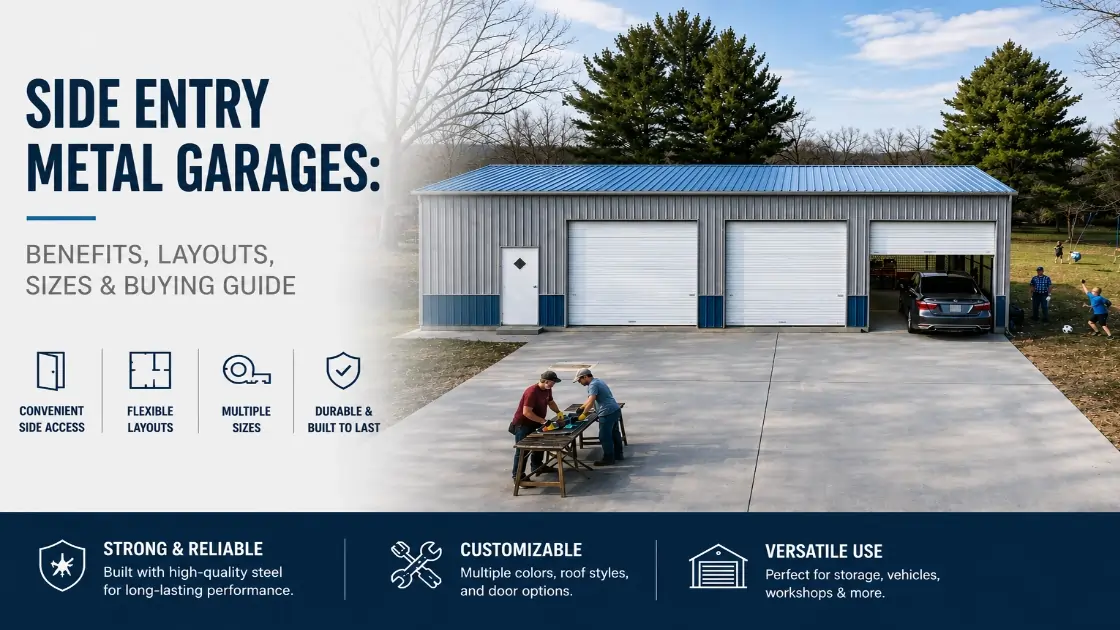
Most garages face the street. The door is on the front, the driveway runs straight in, and the whole setup takes up a significant chunk of your home’s facade. For a lot of properties and a lot of owners, that works fine.
But for a growing number of U.S. homeowners — especially those with multiple vehicles, narrow lots, HOA restrictions, or a need for serious storage and workshop space — a front-entry layout creates problems that a different design solves completely. That design is the side entry metal garage.
Side entry metal garages have the vehicle doors on the long wall of the building rather than the short end. That single difference changes how the garage relates to your property, your driveway, your street view, and how many vehicles you can park in it — all at once.
This guide covers everything: what side entry garages are, when they make sense, how they compare to front-entry designs, how to size one correctly, and what customization options make the most difference.
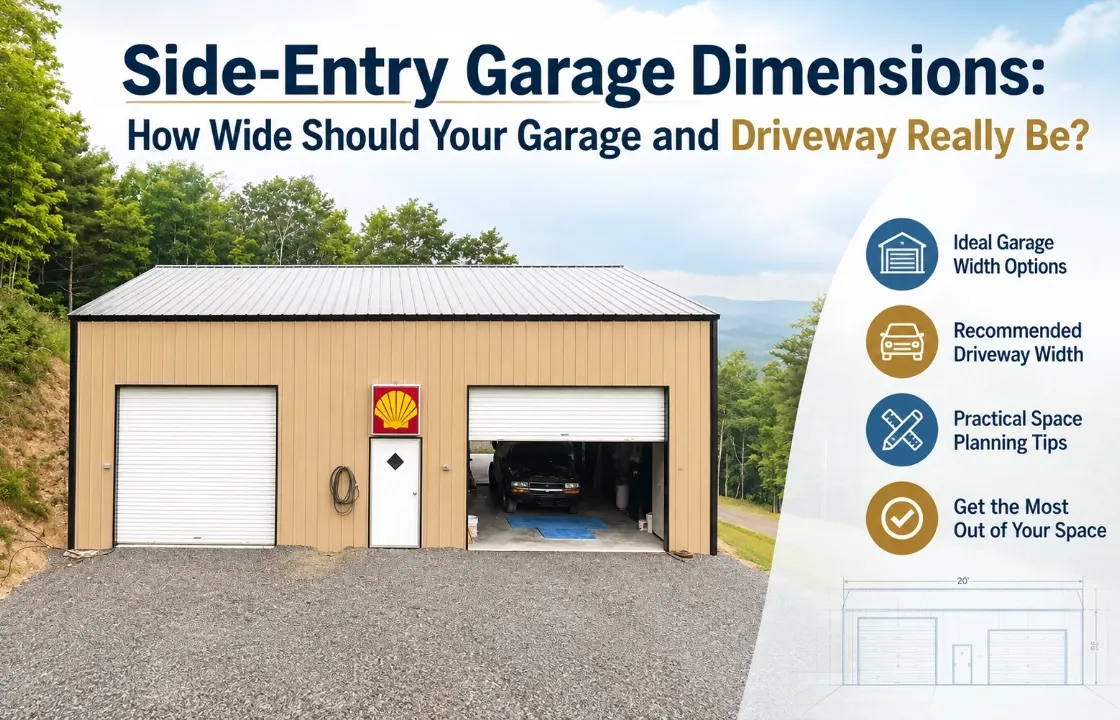
A side entry metal garage is a prefab steel building where the garage door openings are placed on the long sidewall — the length of the building — rather than the shorter end wall facing the street or driveway.
Quick definition: A side entry garage has its vehicle doors on the side (long wall), allowing vehicles to pull in from the side of the property rather than directly from the front. This frees up the front facade of the home and allows multiple vehicles to be accessed independently without one blocking another.
In a standard front-entry garage, the door is on the short end. All vehicles enter from the same direction, which means if you’re parking three cars, you either pull all three in from the front (requiring a very wide building and matching driveway) or you use a tandem layout where one car is always blocked by another.
In a side-entry layout, doors run along the long wall. Each vehicle can have its own door — or multiple vehicles can share a wide opening — and they all pull in from the side of the property. The front of the home stays clear.
This is the comparison most buyers need to see before they decide. Here’s the honest breakdown:
| Feature | Side Entry Metal Garage | Front Entry Metal Garage |
| Door placement | Long sidewall | Short end wall (front) |
| Curb appeal impact | Garage doors hidden from street view | Garage doors visible from street |
| HOA compatibility | High — doors not visible from street | Variable — doors face street |
| Multi-vehicle access | Excellent — each vehicle can have its own door | Limited — vehicles may block each other |
| Lot requirements | Needs side yard depth for driveway approach | Needs front driveway clearance |
| Property frontage | Front of home unobstructed | Garage uses 30–40% of home facade |
| Best for | Multiple vehicles, narrow front lots, HOA communities, RV/boat storage, workshops | Single vehicle, standard driveways, simple residential use |
| Workshop use | Excellent — long wall allows wide work zones | Good, but door placement limits layout options |
The right choice depends on your specific property. If your lot is deeper than it is wide, a side entry layout uses your land more efficiently. If you have strong HOA restrictions on visible garage doors or are simply trying to protect your home’s curb appeal, side entry makes the aesthetic decision easy.
Not every property is the right fit for a side entry layout. But for certain situations, it’s the obvious choice:
You have more than two vehicles. A side entry layout allows multiple independently accessible bays along the long wall. Each driver can get to their vehicle without moving anyone else’s. No shuffling, no blocking.
Your HOA restricts visible garage doors. Many planned communities have rules about garage door visibility from the street. A side entry metal garage satisfies those restrictions automatically — the doors face the side yard, not the road.
You want to improve curb appeal. Front-entry garage doors occupy 30–40% of a home’s street-facing facade. Moving the entry to the side wall gives the front of your home back — landscaping, a porch, or just clean architecture.
You have a long, narrow property. Side entry layouts work extremely well on lots with limited frontage. The building runs along the lot depth, and the approach driveway wraps around the side rather than consuming the front.
You’re building a workshop or equipment storage facility. Long, clear sidewalls create excellent workshop layouts — benches along one wall, equipment storage along the other, vehicle bays in the center.
You need RV or boat storage. A side entry building is well-suited for long vehicles that need a deep pull-through space. The entry from the side makes maneuvering a long trailer or motorhome significantly easier than a straight front-entry approach.
You want a private entrance to your workspace. A side entry garage creates a natural separation between the main home entry and the garage workspace — better privacy and less traffic through your primary living space.
The single most visible benefit: the front of your home looks like a home, not a parking facility. Side entry steel garages eliminate the visual dominance of large garage doors facing the street — which is especially noticeable on multi-car setups where front-entry doors can consume the majority of the front facade.
In a standard end-entry garage, parking three vehicles means one car always goes in first and comes out last. Every vehicle movement involves every other car. In a side entry layout, each bay has its own door. Driver A takes their car out without touching Driver B or C’s space. This matters every single day.
Homeowners associations in many communities restrict the visibility of garage doors from the street — or limit the percentage of the home’s front facade that can be doors or openings. A side entry design satisfies both requirements without compromise. The doors simply aren’t on the wall that faces the street.
Side entry garage buildings typically run parallel to the side property line, using the depth of the lot rather than the frontage. This frees your front yard for landscaping, a walkway, a porch, or additional parking that doesn’t compete with garage access.
When the doors are on the long wall, the interior of the building can be organized very differently than a standard front-entry garage. Workshop zones run end to end. Storage areas don’t compete with vehicle bays. Workbenches can span the full length of the opposite wall without blocking any door opening. For anyone using their garage as a serious workspace, this layout flexibility is a significant functional advantage.
Vehicles entering from the side of the property rather than the front reduces conflicts between garage traffic and street or pedestrian traffic in front of the home. In households with children or frequent foot traffic on the front walk, this is a genuine safety benefit.
Side entry steel garages are built from galvanized steel framing and steel panels that resist rot, pests, and moisture — all the failure modes that eventually compromise wood-framed structures. A well-installed steel side entry garage will still be structurally sound in 40 years with minimal maintenance. A wood structure in the same location typically requires significant repair or replacement within 20 years.
No repainting. No pest treatment. No rot remediation. No warped framing from moisture. Steel garages require occasional inspection of fasteners and sealants and a periodic rinse — that’s it. For busy households and working operations, the freedom from constant maintenance is a practical quality-of-life difference.
Steel is non-combustible. In areas with wildfire risk — which covers significant portions of California, Texas, Colorado, and other western states — a non-combustible steel garage is meaningfully safer than a wood-framed alternative. Steel framing doesn’t contribute structural fuel to a fire.
Sizing a side entry garage correctly requires thinking about both vehicle dimensions and how many bays you need along the long wall. Here’s a practical framework:
| Vehicle Type | Typical Width | Typical Length |
| Compact car (Civic, Corolla) | 5.5–6.0 ft | 14–15 ft |
| Mid-size sedan (Camry, Accord) | 6.0–6.5 ft | 15–16 ft |
| SUV (Pilot, Explorer, Highlander) | 6.5–7.0 ft | 16–17 ft |
| Full-size truck (F-150, Silverado) | 6.7–7.0 ft | 18–20 ft |
| HD truck (F-250, Ram 2500) | 6.9–7.2 ft | 20–22 ft |
| Class C RV | 7.5–8.5 ft | 28–35 ft |
| Class A Motorhome | 8.0–8.5 ft | 35–45 ft |
| Fifth Wheel Trailer | 8.0–8.5 ft | 35–42 ft |
| Boat on trailer | 7–10 ft | 20–35 ft |
| Use Case | Recommended Size | Notes |
| 2-car (sedans/crossovers) | 20×30 ft | 10 ft per bay; functional minimum |
| 2-car (trucks/SUVs) | 24×30 ft | 12 ft per bay; comfortable clearance |
| 3-car (mixed vehicles)3 | 30×30 ft | 10 ft per bay; add depth for storage |
| 3-car (trucks/larger) | 36×30 ft | 12 ft per bay; recommended for comfort |
| 4-car (sedans/crossovers) | 36×30 ft | 9 ft per bay; minimum |
| 4-car (trucks/SUVs) | 40×30 ft | 10 ft per bay; workable |
| Workshop + 2-car | 30×40 ft | Vehicles in 2 bays, workshop at one end |
| RV + 2 vehicles | 40×50 ft | RV bay 14–16 ft wide; extra depth needed |
| Commercial / fleet | 50×60 ft+ | Custom engineering required |
Key sizing rules for side entry layouts:
The most common planning mistake with side entry garages is not accounting for the approach driveway. In a front-entry garage, the driveway runs straight from the street to the door. In a side entry layout, the approach typically comes from the front of the property and turns 90 degrees to enter the side doors.
Here’s what you need to plan for:
Turn radius clearance. A standard passenger vehicle needs about 20–22 feet of clearance to make a comfortable 90-degree turn into a side entry bay. Trucks and SUVs need 22–26 feet. RVs and trailers need 35–50 feet depending on the rig. Measure your available side yard before finalizing your design.
Approach pad or apron. The area in front of each door on the side wall should have a hardened surface (concrete or asphalt) that extends far enough for the approach — typically the length of the vehicle being parked.
Door spacing. If you’re placing multiple doors on the long wall, the spacing between them needs to accommodate safe independent vehicle access. Doors too close together on the wall can create clearance conflicts when two vehicles are being moved at the same time.
Setbacks. Your county’s zoning setback requirements apply to the sides of the building — which is where your doors are in a side entry layout. Confirm the minimum distance required between the building and the property line before finalizing your placement.
One of the strongest advantages of prefab steel construction is how completely customizable the building is — and for side entry garages specifically, a few customization choices make a large practical difference.
Three roof styles are available for Viking side entry metal garages:
Vertical Roof (Recommended): Panels run from ridge to eave, channeling rain and snow cleanly off the sides of the building. The strongest roof option and the one required for all engineer-certified wind-rated builds. For multi-vehicle or commercial side entry garages in any climate with real weather, vertical roof is the right choice.
A-Frame / Boxed Eave: A pitched roof with horizontal panel orientation. Better weather performance than a standard roof; a good middle option for mild-climate applications.
Regular (Horizontal): Standard horizontal panels. The most budget-friendly option; better suited for dry climates with minimal rain and no snow.
For a side entry garage — where the roof spans a longer building than a typical front-entry layout — vertical roof’s superior drainage performance is especially valuable. Learn more about roof style options.
Side entry garages can be configured with:
Door width per bay should match the vehicle entering. 9–10 ft doors work for standard vehicles; 12 ft for trucks; 14 ft for RVs and large commercial vehicles.
A lean-to attached to one side of a side entry garage creates a covered outdoor zone for equipment staging, firewood, covered parking for a trailer or boat, or any other use that doesn’t need full enclosure. It’s one of the most cost-effective ways to expand the functionality of a side entry garage without increasing the main building footprint.
Windows on the end walls (not the side wall with the doors) provide natural light and ventilation without compromising the door layout. For workshops, windows above the workbench on the opposite wall from the doors provide excellent task lighting.
For workshops, home gyms, or any application where you’ll spend real time inside the building, insulation makes the space functional year-round. Closed-cell spray foam is the best option for temperature control and condensation prevention; double-bubble reflective insulation is the standard entry-level option for hot, sunny climates.
Steel panels come in 15+ standard colors for walls, roof, and trim — no upcharge for standard selections. Lighter roof colors reduce heat gain in summer; darker roof tones give a more commercial appearance for workshop and business applications. Two-tone color schemes (contrasting wall and trim colors) are popular for residential side entry garages where curb appeal matters.
Residential multi-vehicle households: The most common application. Two or three daily drivers, each with independent access, without the constant shuffling that a tandem front-entry layout requires.
HOA neighborhoods: Properties where the community’s design standards restrict visible garage doors from the street — or where homeowners simply want a cleaner front-facade appearance.
Home workshops and fabrication shops: Side entry layouts create long, clear interior walls ideal for bench setups, tool organization, and equipment placement. The side doors can be wide-opening commercial doors that allow large materials and equipment to move in and out easily.
Agricultural properties: Farm equipment — tractors, ATVs, implements, trailers — benefits from side entry access. Equipment can be pulled in from the side, reducing the need for tight maneuvering on a short end-wall approach.
RV and boat storage: Long vehicles that require deep buildings work well with side entry design. The approach angle from the side makes it significantly easier to back a trailer or pull in a motorhome than a straight front-entry.
Small business and fleet operations: Commercial properties where multiple vehicles need independent access and the visual appearance of the building from the road matters for the business.
The side entry design can be executed in wood framing or steel. Here’s why steel consistently produces a better long-term outcome:
Structural performance. Pre-engineered steel frames can achieve clear spans without interior columns — which is critical in a long side entry building where you need the full interior width free of posts. Wood-framed structures with comparable clear spans require significantly more complex (and expensive) engineering.
Wind and snow certification. Viking steel garages are available with engineer certification up to 180+ MPH wind ratings and appropriate snow load ratings for any U.S. climate zone. Certified structural drawings for permit applications are included with most enclosed orders.
No rot, no pests, no painting. Galvanized steel framing eliminates the three most common sources of wood garage deterioration over time. A steel side entry garage installed today will look and perform essentially the same in 20 years — without the paint cycles, pest treatments, and rot remediation that wood requires.
Faster installation. Pre-engineered components arrive ready for assembly. Most residential side entry steel garages are installed in one to two days. A wood-framed equivalent takes weeks of on-site framing labor.
Complete customization. Size, door placement, roof style, colors, insulation, windows, lean-tos — all of it is specified at order. You get the building your property needs, not a standard plan you adapt to.
The cost of a side entry metal garage varies based on several factors:
Building size is the primary cost driver. Larger buildings require more steel, more panel coverage, and more installation time. Cost per square foot typically decreases as building size increases.
Roof style has a modest impact. Vertical roof adds a small premium over boxed eave and regular roofs — but provides meaningfully better long-term weather performance that justifies the cost on most U.S. installations.
Steel gauge. Standard residential builds use 14-gauge framing. High-wind or engineer-certified applications require 12-gauge, which carries a moderate cost premium.
Door count and type. Each additional door opening has a cost — roll-up doors, walk-in doors, and commercial overhead doors are priced differently. Side entry garages often have more door openings than front-entry garages of the same total size, which adds to the door line item.
Insulation. Double-bubble reflective insulation is the budget option. Fiberglass batt, rigid board, and closed-cell spray foam all add cost at increasing tiers — but also add meaningful performance value.
Location. Delivery logistics and regional cost differences affect the installed price. A building in rural Montana may cost more to deliver than the same building in suburban Georgia.
Foundation. Concrete slab is required for most permitted enclosed garages and is almost always a separate cost arranged with a local concrete contractor.
For a starting point on pricing by size, visit our metal garage pricing page.
A side entry metal garage is the right choice when standard front-entry designs don’t fit your property, your vehicles, your HOA, or the way you actually use a garage. The design solves real problems — curb appeal, multi-vehicle access, workshop functionality, HOA compliance — in a durable, low-maintenance steel structure built to your exact specifications.
Viking Metal Garages builds fully custom side entry metal garages across all 48 contiguous states — delivered and professionally installed, with engineer-certified drawings included on most enclosed orders.
Call (704)-741-1587 to talk through your layout with a building specialist, or request a free quote online. We’ll help you design a side entry garage that fits your property, your vehicles, and your budget.
Expand each item below to explore a few helpful answers before moving to the next blog post.
A side entry metal garage is a prefab steel building where the vehicle doors are located on the long sidewall — the length of the building — rather than the shorter end wall. This allows multiple vehicles to be accessed independently from the side of the property, keeps garage doors off the street-facing facade, and creates a more flexible interior layout for workshops and storage.
Not necessarily. The building structure itself costs the same as a comparable front-entry garage of identical dimensions. Side entry garages may have more door openings than a similarly sized front-entry building, which adds slightly to the door cost. The approach driveway may also require additional concrete or paving on the side of the property. Overall, the cost difference is modest and often offset by the property and functional benefits.
The three most impactful benefits are: (1) garage doors are hidden from street view, which dramatically improves curb appeal and satisfies HOA requirements; (2) multiple vehicles can be accessed independently without one blocking another; and (3) the interior layout flexibility is superior for workshops, equipment storage, and mixed-use applications.
You need enough side yard depth to make the 90-degree approach turn from the front of the property into the side door. A standard passenger car needs about 20–22 feet of clearance for this turn; a truck needs 22–26 feet; an RV or trailer needs 35–50 feet. Confirm your available side yard before selecting your building dimensions.
Completely. Width, length, eave height, number and placement of doors, roof style, insulation, windows, colors, lean-to additions — everything is specified at order. There are no standard sizes you're limited to. The building is engineered to your exact requirements.
Yes — they're an excellent fit. Long vehicles like motorhomes and boats on trailers are difficult to maneuver into a straight front-entry approach. The side entry layout allows the vehicle to approach from the front of the property and turn into a deep side bay, which is often much easier to navigate. Make sure you have adequate side yard clearance for the approach turn and that the door height accommodates your RV's full height.
Vertical roof is the recommended choice for most side entry metal garages — especially on buildings with significant width and length. Vertical panels shed rain, snow, and debris cleanly off the sides without accumulation at horizontal seam lines. For any climate with regular precipitation, vertical roof delivers better long-term performance and lower maintenance than boxed eave or regular roof styles.
Very well-suited. The long sidewall layout creates natural zones for workbenches, tool storage, and equipment organization along the wall opposite the door openings. Vehicle bays sit in the center, and the workshop area runs end to end at the back — without any door openings interrupting the workspace. For serious automotive, woodworking, or fabrication work, this layout is more practical than a standard front-entry garage of the same total square footage.
Last Call for Summer Savings! Get Up To 30% Off |View Offer >>
Last Call for Summer Savings! Get Up To 30% Off |View Offer >>
Last Call for Summer Savings! Get Up To 30% Off |View Offer >>
Last Call for Summer Savings! Get Up To 30% Off |View Offer >>
Last Call for Summer Savings! Get Up To 30% Off |View Offer >>
Last Call for Summer Savings! Get Up To 30% Off |View Offer >>
Last Call for Summer Savings! Get Up To 30% Off |View Offer >>
Last Call for Summer Savings! Get Up To 30% Off |View Offer >>
Last Call for Summer Savings! Get Up To 30% Off |View Offer >>
Last Call for Summer Savings! Get Up To 30% Off |View Offer >>
Last Call for Summer Savings! Get Up To 30% Off |View Offer >>
Last Call for Summer Savings! Get Up To 30% Off |View Offer >>
Last Call for Summer Savings! Get Up To 30% Off |View Offer >>
Last Call for Summer Savings! Get Up To 30% Off |View Offer >>