Metal Garages
September 18, 2026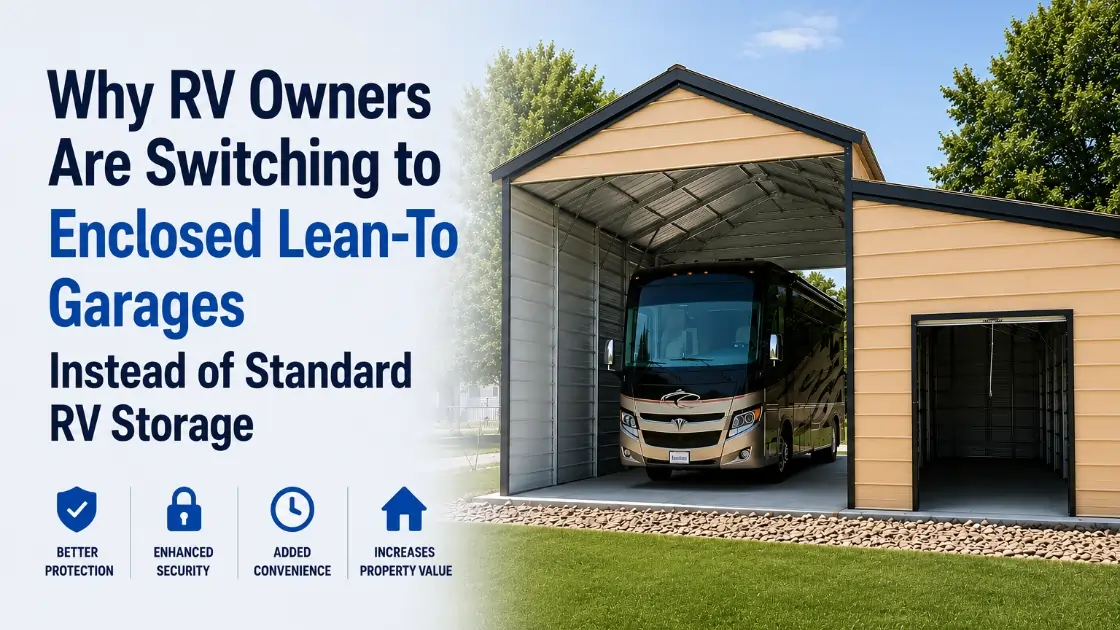
You bought the RV for the freedom. And then you discovered the storage problem.
Every year, from late fall through early spring, your rig sits in a rented lot — or worse, parked in the driveway under a fabric cover — while the sun fades the paint, the seals dry out, the roof bakes, and the monthly bill keeps coming. You’re paying to store something you own, in a space you don’t control, with access that’s inconvenient at best and restricted at worst.
A growing number of RV owners are running the numbers and coming to the same conclusion: a metal RV garage with an enclosed lean-to, built on their own property, costs less over time than what they’re spending on storage rental — and it does a significantly better job of protecting the investment.
This guide breaks down why that switch is happening, what it looks like in real numbers, and what makes the enclosed lean-to design specifically worth the attention it’s getting.
The standard options for RV storage are outdoor exposed lots, covered parking, and indoor facilities. They’re all widely available. They all have real problems.
Outdoor RV storage lots typically cost between $30 and $160 per month, making them the budget choice. But the monthly fee is only part of the cost. Everything that outdoor storage doesn’t protect against — UV radiation, rain, wind-driven debris, hail, freezing temperatures, bird damage — shows up in your maintenance bills.
UV exposure alone does measurable damage to an RV over a single storage season. The roof membrane cracks and becomes less water-tight. Sidewall decals fade. Rubber seals around windows and doors harden and shrink. The result is a more vulnerable vehicle — one that’s more likely to develop a water leak in the spring than the RV that was stored under cover.
A fabric cover helps with UV and light precipitation, but it doesn’t protect against hail (which can shatter exterior lights and dent aluminum sidewalls), doesn’t stop rodents from getting into engine compartments and wall cavities, and can actually trap moisture against the RV surface if it’s not a breathable material. A fabric cover is better than nothing. It’s not a storage solution.
Covered storage typically costs $125–$200 per month — roughly double what outdoor lots charge — and provides a roof and sometimes side walls. This meaningfully reduces UV damage and keeps rain and snow off the roof directly. It’s a better product than outdoor storage.
The catch: you’re still renting. You don’t control when you can access your RV. You work around facility hours, gate access, and occasionally a line of other RV owners trying to get in on a holiday weekend. You pay the rate they set, and that rate goes up.
RV storage costs range from $27/month for basic outdoor parking to $433+ for secure indoor units, with costs varying significantly by region. Urban areas, tourist destinations, and regions with limited storage supply typically charge more — which is precisely where demand for good storage is highest.
Enclosed storage is usually the priciest option — between $50 and $450 a month depending on the RV’s size and location. Private enclosed units — essentially an individual garage-style bay for one RV — push toward the top of that range.
Indoor climate-controlled storage costs more than standard indoor storage but protects against damage from weather extremes. For an owner with a Class A diesel pusher or a high-end fifth wheel worth $100,000–$300,000, paying $300–$450/month for genuine enclosed protection is defensible. But it adds up fast.
At $300/month, you spend $3,600 in the first year. Over five years: $18,000. Over ten years: $36,000. You’ve paid the cost of a second vehicle to store the first one.
Monthly rent is the obvious cost. Here’s what tends to get missed:
Transportation time and fuel. How far is the storage facility from your home? Every pre-trip RV preparation visit, every maintenance check, every “I need to grab something from the rig” requires a round trip. At 15–20 miles each way, two visits per month, that’s 60–80 miles driven and an hour or more of time — every month, every year.
Limited access frustration. Most storage facilities have gate hours — typically 6 a.m. to 10 p.m., sometimes shorter. If you want to prep for an early-morning departure or return late from a trip, you work around their schedule, not yours. Some facilities charge extra for 24-hour access.
Insurance complications. Many insurance providers view off-site storage as a risk factor. Some policies require documentation of storage facility security features. A vehicle stored on your own property under a structure you own is typically simpler to insure and may qualify for lower premiums.
HOA and municipal restrictions. Some HOAs don’t allow RVs on driveways or in yards, requiring them in garages or off-site. Not following HOA rules can cause fines or legal trouble. Many suburban and urban homeowners have no legitimate choice but to rent storage. But for homeowners on rural or semi-rural properties with adequate space, there’s another option entirely.
Damage not covered by storage facility liability. Storage facilities are generally not liable for weather damage, theft from within a locked building, or damage from other vehicles in the facility. Your RV is your problem once it’s on their lot. Any damage that occurs there — from a hailstorm, a roof leak in the facility, or another owner’s RV rolling into yours — is a claim against your own insurance.
The math shift happens at different points for different owners, but the logic is the same: at some storage rental cost and time horizon, owning a metal RV garage on your property costs less than renting.
For a homeowner currently paying $200/month for covered storage:
| Year | Total Rental Cost | Vs. Owned Garage |
| Year 1 | $2,400 | Building investment + $0 rent |
| Year 3 | $7,200 | Same building investment + $0 rent |
| Year 5 | $12,000 | Building fully paid back; $0/month ongoing |
| Year 10 | $24,000 | Still $0/month; building still standing |
| Year 20 | $48,000 | $48,000 spent; nothing owned |
A metal RV garage built on your own property is a one-time investment. Storage rental is a perpetual expense with no equity and no asset at the end. The crossover point — where building ownership becomes cheaper than continued renting — typically lands somewhere between year 3 and year 6 depending on your local storage costs and the building size.
Beyond the cost math, there are three things a rented storage unit will never provide:
Complete access on your schedule. Your RV is 50 feet from your house. You can prep for a trip at 4 a.m. You can charge the batteries on a Tuesday afternoon. You can work on maintenance in the evening without driving anywhere. There’s no gate code, no facility hours, no waiting.
Weather protection you control. The enclosed lean-to RV garage protects against everything simultaneously — UV, rain, hail, wind, snow, pests, and theft. The protection level isn’t determined by the storage facility’s building condition. It’s determined by the engineering and materials of the building you ordered.
Property value. A permitted, permanently installed metal garage adds to your property’s assessed value. Secure storage offers peace of mind and long-term savings — but a rented storage unit contributes nothing to your net worth. A metal building on your property does.
A standard RV garage protects the vehicle. An enclosed lean-to RV garage does that and more — it adds a fully enclosed secondary section that serves as a dedicated workspace, storage zone, or utility room, all under the same roof.
Here’s what that looks like in practice:
The main RV bay provides covered or enclosed protection for the vehicle itself. Depending on the configuration, this can be an open-side carport-style bay (lower cost, still protects from sun and precipitation) or a fully enclosed garage section.
The enclosed lean-to is a separate, fully enclosed section attached to the side of the building. It has its own door — typically a roll-up door or walk-in door — and its own enclosed walls. This becomes whatever you need it to be:
The combination of an RV bay plus an enclosed lean-to on a single footprint is what makes this building type so practical for the way RV owners actually use their rigs. You’re not just storing a vehicle. You’re creating an RV operations center on your own property.
For an owner on the fence about building vs. continuing to rent, it helps to understand what outdoor and minimally covered storage is actually costing in vehicle condition.
UV damage is the most pervasive and underappreciated form of RV deterioration. The sun’s UV radiation breaks down the roof membrane on fiberglass and TPO roofs, causing cracking and micro-fractures that eventually allow water penetration. It fades exterior paint and graphics. It hardens rubber window and door seals, reducing their water-tightness. A single outdoor storage season in a sun-intensive climate (the Southwest, Southeast, or anywhere with regular full-day sun exposure) produces measurable UV degradation.
Hail is the most suddenly expensive weather event for an unprotected RV. A moderately severe hailstorm can produce thousands of dollars in damage — shattered exterior running lights, dented aluminum sidewalls, a compromised roof membrane, broken vent covers. Insurance covers it (minus your deductible), but the claim raises your premium and the repair process puts your RV out of service.
Moisture infiltration is often not discovered until it’s already significant. When seals fail from UV exposure or freeze-thaw cycling, water enters the wall cavities during rain events. Delamination of fiberglass sidewalls, rot in wood framing members, and mold in wall insulation are the common results — and none of them are cheap to remediate.
Rodents are a year-round risk for outdoor and even indoor stored RVs. Mice enter through incredibly small gaps — any opening around a wire penetration, a plumbing pass-through, or a damaged compartment seal. Nesting in the engine bay, chewing wiring, contaminating the interior — a single season of rodent access can produce $2,000–$8,000 in damage that’s rarely covered by standard RV insurance.
Theft and catalytic converter theft are increasingly common in outdoor storage lots. A vehicle that’s stored off-site in a minimally secured facility is a target. An RV garaged on your own property, with a roll-up door and a lock, is significantly harder to access and significantly less appealing to opportunistic thieves.
The 18’×30’×12′ RV Garage with Enclosed Lean-To is one of the most practical entry-level configurations for RV owners who want solid protection and useful secondary storage without overbuilding for their needs.
Here’s what the building includes:
Main RV section:
Enclosed lean-to section:
Total combined footprint: The main bay plus the lean-to creates a comprehensive RV operations space on a tight, efficient footprint that fits most residential and rural properties.
Starting price: $10,195 — which, compared to $200/month in covered storage rental, reaches payback in approximately four years, with zero ongoing monthly cost thereafter.
Customizable: Door placement, colors, insulation, roof style, and lean-to features can all be modified from the standard spec. Call (704)-741-1587 or request a quote to configure the building to your specific RV dimensions and site requirements.
The 18×30 footprint works for a specific range of vehicles. Here’s a quick reference to help you confirm it works for your rig — or identify that you need to go larger:
| RV Class | Typical Width | Typical Length | Min. Garage Width | Min. Garage Length |
| Class B (camper van) | 6.5–7.5 ft | 18–24 ft | 12–14 ft | 24–30 ft |
| Class C (mid-size motorhome) | 7.5–8.5 ft | 25–35 ft | 14–16 ft | 30–40 ft |
| Travel trailer / camper | 7–8.5 ft | 18–35 ft | 14–16 ft | 24–40 ft |
| Class A (full-size coach) | 8–8.5 ft | 35–45 ft | 16–20 ft | 40–50 ft |
| Fifth wheel | 8–8.5 ft | 30–42 ft | 16–18 ft | 36–48 ft |
| Boat on trailer | 7–10 ft | 20–35 ft | 14–16 ft | 26–40 ft |
The 18×30 configuration works well for: Class B motorhomes, smaller Class C motorhomes, travel trailers up to 28 feet, and camper vans — with the enclosed lean-to serving as dedicated gear and equipment storage.
For larger Class C, Class A, or fifth wheel applications, Viking builds custom RV garages in any dimension. Explore the full range of RV garage options or call a building specialist to configure the right size for your specific rig.
The enclosed lean-to section of this building is 12 feet wide and 30 feet long — 360 square feet of fully enclosed, independently accessible storage. That’s a significant amount of space that most RV owners will find uses for faster than they expect.
ATV and golf cart storage: One or two ATVs or a golf cart fit comfortably in the lean-to with room to spare. They’re protected from weather and secured behind a locked roll-up door.
Lawn and garden equipment: Mowers, trimmers, blowers, pressure washers, tillers — all the equipment that currently competes for space in your garage or sits outside under a tarp.
Seasonal storage: Patio furniture, holiday décor, firewood storage, pool equipment, winter sports gear — the lean-to becomes the overflow storage your main garage was never big enough to hold.
RV maintenance and prep station: A fold-down workbench, a 20-amp circuit, and good overhead lighting turn the lean-to into a dedicated RV service space. Oil changes, filter replacements, tire storage, and pre-trip equipment prep all happen here — not in the driveway.
Generator and propane storage: Many RV owners have portable generators and propane equipment that shouldn’t be stored inside a living space. The lean-to, with proper ventilation, is a safer storage location than a garage attached to a home.
Site requirements: The building needs a level, stable surface — compacted gravel or concrete slab. Concrete slab is required for a permitted enclosed structure in most U.S. counties. The site needs to be accessible for a delivery truck and have adequate clearance for the RV to maneuver in and out.
Permits: Most enclosed garages require a building permit. Viking provides engineer-certified structural drawings with most enclosed orders, which satisfies the structural engineering portion of most permit applications. Check your county’s setback requirements before finalizing the building placement.
HOA and deed restrictions: If your property is in an HOA community, confirm approval before ordering. Some communities have restrictions on building height, exterior color, or structure type.
Installation: Most residential-scale buildings in this size range are installed in one to two days by the professional installation crew. The building is delivered and assembled on-site — you don’t manage subcontractors or coordinate multiple trades.
Financing: Viking offers both traditional financing (up to $50,000 in building value, flexible payment terms) and a Rent-to-Own program with no credit check required. Visit our financing page for current options.
Conclusion
Every month you spend paying a storage facility is money that builds no equity, buys no asset, and doesn’t protect your RV nearly as well as a building on your own property. The switch from rented storage to an owned metal garage isn’t just a cost calculation — it’s a convenience calculation, a security calculation, and a long-term protection calculation. On all three, ownership wins.
The 18’×30’×12′ RV Garage with Enclosed Lean-To is a practical entry point for Class B and Class C motorhome owners — solid RV protection, an enclosed lean-to with 360 square feet of independently accessible storage, and a delivered-and-installed price starting at $10,195.
If your RV is larger, or if you want to explore a fully enclosed main bay, custom door height, or other configurations, Viking builds custom metal RV garages in any dimension across all 48 contiguous states.
Call (704)-741-1587 to talk through sizing and site requirements with a building specialist, or request a free custom quote online. Your RV — and your storage budget — will both benefit from the conversation.
Expand each item below to explore a few helpful answers before moving to the next blog post.
An enclosed lean-to RV garage is a steel building that combines a primary bay for RV protection with a separate, fully enclosed secondary section (the lean-to) attached to one side. The lean-to has its own doors and walls and can be used independently for equipment storage, a workspace, or additional vehicle storage. It's a two-in-one structure on a single footprint.
Significantly better in most respects. Outdoor storage offers no protection from UV damage, hail, wind-driven debris, or rodents — all of which cause real, measurable damage to RVs in storage. An enclosed garage eliminates all of these risks and provides 24/7 access on your schedule. The only scenario where outdoor storage wins is cost on day one — but over any time horizon beyond two to three years, building ownership costs less.
The 18'×30'×12' RV Garage with Enclosed Lean-To starts at $10,195, delivered and installed. Larger configurations cost more; the specific price depends on size, roof style, insulation, and your location. Contact Viking for a custom quote based on your RV's dimensions and site requirements.
That's exactly what it's designed for. ATVs, lawn equipment, tools, seasonal items, RV gear and supplies, generators — any combination of these fits in the lean-to's 360 square feet of enclosed, independently accessible space. The roll-up door and walk-in door make access easy for all sizes of equipment.
For an owner currently paying $150–$300/month in storage rental, the payback period on a metal RV garage is typically three to six years. After payback, the ongoing storage cost is $0. The building also adds to your property's assessed value, which is the opposite of rental — which builds no equity whatsoever. For most RV owners with adequate property space, the math strongly favors ownership over continued renting.
Width should exceed your RV's actual width by at least 4–6 feet (2–3 feet on each side) for comfortable door maneuvering. Length should exceed your RV's actual length by at least 4–5 feet. Height (the garage door opening) must clear your RV's total height — including roof-mounted air conditioners and antennas — by at least 18–24 inches. The 18×30 configuration works well for Class B and smaller Class C motorhomes, travel trailers up to 28 feet, and camper vans.
A permitted, permanently installed garage adds to the property's assessed value — unlike rental storage, which contributes nothing. The exact value added depends on your local market and the garage's size, condition, and integration with the property. In most residential markets, a quality steel garage adds meaningful assessed value.
A properly installed galvanized steel garage will realistically last 40–50 years or more with minimal maintenance. The manufacturer's 20-year rust-through warranty on the steel panels reflects the material's longevity. Compare that to the 0 years of asset life you get from 10 years of storage rental payments.
Last Call for Summer Savings! Get Up To 30% Off |View Offer >>
Last Call for Summer Savings! Get Up To 30% Off |View Offer >>
Last Call for Summer Savings! Get Up To 30% Off |View Offer >>
Last Call for Summer Savings! Get Up To 30% Off |View Offer >>
Last Call for Summer Savings! Get Up To 30% Off |View Offer >>
Last Call for Summer Savings! Get Up To 30% Off |View Offer >>
Last Call for Summer Savings! Get Up To 30% Off |View Offer >>
Last Call for Summer Savings! Get Up To 30% Off |View Offer >>
Last Call for Summer Savings! Get Up To 30% Off |View Offer >>
Last Call for Summer Savings! Get Up To 30% Off |View Offer >>
Last Call for Summer Savings! Get Up To 30% Off |View Offer >>
Last Call for Summer Savings! Get Up To 30% Off |View Offer >>
Last Call for Summer Savings! Get Up To 30% Off |View Offer >>
Last Call for Summer Savings! Get Up To 30% Off |View Offer >>