
2 car garage
September 25, 2026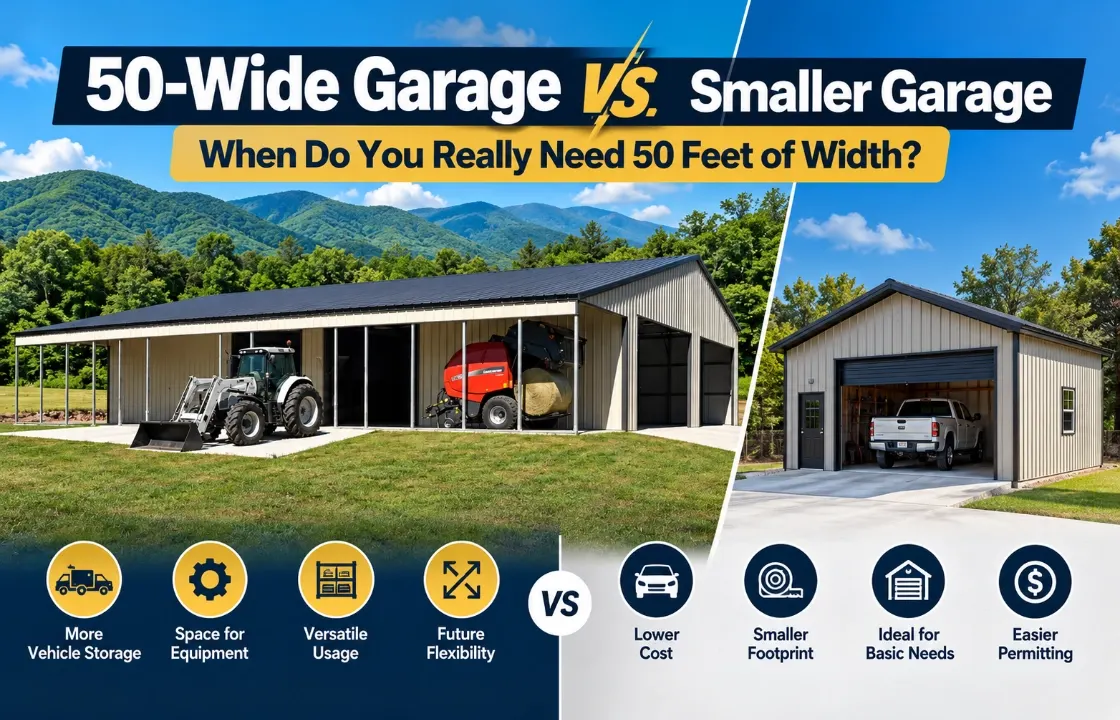
A 50-wide garage is a serious amount of space. Compared with a typical two- or three-car garage, those extra feet can completely change how you use the building. But bigger does not automatically mean better.
The real question is whether you can use 50 feet of width effectively.
If you need space for several vehicles, trucks, trailers, equipment, storage, or a dedicated workshop, a 50-foot-wide garage can give you the flexibility that a smaller structure cannot. On the other hand, if you only need parking for one or two vehicles, choosing a much wider garage may leave you paying for space you rarely use.
So, when does 50 feet of width actually make sense?
A 50-wide garage is 50 feet across from one side to the other. Its total usable floor area depends on its depth.
For example:
| Garage Size | Approx. Floor Area | Potential Use |
| 30×30 | 900 sq. ft. | Multiple vehicles and basic storage |
| 40×30 | 1,200 sq. ft. | Vehicles, storage, and workspace |
| 50×30 | 1,500 sq. ft. | Multiple vehicles, equipment, and workshop |
| 50×40 | 2,000 sq. ft. | Larger vehicle collection and dedicated work areas |
| 50×50 | 2,500 sq. ft. | Extensive vehicle, storage, and workspace needs |
This is why you should not look at width alone. A 50×20 garage has 1,000 square feet, while a 50×40 garage has twice that amount. The 50-foot width becomes particularly useful when you want to create separate areas inside the same building instead of using every square foot simply for parking.
The right garage width depends on how many vehicles you have and what else needs to fit inside.
| Garage Type | General Width Range | Best Suited For |
| 1-car garage | 12–16 ft | One vehicle |
| 2-car garage | 20–24 ft | Two vehicles and basic storage |
| 3-car garage | 30–36 ft | Three vehicles and storage |
| 4-car garage | 40–48 ft | Four vehicles and larger storage needs |
| 5-car garage | 50 ft | Multiple vehicles, equipment, storage, and workspace |
These are general planning ranges rather than fixed rules. Vehicle size, door placement, storage requirements, and the amount of room needed to move around inside can change the ideal dimensions.
For someone with two cars and a few shelves, a 50-foot width may be excessive. For someone storing trucks, trailers, equipment, and several vehicles, those additional feet can be extremely useful.
A 50-wide garage can provide valuable extra space, but it is not necessary for every property or purpose. It makes the most sense when you need room for multiple vehicles, large equipment, storage, or a dedicated workspace.
One of the clearest reasons to consider a 50-wide garage is having several vehicles to store. A 50-foot span gives you more flexibility for arranging cars, trucks, motorcycles, or other vehicles while maintaining space for doors and movement.
If your needs are centered around parking five vehicles, a five car metal garage can be a more logical starting point than trying to squeeze everything into a smaller structure. The key is to think beyond the number of vehicles. Large trucks and other oversized vehicles need more room than compact cars, and you may also want walking space between vehicles.
A garage does not have to be used only for parking. If you work on vehicles, maintain equipment, build projects, or need a dedicated workspace, a wider building allows you to separate parking from working areas.
For example, one portion of the building could hold vehicles while another contains:
This is where a 50×30 garage can become much more useful than a 30×30 garage. The additional width provides 600 more square feet without increasing the building’s depth.
Need parking and workspace together? Design the width around both.
Cars are only one reason people need large garages. Farm and property owners may need indoor space for tractors, lawn equipment, trailers, ATVs, trucks, or other machinery. Commercial users may need room for equipment and inventory as well.
In these situations, a narrow building can make parking and maneuvering difficult even when its total floor area looks sufficient on paper. For larger commercial or industrial applications, industrial metal garages can provide the larger footprint needed for vehicles, equipment, storage, and operational space.
Your garage may start as vehicle storage but become something different later. Perhaps you eventually need a workshop, additional storage, equipment space, or an area for a growing operation. Having extra width can make it easier to change the interior layout without constructing another building.
For example, a 50-wide structure could initially be used primarily for vehicle storage. Later, part of the building could become a workshop while the remaining space continues to house vehicles.
For commercial applications, larger configurations can also support different operational needs. The right size depends on the industry, equipment, inventory, and workflow involved.
Well, a 50-wide garage isn’t necessary for every property or storage need. A smaller garage can be a more practical choice when you only need space for a few vehicles, basic storage, or a compact workspace.
If your primary goal is to keep one or two vehicles protected and you have limited storage needs, a smaller garage is usually more practical.
A typical two-car configuration can provide enough room for vehicles, shelves, tools, and some additional storage without requiring 50 feet of width. There is little benefit in having a large empty area simply because more space was available.
The building is only one part of the planning process. You also need to consider the available building area, driveway access, setbacks, property layout, and how vehicles will enter and leave the garage.
A 50-foot-wide building may fit comfortably on one property but create significant layout challenges on another. Before choosing a larger width, measure the actual site and determine how the building will work with the surrounding space.
If you only need a few shelves, a workbench, and space for household or property-related items, you may not need a 50-foot span.
A 30- or 40-foot-wide building could provide enough room while keeping the overall footprint more manageable. The best garage is not necessarily the biggest one. It is the one that gives every part of the building a useful purpose.
Keeping the depth at 30 feet makes the effect of width easier to understand. A 30×30 garage provides about 900 square feet. Increasing the width to 40 feet gives you 1,200 square feet. Going to 50 feet increases the floor area to 1,500 square feet.
| Building Size | Floor Area | What the Extra Width Can Provide |
| 30×30 | 900 sq. ft. | Vehicle parking and basic storage |
| 40×30 | 1,200 sq. ft. | More parking, storage, and workspace |
| 50×30 | 1,500 sq. ft. | Multiple vehicles, equipment, storage, and dedicated workspace |
The difference between 30 and 50 feet is 20 feet of additional width. That can be enough to change the way the entire building is organized.
A 50 wide garage buildings configuration can therefore make sense when the additional floor area has a specific purpose.
You can also increase depth instead of width, but that changes how vehicles and work areas are arranged. Width is particularly valuable when you want multiple side-by-side parking bays or separate functional zones.
A 50-wide garage can support several different layouts depending on its depth and intended use.
You can create parking areas for several vehicles while reserving wall space for shelves, cabinets, tools, and other equipment.
A larger width can allow vehicles to occupy one section while a workshop occupies another. This can be useful for people who regularly repair or maintain vehicles.
A larger building can make it easier to organize trucks, trailers, machinery, and other equipment rather than leaving them scattered across outdoor areas.
For example, a 50x52x14 side entry commercial garage provides a much larger footprint than a standard residential garage and demonstrates how wider buildings can be designed around commercial vehicle and workspace requirements.
You can also keep part of the building open for future use instead of filling every section immediately. A 50x60x12 metal garage with lean to is another example of how a wide structure can combine a large enclosed area with additional covered space.
Before ordering a 50-wide garage, answer these questions:
If you cannot identify a clear use for the additional width, a smaller garage may be the smarter choice.
For commercial projects, it is also worth considering how the building supports your actual operation rather than simply selecting the largest available footprint. Different industries have different space requirements, which is why understanding the top industries benefit from commercial steel buildings can help when evaluating a larger structure for business use.
You probably need 50 feet of width when the extra space has a defined job.
If you have several vehicles, large trucks, trailers, equipment, a workshop, extensive storage needs, or commercial requirements, the additional width can make the building easier to organize and more useful over time.
But if you only need parking for one or two vehicles with moderate storage, a smaller garage can make more sense. The goal is not to choose the biggest garage you can fit. Choose the width that matches how you will actually use the space.
If the larger footprint fits your property and your budget, you can also explore metal garage financing when planning the project.
Expand each item below to explore a few helpful answers before moving to the next blog post.
Yes, a 50-foot width can provide substantial side-by-side parking space for multiple vehicles. The exact number depends on vehicle sizes, door placement, and the building's depth.
There is no single ideal depth. A 50×30 garage provides 1,500 square feet, while a 50×40 garage provides 2,000 square feet. Choose the depth based on the vehicles, equipment, storage, and workspace you need inside.
A 50×30 building provides about 1,500 square feet, so it can accommodate vehicles and a dedicated workshop area when the interior is planned carefully.
The additional 10 feet of width can provide meaningful extra floor area and make it easier to create separate parking, storage, equipment, or workspace zones. Whether that extra space is useful depends on your actual needs.
Yes. A wide building can be planned around multiple functional zones, such as vehicle parking, storage, equipment, and workshop space. The final layout should be based on how the building will be used and how people and vehicles need to move through it.
Last Call for Summer Savings! Get Up To 30% Off |View Offer >>
Last Call for Summer Savings! Get Up To 30% Off |View Offer >>
Last Call for Summer Savings! Get Up To 30% Off |View Offer >>
Last Call for Summer Savings! Get Up To 30% Off |View Offer >>
Last Call for Summer Savings! Get Up To 30% Off |View Offer >>
Last Call for Summer Savings! Get Up To 30% Off |View Offer >>
Last Call for Summer Savings! Get Up To 30% Off |View Offer >>
Last Call for Summer Savings! Get Up To 30% Off |View Offer >>
Last Call for Summer Savings! Get Up To 30% Off |View Offer >>
Last Call for Summer Savings! Get Up To 30% Off |View Offer >>
Last Call for Summer Savings! Get Up To 30% Off |View Offer >>
Last Call for Summer Savings! Get Up To 30% Off |View Offer >>
Last Call for Summer Savings! Get Up To 30% Off |View Offer >>
Last Call for Summer Savings! Get Up To 30% Off |View Offer >>