
Metal Garages
September 18, 2026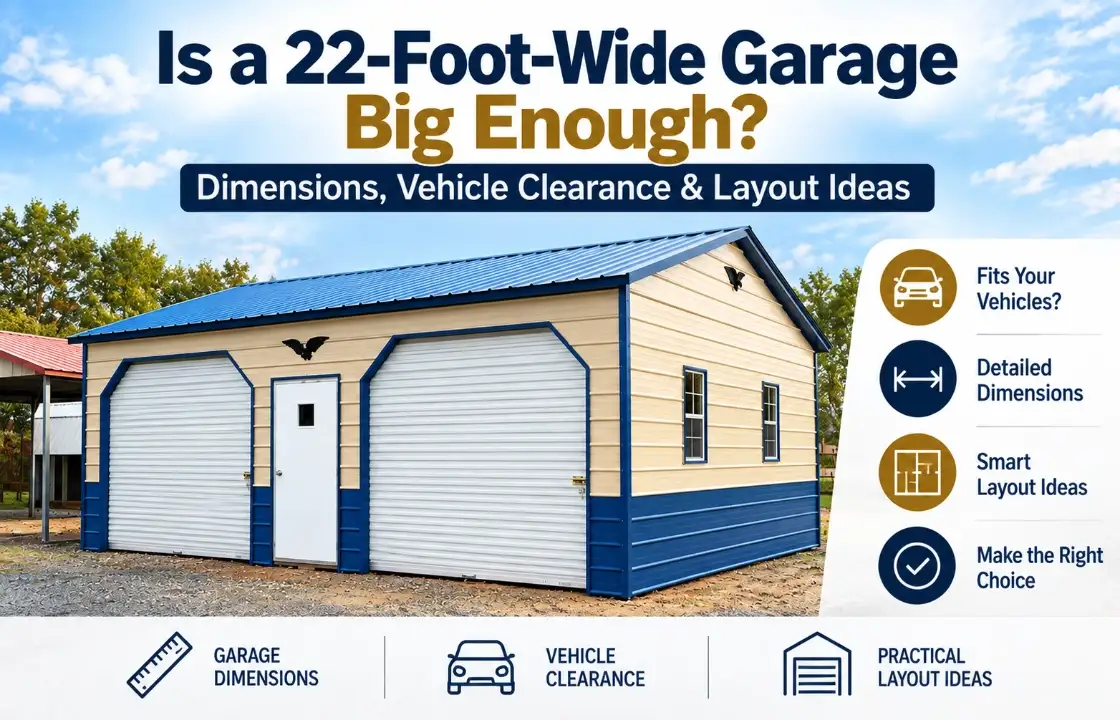
Is a 22-foot-wide garage actually spacious enough for two vehicles, or will it feel cramped once you add storage and walking space? A 22 feet wide garage can offer a useful middle ground, but the right choice depends on your vehicles, desired clearance, and how you plan to use the space. Let’s look at the dimensions and layouts that make the most sense and help you make the right decision.
A 22-foot garage has a total exterior width of 22 feet, or 264 inches. That sounds spacious when viewed as a single number, but the usable interior space will be less after accounting for the building’s framing and walls.
For two vehicles parked side by side, the width needs to accommodate:
For example, two vehicles that are each around 6.5 to 7 feet wide would use approximately 13 to 14 feet of combined vehicle width. That leaves roughly 8 to 9 feet across the overall building for the spaces between and beside the vehicles before accounting for the building’s wall thickness.
That is why a 22-foot garage can work well for two vehicles, but the final experience depends heavily on vehicle size and how you use the remaining space.
If you are comparing different dimensions, read the two-car garage dimensions guide. It provides additional context on how width and length affect two-vehicle layouts.
For many two-car layouts, yes. A 22-foot width provides more usable clearance than a 20-foot-wide garage and can be a practical choice for two average-sized cars.
However, “fits” and “fits comfortably” are two different things.
A compact sedan pair will generally have an easier time in a 22-foot garage than two large pickup trucks. Vehicle mirrors, door swing, body width, and how close you need to park to the walls all affect the usable clearance.
Vehicle clearance is one of the most important things to consider before choosing garage dimensions. The width of your truck, SUV, or car tells you how much physical space the vehicle occupies, but you also need room to move around it.
Viking’s current garage-size information lists typical widths of approximately 5.8 to 6.1 feet for compact cars, 6.0 to 6.2 feet for midsize sedans, 6.6 to 6.9 feet for full-size SUVs, and 6.7 to 7.0 feet for full-size pickup trucks.
For your own garage, measure your actual vehicles rather than relying only on general vehicle categories.
Measure:
This matters particularly with trucks and SUVs. A vehicle may technically fit inside a garage while making everyday use frustrating because there is not enough room to open the doors or walk around it.
Width answers one part of the question. Length determines what you can do with the space behind the vehicles.
A 22×20 garage can work when the main purpose is parking two relatively compact vehicles, and you do not need a large amount of storage.
The 20-foot depth is the part that can become restrictive. A full-size pickup can take up much of that depth once you account for the garage door, front clearance, and walking space.
If parking is your only priority, 22×20 can make sense. If you already know you want shelving, a workbench, lawn equipment, or other storage inside, adding length may be more useful than adding more width.
A 22×22 garage adds 44 square feet compared with a 22×20. Those extra two feet of depth may not sound significant, but they can make it easier to leave space around the vehicles.
It also gives you slightly more flexibility for a storage wall or work area without changing the overall width of the building.
A 22×30 garage is where the extra length becomes much more noticeable. You still have the same 22-foot width for two vehicles, but the additional 10 feet of depth can create a separate storage or workspace zone behind the parking area.
For someone who wants a two-car garage that also stores tools, seasonal equipment, bicycles, lawn equipment, or a workbench, 22×30 can be a more practical layout than simply choosing a 22×20.
The best garage layout depends on what needs to happen inside the building after the vehicles are parked.
This is the simplest arrangement. Park one vehicle on each side and keep the center and side areas as clear as possible. This works well when the garage is primarily for vehicle storage. Use wall-mounted hooks or shallow shelving instead of allowing storage containers to spread across the floor.
If storage is important, dedicate one long wall to shelves, cabinets, tires, tools, or seasonal equipment. The key is to control the depth of the storage. Deep shelving can quickly reduce the usable clearance around the vehicles.
This layout works particularly well in a longer 22×30 garage because the extra depth gives you more options for separating parking from storage.
Place the two vehicles toward the front or center of the building and reserve the rear portion for a workbench.
This arrangement works better when the garage is at least 30 feet long. In a shorter building, the workbench may interfere with vehicle movement or make it difficult to walk behind parked vehicles.
A side-entry design changes the way vehicles approach the garage and can make sense when the property layout allows vehicles to enter from the long side. In side-entry metal garages, door placement can affect driveway access, vehicle movement, and interior layout.
Before selecting this design, check the turning area outside the building as carefully as the interior dimensions.
Garage door placement can make a noticeable difference in how easily you park and move around a 22-foot garage. Two separate doors can give each vehicle its own entry point, while one wider door may provide a simpler approach for larger vehicles. Consider the door width, height, and clearance around the opening when planning your garage layout. Walk-in door placement also matters because it can affect available wall space for storage. For a 22-foot-wide garage, the right door configuration should match your vehicle sizes, driveway access, and everyday use.
This is one of the most important decisions when comparing garage dimensions.
A 22-foot width can be a good compromise when property limitations or setbacks make a 24-foot structure difficult. It also gives you more width than a 20-foot garage without increasing the building footprint as much.
A 24-foot garage becomes more attractive when you regularly park larger trucks or SUVs, need generous door-opening clearance, or want more flexibility for storage along the walls.
Think about the decision this way:
Choose 22 feet when:
Consider 24 feet when:
There is no single “perfect” garage width. The right choice is the smallest footprint that gives you comfortable clearance for the way you actually use the building.
Once you reach 22 feet of width, adding length can sometimes provide more practical value than adding another few feet of width.
For example, suppose two vehicles fit comfortably across the width, but you also need storage. Increasing the building from 22×20 to 22×30 adds 220 square feet of floor area.
That extra space can become a dedicated storage zone without changing the parking width. This is why garage planning should consider both dimensions together rather than searching for a single ideal width.
For a broader comparison of common configurations, you can review this metal garage sizes guide, which breaks down how different widths and lengths can serve different uses.
A 22-foot garage can still work for larger vehicles, but the margin for error becomes smaller. A full-size pickup may be around 18 to 20 feet long and approximately 6.7 to 7 feet wide, according to Viking’s current size guide.
Two such vehicles can therefore occupy a substantial portion of a 22-foot-wide layout.
Before choosing the building, measure:
If you frequently carry passengers, have children entering and exiting the vehicles, or need to load equipment from both sides, additional clearance can make the garage much easier to use.
Storage is often where a garage that seemed spacious becomes crowded. Instead of deciding how much storage you can add after the building is selected, include it in the original layout.
Consider using:
The goal is to keep frequently used items accessible without allowing storage to consume the parking area.
A longer 22-foot garage can be especially useful here because you can create separate zones for vehicles and storage rather than trying to fit everything along the side walls.
For many two-vehicle layouts, 22 feet is a practical garage width that provides more breathing room than a 20-foot structure while taking up less width than a 24-foot garage.
The better question is what you want to fit inside. Two compact or midsize vehicles may work well in a 22×20 or 22×22 garage, while two larger vehicles or a combination of vehicles and storage may benefit from a 22×30 layout.
If you are still comparing sizes, look at the entire footprint rather than width alone. A little additional length can create a dedicated storage or workspace area, while a few additional feet of width can improve vehicle clearance. Feel free to explore the 22-wide garage buildings; you will see many buildings to choose from.
Expand each item below to explore a few helpful answers before moving to the next blog post.
Yes, a 22-foot-wide garage can typically be customized with different lengths, heights, doors, windows, and other features. Your choices should depend on your property, vehicles, and intended use.
Choose a wall height based on your vehicle height, garage door requirements, and whether you plan to store taller equipment. Trucks with roof accessories or future vehicle lifts may require additional height.
Permit requirements vary by city, county, and state. Check with your local building department before construction to confirm zoning, setbacks, permits, and site requirements
The main difference is the length, not the width. A 22x30 garage provides 220 more square feet, giving you greater flexibility for equipment, storage, or other uses.
Yes, a 22-foot garage can include a workshop area if the overall length provides enough room after parking. A longer layout can make it easier to separate the work area from vehicle parking.
Think beyond your current vehicles and consider future storage, equipment, or vehicle changes. Planning these needs early can help you choose the right garage dimensions and avoid running out of usable space later.
Last Call for Summer Savings! Get Up To 30% Off |View Offer >>
Last Call for Summer Savings! Get Up To 30% Off |View Offer >>
Last Call for Summer Savings! Get Up To 30% Off |View Offer >>
Last Call for Summer Savings! Get Up To 30% Off |View Offer >>
Last Call for Summer Savings! Get Up To 30% Off |View Offer >>
Last Call for Summer Savings! Get Up To 30% Off |View Offer >>
Last Call for Summer Savings! Get Up To 30% Off |View Offer >>
Last Call for Summer Savings! Get Up To 30% Off |View Offer >>
Last Call for Summer Savings! Get Up To 30% Off |View Offer >>
Last Call for Summer Savings! Get Up To 30% Off |View Offer >>
Last Call for Summer Savings! Get Up To 30% Off |View Offer >>
Last Call for Summer Savings! Get Up To 30% Off |View Offer >>
Last Call for Summer Savings! Get Up To 30% Off |View Offer >>
Last Call for Summer Savings! Get Up To 30% Off |View Offer >>