2 car garage
September 12, 2026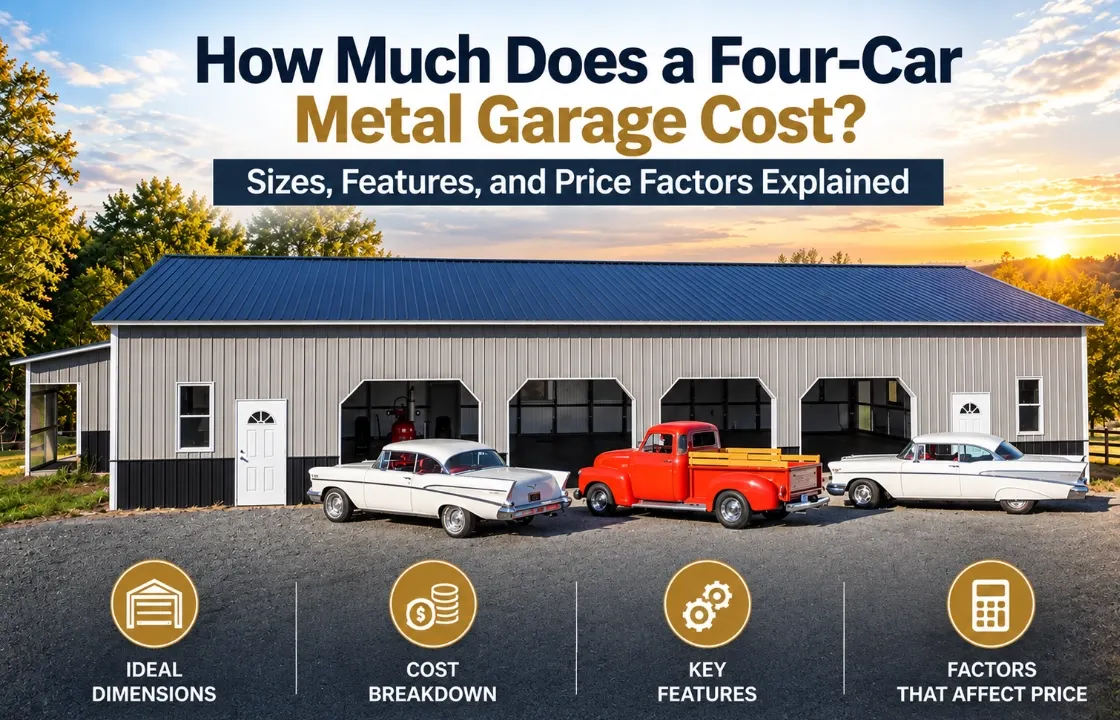
Four vehicles can quickly turn a garage into a tight parking area, especially when you also need space for tools, tires, motorcycles, or a workbench. That is why choosing a four-car metal garage is not only about finding enough room for four vehicles.
The bigger question is how much space you actually need. What will be the four-car metal garage cost? And which features are worth adding. This guide breaks down four-car metal garage prices, dimensions, roof styles, and the factors that can change the final cost.
A four-car metal garage costs several thousand dollars, with the final price increasing for larger sizes, upgraded roofs, additional doors, insulation, and customization.
There is no fixed 4-car metal garage price. A 24 × 30-foot garage offers about 720 square feet, while a 30 × 50-foot building provides 1,500 square feet, so the larger structure will generally cost more.
Remember that advertised prices may not include delivery, installation, anchoring, foundation work, permits, or customization. Always compare the complete project cost before making a decision.
The garage dimensions depend on the vehicles you own and how much additional space you need. It affects the final four-car metal garage cost. Four small cars require less room than four full-size trucks or SUVs. The difference becomes even more noticeable when you want shelving, tools, or a workbench along the walls.
A 24 × 30-foot garage gives you approximately 720 square feet. That can work for straightforward four-vehicle parking, particularly when the vehicles are relatively compact and the building is designed carefully.
However, it can feel crowded if you have large trucks or SUVs.
You also need to think about what happens after the vehicles are parked. Can you open the doors comfortably? Can you walk between vehicles? Can you reach equipment stored along the wall? If the answer is no, the building may technically fit four vehicles but still not be the right choice.
Moving to 24 × 40 gives you 960 square feet, while 30 × 40 provides 1,200 square feet. That additional space can make a noticeable difference. You may have enough room for four vehicles while still maintaining a storage wall, workbench, tool area, or motorcycle parking.
A wider structure can also make vehicle movement more comfortable. For buyers considering 40-wide-garage-buildings, the extra width can be useful when large vehicles or additional storage are part of the plan.
Do not plan the garage by adding the width of four vehicles together. You also need clearance for opening doors, walking between vehicles, accessing storage, and moving around parked vehicles.
Think about how you will use the garage on a normal day. If you have to move one vehicle every time you want to reach another, the layout needs more thought. The same applies to wall storage. Shelving and cabinets take up floor width even though they are not technically part of the parking area.
Two garages with the same dimensions can have different prices because several factors affect the final cost.
Larger or taller garages require more materials and may have different structural requirements, increasing the overall four-car metal garage cost.
Regular, boxed-eave, and vertical roofs have different designs and price points. Your climate, appearance preference, and budget should guide the choice.
The number, size, and placement of garage doors can affect the price. Larger doors are useful for trucks and SUVs, while a walk-in or side entrance can make everyday access easier. Consider the side entry metal garage’s benefits before choosing your layout.
Steel gauge, local wind or snow requirements, and building codes can influence the structural specifications and cost.
The building price may not include installation, anchoring, foundation work, site leveling, delivery, or permits. Always compare complete project costs, not just starting prices.
Roof style affects appearance, drainage, weather performance, and four-car metal garage cost.
| Roof Style | Appearance | General Characteristics | Price Level |
| Regular | Simple, rounded | Straightforward design | Lower |
| Boxed-Eave | Traditional A-frame | More finished appearance | Mid-range |
| Vertical | Clean, vertical panels | Good water and debris movement | Higher |
A regular roof is a straightforward choice for basic vehicle storage. It can work well when your main goal is to keep vehicles protected from sun and precipitation without adding a more complex roof design.
A boxed-eave roof has an A-frame appearance and horizontal roof panels. It offers a more traditional look and can be a good middle-ground option when appearance matters but you do not necessarily need a vertical roof.
A vertical roof has panels running from the ridge toward the edges. This design allows water and debris to move downward along the panel direction, which can be useful in areas with demanding weather.
If you’re comparing the latest 2026 garage roof styles, consider a complete guide and the climate where the building will be installed. The best roof is the one that fits your weather, building, and everyday use.
A four-car garage does not have to be used exclusively for four cars. The extra space can become valuable storage for tools, tires, lawn equipment, motorcycles, ATVs, or other items.
If parking is the priority, a 24 × 30 structure may work for some vehicle combinations. But if you want shelving along the walls, storage cabinets, spare tires, and tools, additional floor space can make the building much easier to use.
A workshop requires more than an empty corner. You need enough room for a workbench, tools, movement around the vehicle, and possibly larger equipment.
This is where a 30 × 40 or larger structure starts becoming more attractive. The extra space gives you the ability to separate parking from working areas rather than trying to squeeze everything between four vehicles.
The moment you add another vehicle, your garage needs change again. A motorcycle may fit beside a car, but an ATV, UTV, trailer, or lawn tractor can consume considerably more space. If you already know that the building will store more than four vehicles, plan for those items before finalizing the dimensions.
A garage designed only for parking can be relatively compact. A four-car garage with a workshop is different. You need enough space to move around vehicles while leaving room for tools and projects.
For example, a 30 × 50 building provides 1,500 square feet. That is considerably more space than a 24 × 30 structure and can allow you to divide the interior into parking, storage, and workspace areas. A detailed 30×50 metal building buyer’s guide can also be useful when comparing how a larger footprint can support several uses.
The key is to decide whether your workshop will be occasional or part of your everyday routine. If you plan to spend several hours each week working inside the garage, extra space can make a significant difference.
Not every customization is equally useful.
If you own trucks or large SUVs, wider and taller doors can make entry much easier. Think about the largest vehicle you expect to store rather than only the vehicles you currently own.
A walk-in door is useful for quick access. You can enter the building without opening a large vehicle door, which can be especially convenient when the garage doubles as a workshop.
Windows can make a large garage feel less enclosed and provide natural daylight during working hours. However, their usefulness depends on how you plan to use the space.
If the garage is only used for parking, insulation may not be a priority. If you plan to use it as a workshop or spend considerable time inside, insulation can become much more valuable for temperature and moisture control.
A workshop usually needs better lighting and electrical access than a simple parking structure. Think about outlets, overhead lighting, workbench locations, and equipment before construction rather than trying to work everything out later. Spend on features that change how you use the garage, not features you will barely notice.
One large building is not always the only option. Some property owners may consider building two separate two-car garages instead.
| One Four-Car Garage | Two Two-Car Garages |
| One large shared space | Separate spaces |
| Easier to create a workshop | Better separation |
| Fewer exterior structures | More flexibility |
| Shared storage | Different uses for each building |
A single four-car garage can be useful when you want one large workspace or shared storage area.
Two smaller buildings may make more sense when you want to separate personal vehicles from equipment or when the property layout makes one large building difficult. The better choice depends on your land, access, budget, and intended use.
Instead of looking at the advertised four-car metal garage cost alone, think of the project as a combination of costs. For example, imagine you start with a basic four-car building.
You then add a vertical roof, larger vehicle doors, insulation, windows, electrical work, and a concrete foundation. The final price can be significantly higher than the original building price.
This does not mean every feature is necessary. It simply shows why two people can request similar-sized garages and receive very different quotes.
When comparing suppliers, ask for the same specifications in every quote. That makes the comparison much more useful.
Expand each item below to explore a few helpful answers before moving to the next blog post.
A four-car garage can start around 720 square feet with a 24 × 30 footprint, but the ideal size depends on vehicle dimensions and whether you need storage or workspace. Larger trucks, SUVs, and workshop areas generally require more space.
There is no universal minimum width because vehicle sizes and local requirements differ. A 24-foot-wide garage can work for some four-vehicle layouts, but additional width can provide more comfortable door clearance, walking space, and storage.
Yes. However, full-size trucks require more width, length, and height than compact cars. If you own multiple trucks, consider both the vehicle dimensions and the space needed to open doors and move around them.
The required height depends on the vehicles and equipment stored inside. Standard cars need less clearance than trucks, RVs, trailers, or vehicles with roof accessories. Measure the tallest vehicle and allow additional clearance above it.
Yes. A larger footprint such as 30 × 40 or 30 × 50 can provide enough space to divide the building into parking, storage, and workshop areas. The exact layout depends on how much workspace and equipment you need.
The appropriate foundation depends on soil conditions, drainage, local building requirements, and the structure being installed. A concrete slab is commonly used for larger garages because it provides a level, durable surface, but the foundation should be planned according to the specific site and building requirements.
Last Call for Summer Savings! Get Up To 30% Off |View Offer >>
Last Call for Summer Savings! Get Up To 30% Off |View Offer >>
Last Call for Summer Savings! Get Up To 30% Off |View Offer >>
Last Call for Summer Savings! Get Up To 30% Off |View Offer >>
Last Call for Summer Savings! Get Up To 30% Off |View Offer >>
Last Call for Summer Savings! Get Up To 30% Off |View Offer >>
Last Call for Summer Savings! Get Up To 30% Off |View Offer >>
Last Call for Summer Savings! Get Up To 30% Off |View Offer >>
Last Call for Summer Savings! Get Up To 30% Off |View Offer >>
Last Call for Summer Savings! Get Up To 30% Off |View Offer >>
Last Call for Summer Savings! Get Up To 30% Off |View Offer >>
Last Call for Summer Savings! Get Up To 30% Off |View Offer >>
Last Call for Summer Savings! Get Up To 30% Off |View Offer >>
Last Call for Summer Savings! Get Up To 30% Off |View Offer >>